 MuQ & MuQ-MuLan





This is the official repository for the paper "MuQ: Self-Supervised Music Representation Learning with Mel Residual Vector Quantization".
In this repo, the following models are released:
- MuQ: A large music foundation model pre-trained via Self-Supervised Learning (SSL), achieving SOTA in various MIR tasks.
- MuQ-MuLan: A music-text joint embedding model trained via contrastive learning, supporting both English and Chinese texts.
Overview
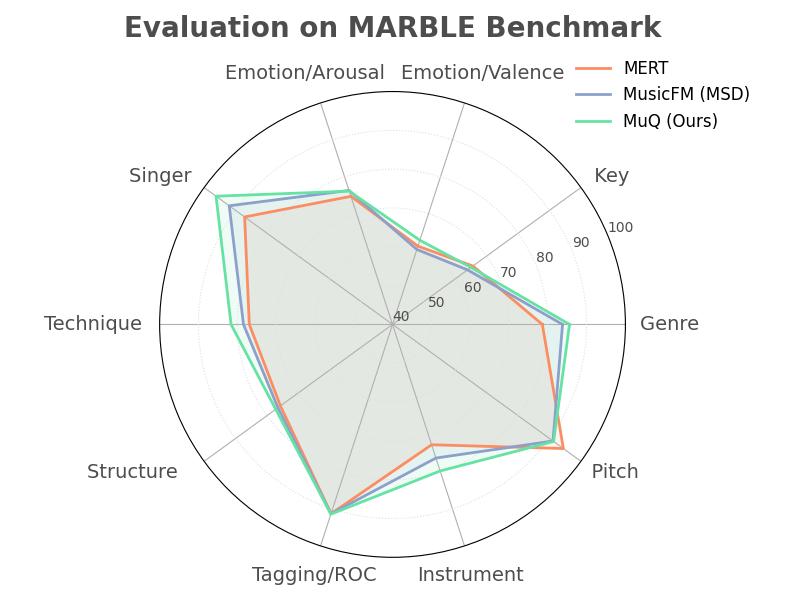
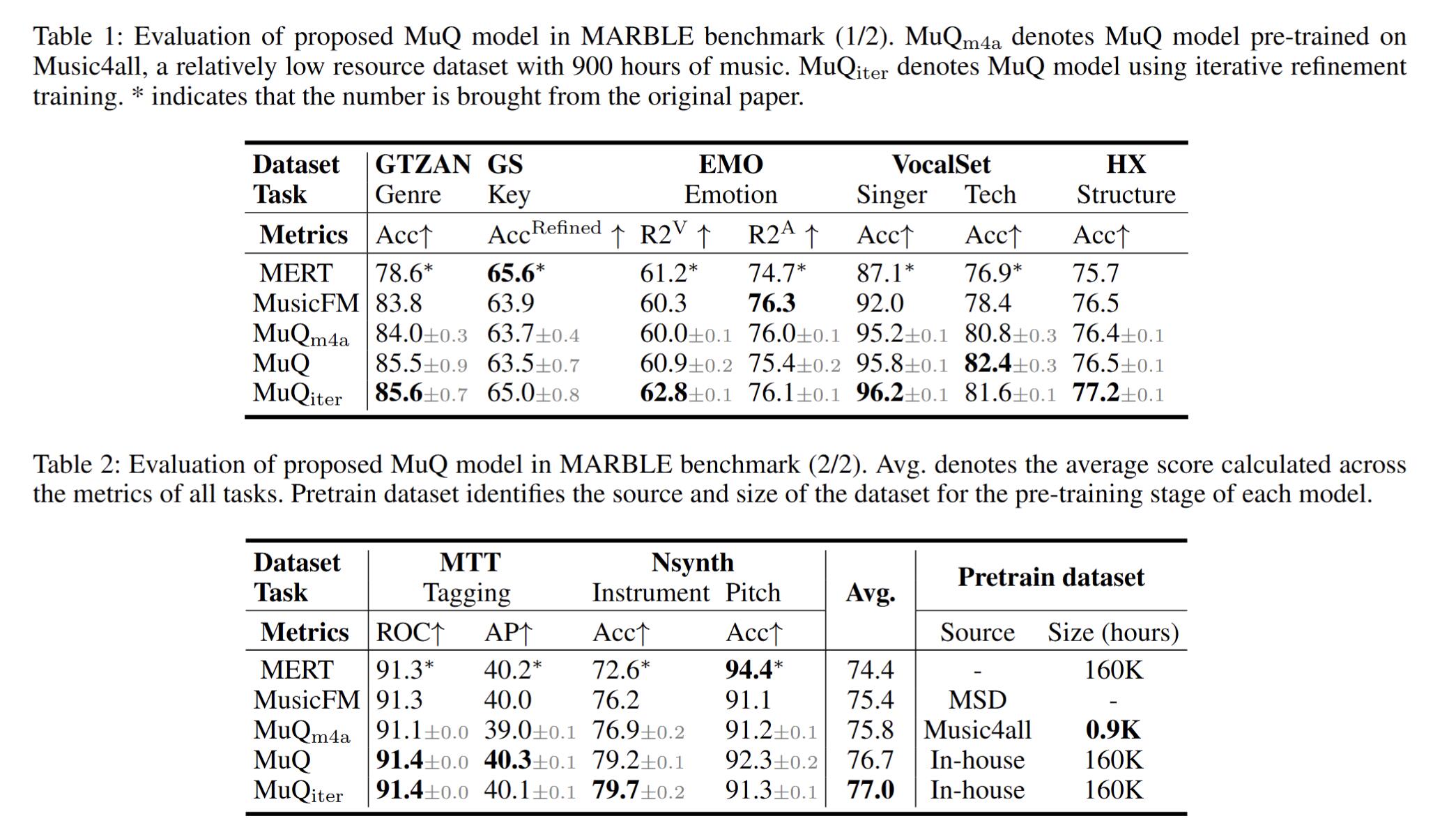
We develop the MuQ for music SSL. MuQ applys our proposed Mel-RVQ as quantitative targets and achieves SOTA performance on many music understanding (or MIR) tasks.
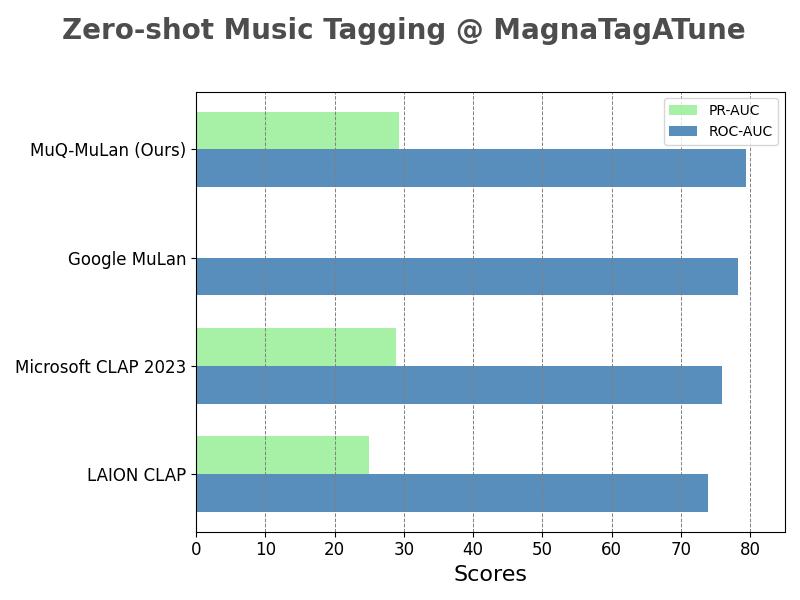
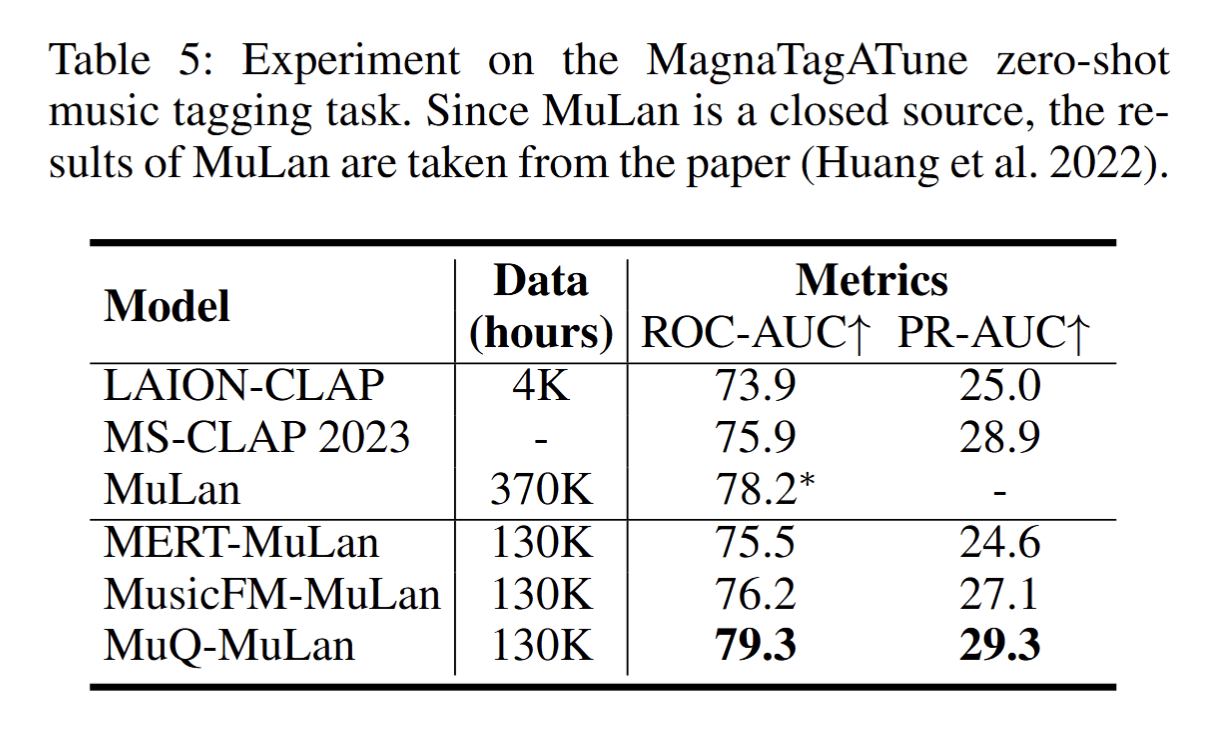
We also construct the MuQ-MuLan, a CLIP-like model trained by contrastive learning, which jointly represents music and text into embeddings.
For more details, please refer to our paper.
Usage
To begin with, please use pip to install the official muq lib, and ensure that your python>=3.8:
pip3 install muq
To extract music audio features using MuQ, you can refer to the following code:
import torch, librosa
from muq import MuQ

device = 'cuda'
wav, sr = librosa.load("path/to/music_audio.wav", sr = 24000)
wavs = torch.tensor(wav).unsqueeze(0).to(device)

# This will automatically fetch the checkpoint from huggingface
muq = MuQ.from_pretrained("OpenMuQ/MuQ-large-msd-iter")
muq = muq.to(device).eval()

with torch.no_grad():
    output = muq(wavs, output_hidden_states=True)

print('Total number of layers: ', len(output.hidden_states))
print('Feature shape: ', output.last_hidden_state.shape)
Using MuQ-MuLan to extract the music and text embeddings and calculate the similarity:
import torch, librosa
from muq import MuQMuLan

# This will automatically fetch checkpoints from huggingface
device = 'cuda'
mulan = MuQMuLan.from_pretrained("OpenMuQ/MuQ-MuLan-large")
mulan = mulan.to(device).eval()

# Extract music embeddings
wav, sr = librosa.load("path/to/music_audio.wav", sr = 24000)
wavs = torch.tensor(wav).unsqueeze(0).to(device)
with torch.no_grad():
    audio_embeds = mulan(wavs = wavs)

# Extract text embeddings (texts can be in English or Chinese)
texts = ["classical genres, hopeful mood, piano.", "一首适合海边风景的小提琴曲,节奏欢快"]
with torch.no_grad():
    text_embeds = mulan(texts = texts)

# Calculate dot product similarity
sim = mulan.calc_similarity(audio_embeds, text_embeds)
print(sim)
Note that both MuQ and MuQ-MuLan strictly require 24 kHz audio as input. We recommend using fp32 during MuQ inference to avoid potential NaN issues.
Performance
Model Checkpoints
| Model Name | Parameters | Data | HuggingFace🤗 |
|---|---|---|---|
| MuQ | ~300M | MSD dataset | OpenMuQ/MuQ-large-msd-iter |
| MuQ-MuLan | ~700M | music-text pairs | OpenMuQ/MuQ-MuLan-large |
Note: Please note that the open-sourced MuQ was trained on the Million Song Dataset. Due to differences in dataset size, the open-sourced model may not achieve the same level of performance as reported in the paper. The training recipes can be found here.
License
The code in this repository is released under the MIT license as found in the LICENSE file.
The model weights (MuQ-large-msd-iter, MuQ-MuLan-large) in this repository are released under the CC-BY-NC 4.0 license, as detailed in the LICENSE_weights file.
Citation
@article{zhu2025muq,
      title={MuQ: Self-Supervised Music Representation Learning with Mel Residual Vector Quantization},
      author={Haina Zhu and Yizhi Zhou and Hangting Chen and Jianwei Yu and Ziyang Ma and Rongzhi Gu and Yi Luo and Wei Tan and Xie Chen},
      journal={arXiv preprint arXiv:2501.01108},
      year={2025}
}
Acknowledgement
We borrow many codes from the following repositories:
Also, we are especially grateful to the awesome MARBLE-Benchmark.