EvalOrigin
A trace-to-evaluation compiler. Feed it the execution traces and incidents your system already produces, and it compiles them into durable evaluation assets: regression cases, weighted rubrics, replay fixtures, and a release gate with an exit code your CI can read. The same inputs always compile to byte-identical output, so a pack is a stable artifact you can commit and diff.
The Python package is the reference compiler. A companion Go module under
compiler/ reimplements the gate at parity, so the verdict can run in a Go
pipeline without a Python runtime.
The pipeline
Every stage is a pure function of its inputs. Identifiers are content-hashed, so re-running on the same traces reproduces the same pack.
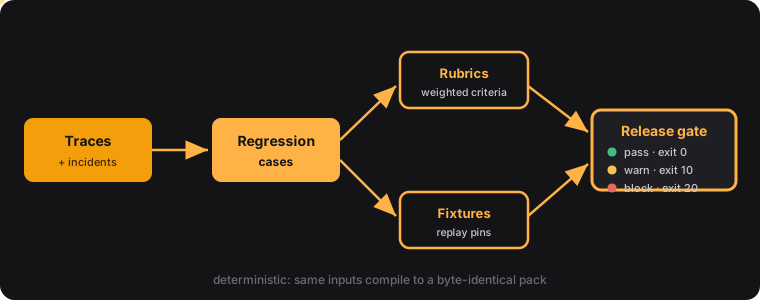
traces + incidents -> regression cases -> rubrics + fixtures -> gate -> pack
A failing trace becomes a regression case. Every incident becomes one too. A
passing trace is pinned only when it carries a golden tag, so healthy paths
enter the pack on purpose rather than by accident. Cases are sorted by severity,
then entrypoint, then id, and de-duplicated by content hash.
What an operator does
- Compile a full pack to JSON:
python -m evalorigin compile <inputs> --name demo -o pack.json - Print the release verdict and let the exit code gate CI:
python -m evalorigin gate <inputs> - Render a Markdown release report:
python -m evalorigin report <inputs> -o report.md - Emit a single artifact type:
cases,rubric(optionally--entrypoint X), orfixtures - Summarize inputs before committing to a compile:
python -m evalorigin inspect <inputs>
Inputs are .json (a single object, an array, or a {"traces": [...], "incidents": [...]} wrapper)
or .jsonl with one record per line. A record is read as an incident when it
carries an incident_id, or a severity paired with a title or trace;
otherwise it is parsed as a bare trace. The bundled fixtures live in
examples/fixtures/ (traces.jsonl, incidents.json) and a full set of
compiled outputs sits in examples/output/.
The gate
The verdict is pass, warn, or block, driven by an explainable score rather
than an opaque heuristic, so the reasons print alongside it. Any case at a
blocking severity forces a block. Otherwise a weighted risk score in [0, 1]
is compared against two thresholds:
| Verdict | Condition | Exit code |
|---|---|---|
pass | score below the warn threshold, no blocking cases | 0 |
warn | score at or above the warn threshold (default 0.35) | 10 |
block | a blocking-severity case, or score at or above the block threshold (default 0.65) | 20 |
Blocking severities and thresholds are configurable:
python -m evalorigin gate examples/fixtures/incidents.json examples/fixtures/traces.jsonl \
  --block-severities critical,high --warn-threshold 0.4 --block-threshold 0.7
Rubrics
Each entrypoint gets a weighted rubric whose criteria adapt to what its cases
actually exercise. An output-equality check and an error-freedom check always
exist. A step-budget check is added when cases record steps, and a severity
guard is added when any case is high or critical. Weights are normalised so
the criteria sum to 1.0.
Run it
Requires Python 3.11 or newer. The package has no dependencies.
python -m evalorigin compile examples/fixtures/incidents.json examples/fixtures/traces.jsonl \
  --name demo -o examples/output/pack.json

python -m evalorigin report examples/fixtures/incidents.json examples/fixtures/traces.jsonl \
  --name demo -o examples/output/report.md
The Makefile wraps the common flows: make compile, make report, make gate,
make cases, make rubric, make fixtures, make inspect, and make demo to
regenerate every artifact under examples/output/. make check compiles the
Python package and builds and vets the Go module.
Go gate at parity
cd compiler
go build ./...
The compiler/ module carries the gate logic and an evalgate command that
mirrors the Python verdict, so the release decision can run inside a Go build.
Layout
evalorigin/
├─ evalorigin/            Python package (stdlib only)
│  ├─ model.py            dataclasses with deterministic to_dict
│  ├─ loader.py           JSON / JSONL loaders, canonical serialization
│  ├─ compiler.py         cases -> rubrics + fixtures -> gate -> pack
│  ├─ gate.py             risk score and pass / warn / block verdict
│  ├─ report.py           deterministic Markdown rendering
│  └─ cli.py              argparse CLI and gate exit codes
├─ compiler/              Go module: gate at parity + evalgate command
├─ examples/              fixtures/ inputs and output/ compiled artifacts
├─ docs/assets/           logo.svg and pipeline.svg
└─ pyproject.toml  Makefile  ROADMAP.md  CHANGELOG.md  LICENSE
Determinism
Serialized output is byte-stable across runs and machines. Collections are pre-sorted, keys are emitted in a fixed order, and no timestamps or random ids leak into a pack unless the input supplies them. That is what makes a pack safe to commit and diff: a changed pack means the traces changed, not the compiler.
License
Apache-2.0. See LICENSE. Milestones that are done live in ROADMAP.md; the change history is in CHANGELOG.md.