DeepDiagram AI: Agentic AI Visualization Platform
DeepDiagram AI is an open-source, intelligent visualization platform that leverages Agentic AI and multi-agent orchestration to transform natural language and multimodal inputs into professional diagrams. Unlike traditional tools, DeepDiagram employs a LangGraph-powered architecture where specialized agents handle different visualization domains—from interactive mind maps to complex infographics.
Demo: http://deepd.cturing.cn/


🚀 Core Features
🧠 Mind Map Agent
- Powered by:
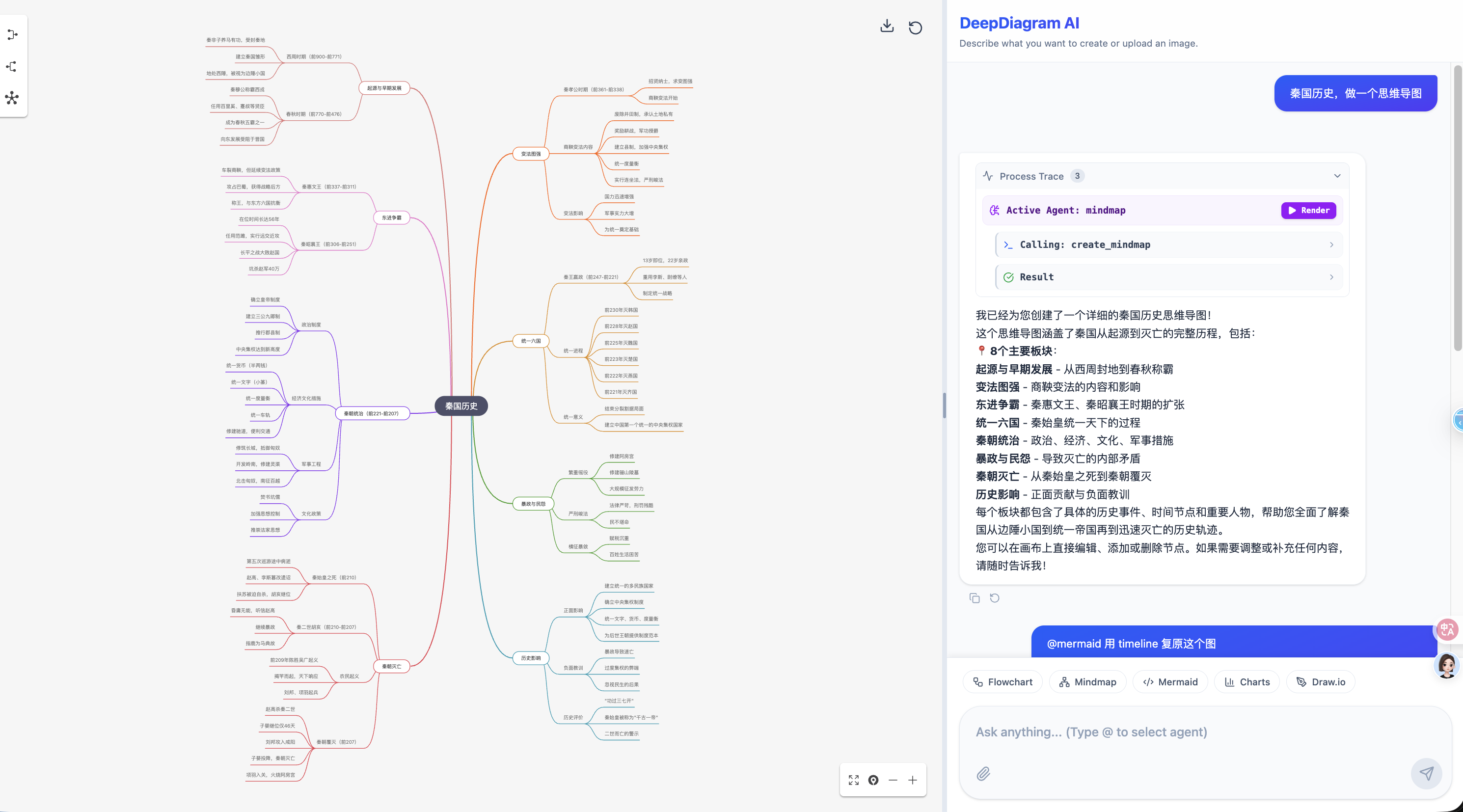
mind-elixir - Capabilities: Generates 4-5 level deep, structured, interactive mind maps in Markdown format
- Use Cases: Knowledge mapping, brainstorming, concept organization
- Workflow: Supports real-time preview, editing, and export to PNG
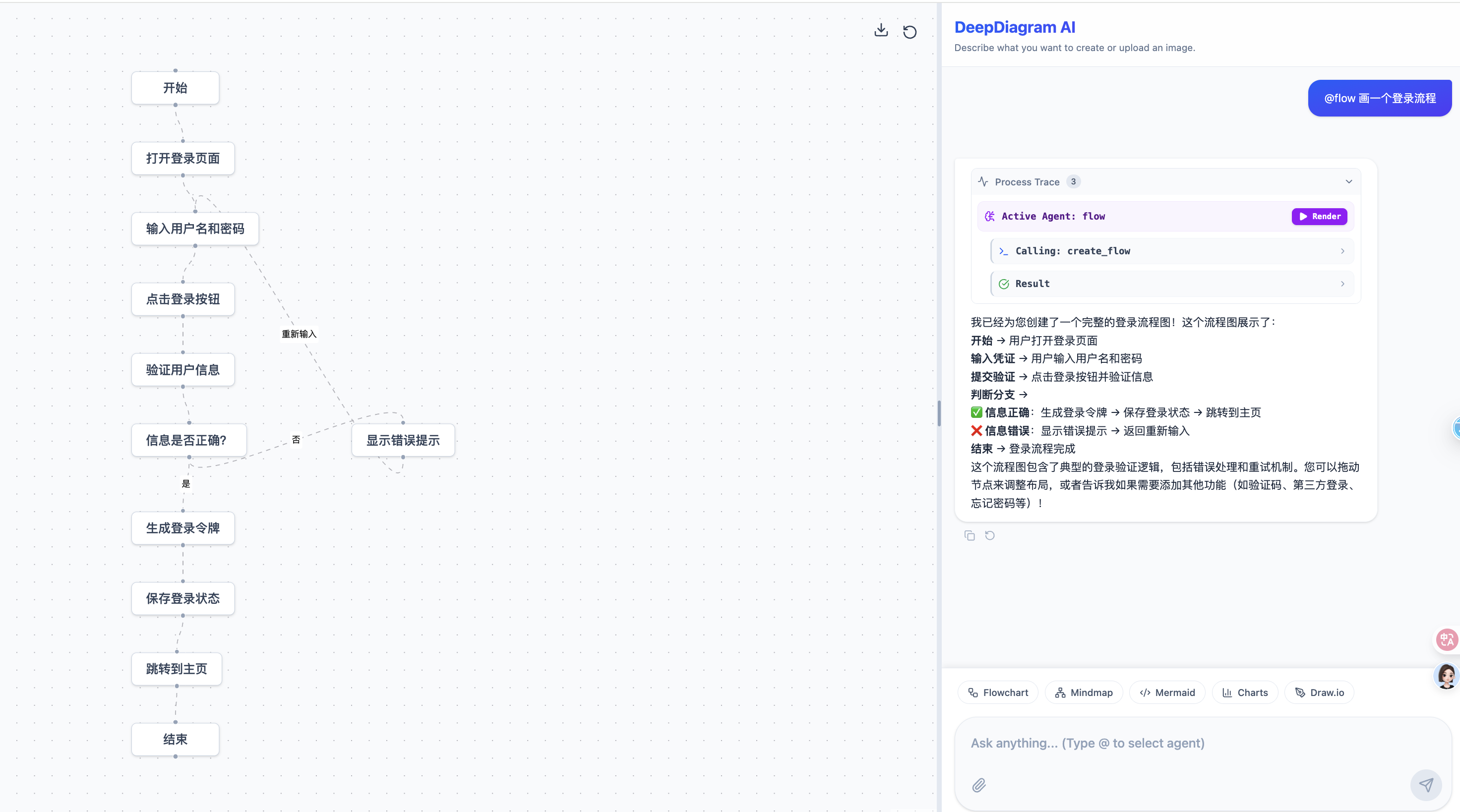
🔀 Flowchart Agent
- Powered by:
React Flow - Capabilities: Creates business process flows with intelligent auto-layout and custom node styling
- Use Cases: Business processes, logic flows, step-by-step procedures
- Workflow: Interactive canvas with drag-and-drop editing and high-quality image export
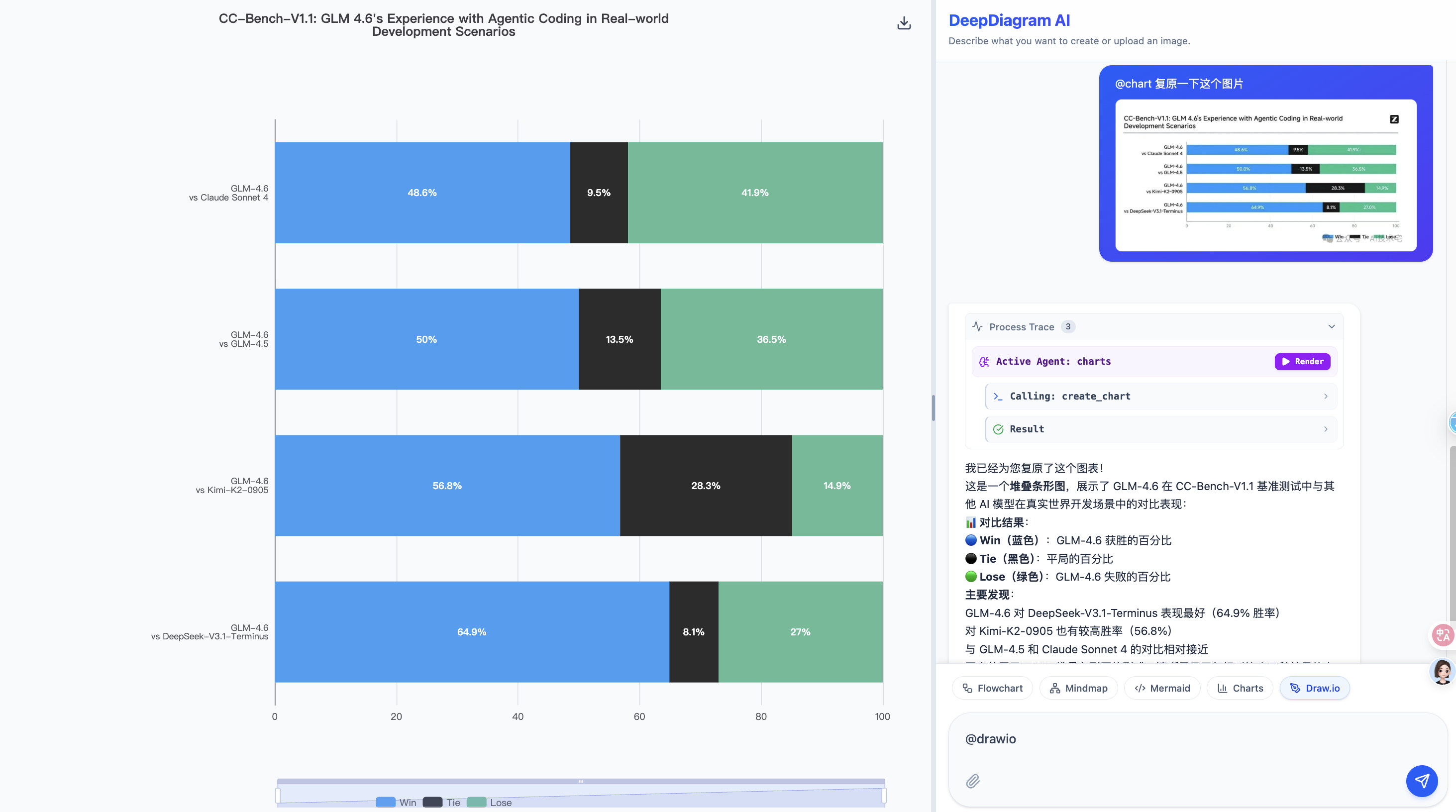
📊 Data Chart Agent
- Powered by:
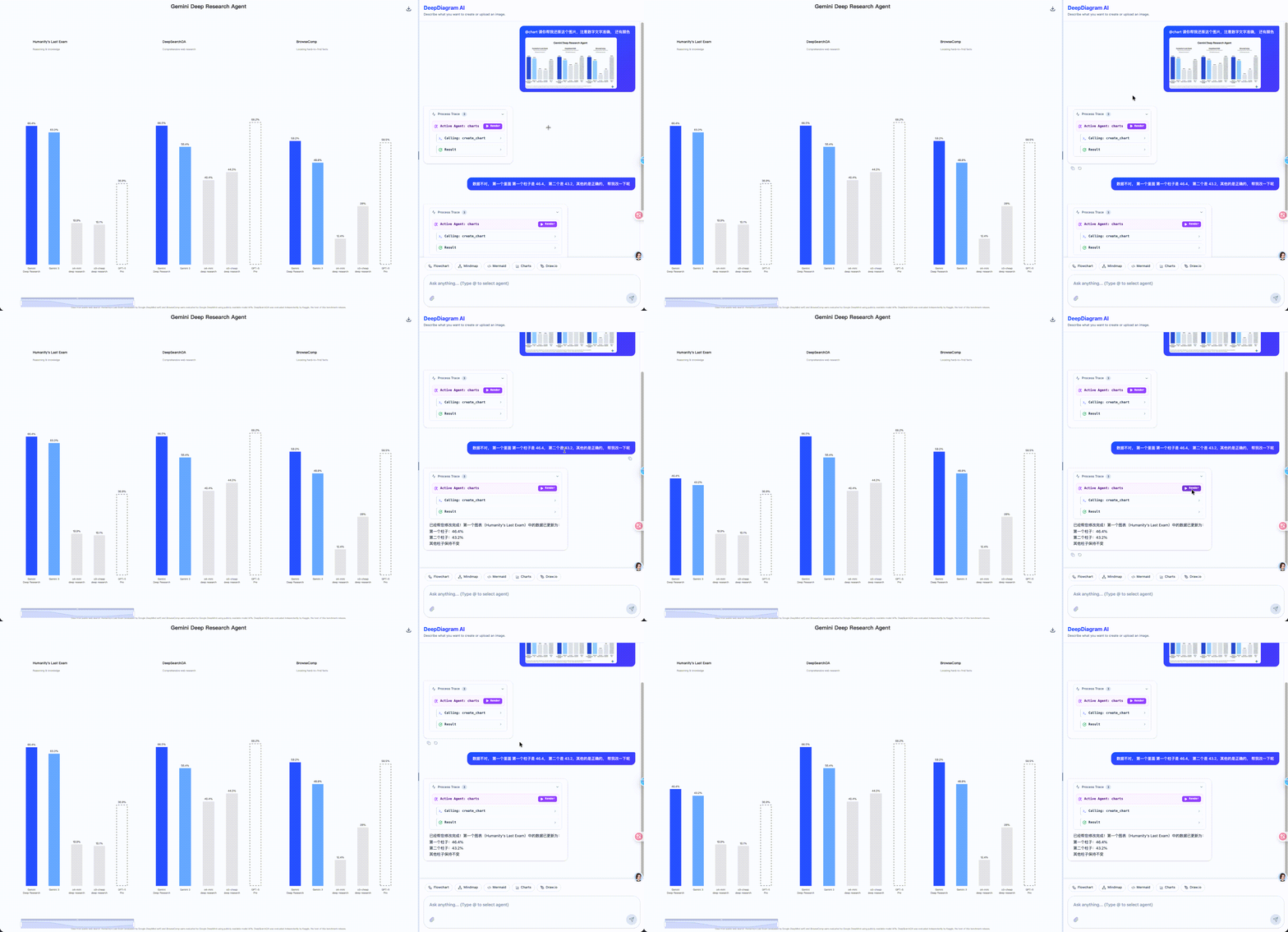
Apache ECharts 6.0 - Capabilities: Visualizes data using bar charts, line graphs, pie charts, gauges, and more with modern animations
- Use Cases: Data visualization, dashboards, trend analysis
- Workflow: Analyzes data or descriptions to generate rich, interactive ECharts configurations
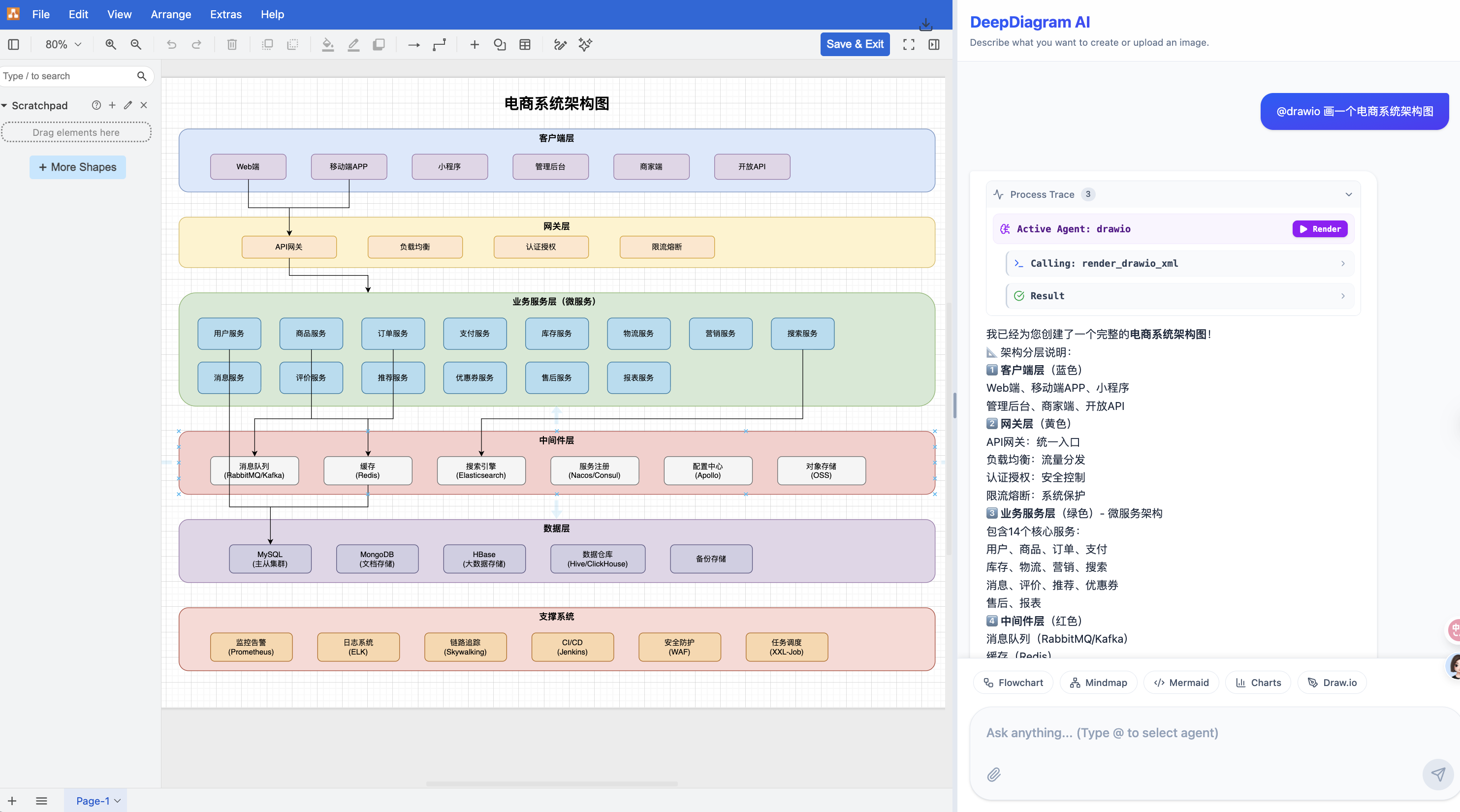
✏️ Draw.io Agent
- Powered by:
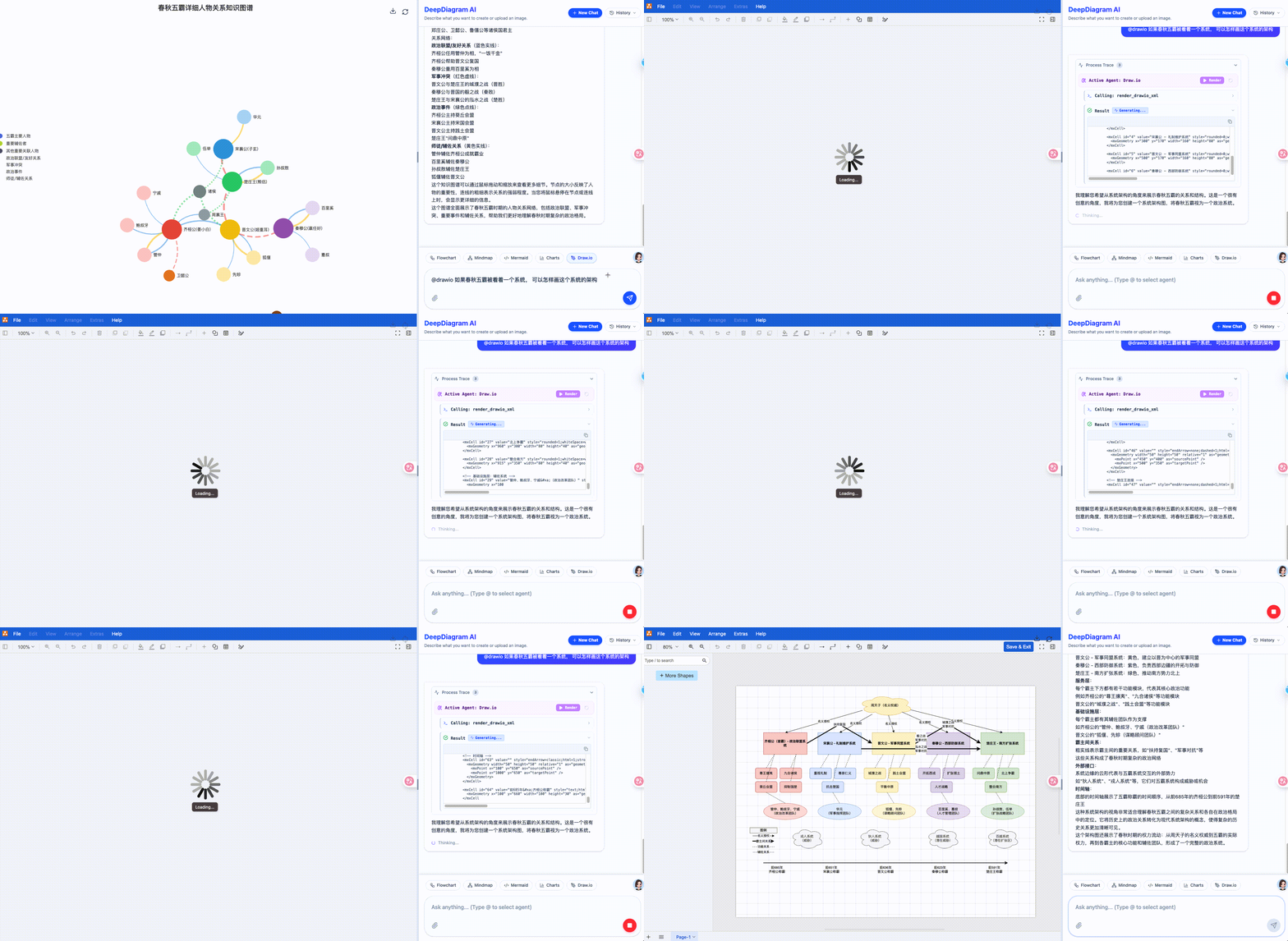
Draw.io(Atlas Theme) - Capabilities: Produces professional-grade cloud architecture and network topology diagrams
- Use Cases: Cloud infrastructure, system architecture, technical blueprints
- Workflow: Advanced canvas with auto-centering and sidebar concealment for a focused drawing experience
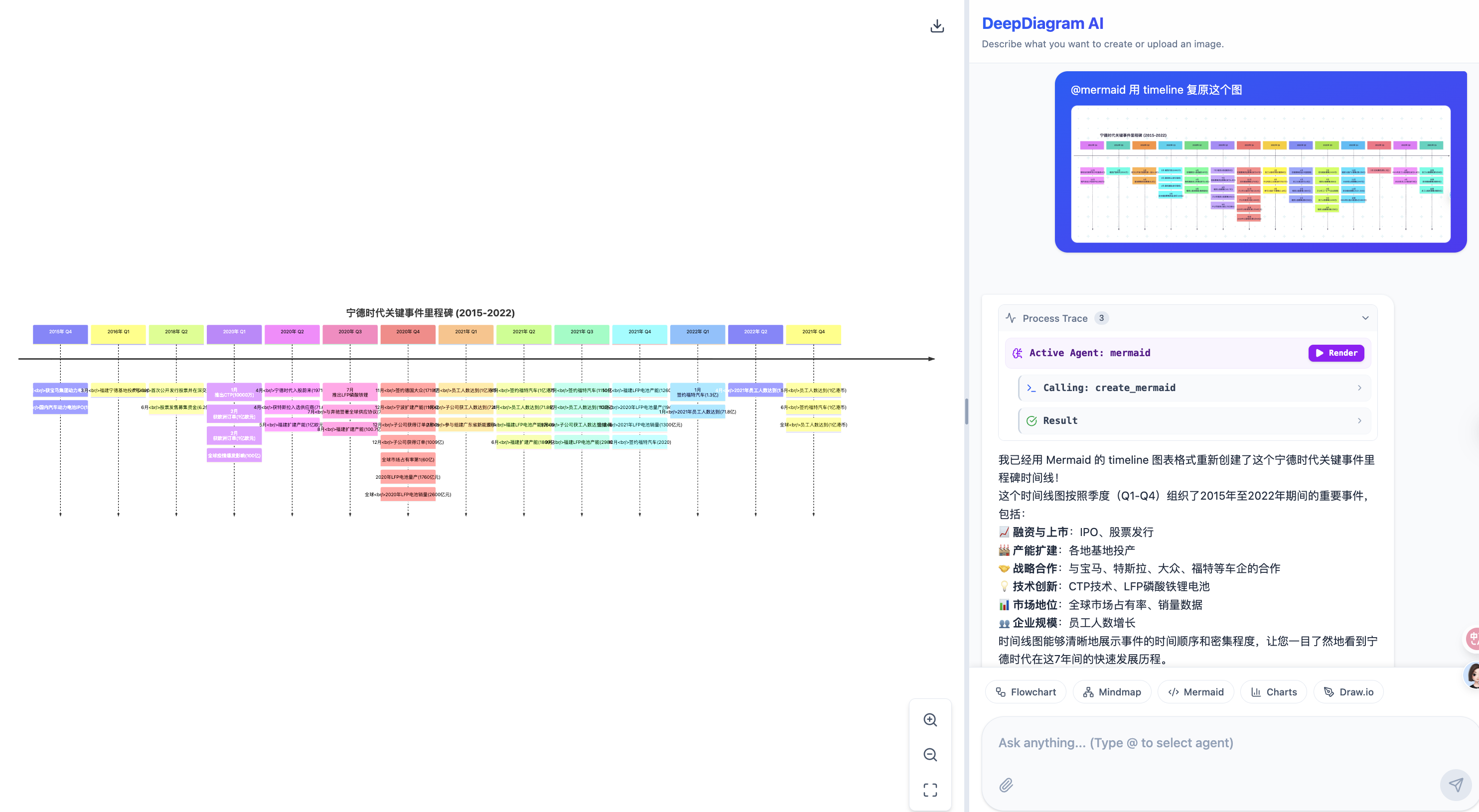
🧜 Mermaid Agent
- Powered by:
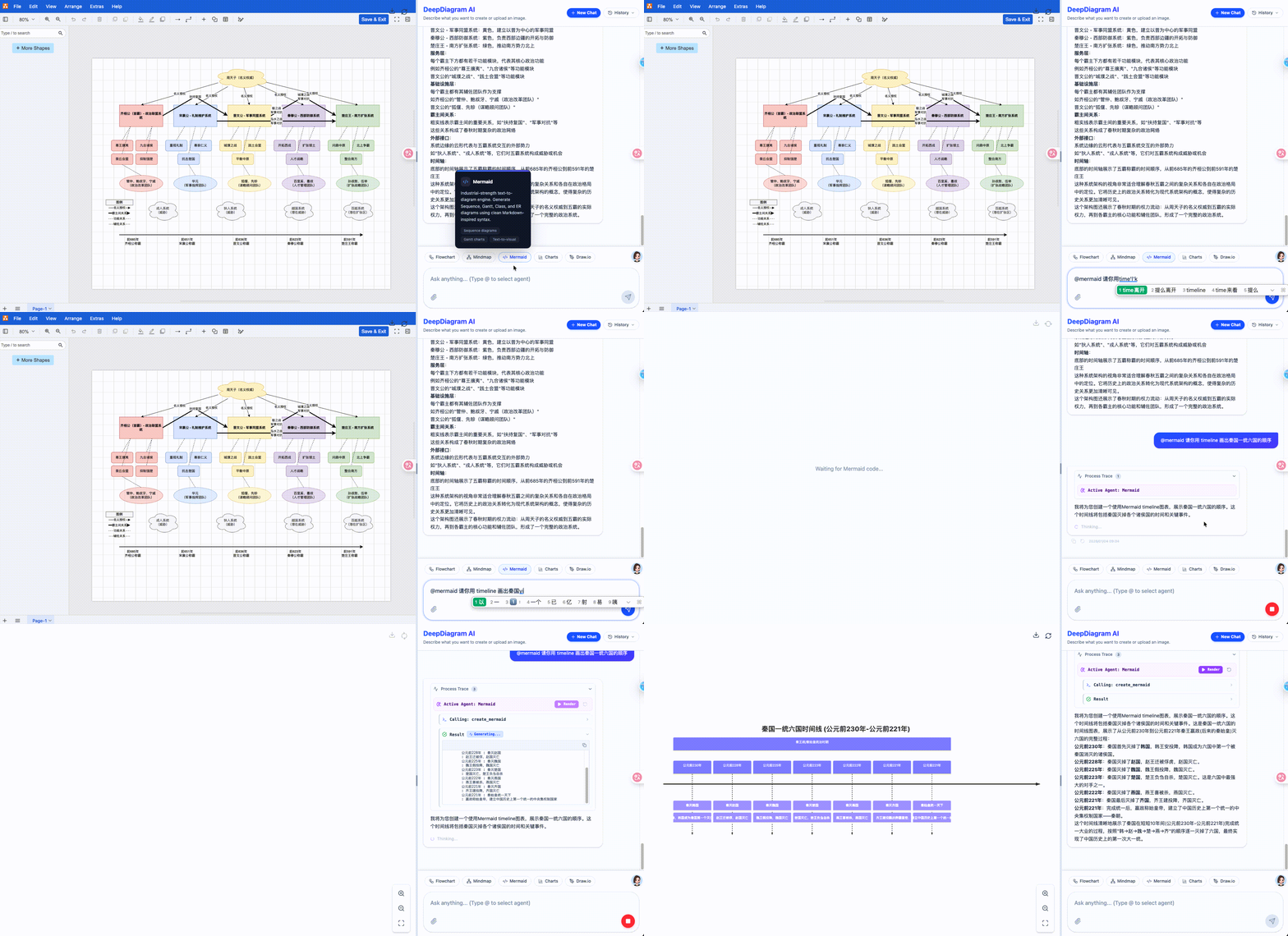
Mermaid.js 11.12+react-zoom-pan-pinch - Capabilities: Generates text-driven diagrams including Sequence, Gantt, Timeline, State, Class, and ER diagrams
- Use Cases: Technical documentation, software design, project planning
- Workflow: Native interactive canvas with adaptive scaling, zoom/pan controls, and high-resolution SVG/PNG export
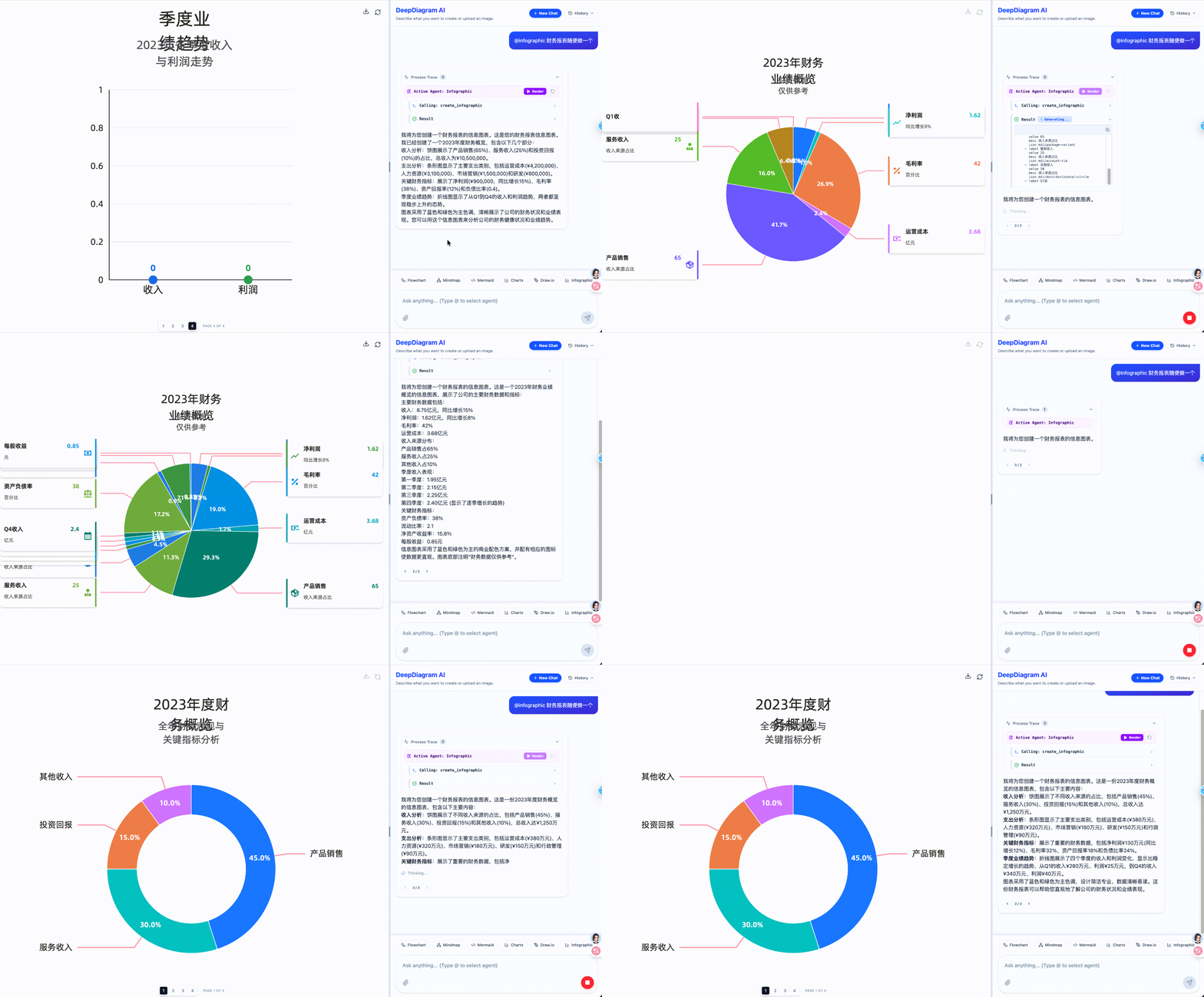
🎨 Infographic Agent
- Powered by:
AntV Infographic - Capabilities: Creates professional digital infographics, data posters, and visual summaries using declarative DSL
- Use Cases: Data storytelling, visual summaries, creative presentations
- Workflow: Two-phase intelligent pipeline:
- Template Selection: LLM analyzes user intent and selects optimal template from 50+ options (chart, compare, hierarchy, list, relation, sequence)
- Code Generation: Template-specific prompts with syntax rules generate precise DSL code
✨ Advanced Features
🤖 Intelligent Router & XML Tag Output
- Context-Aware Routing: Automatically routes requests to the optimal agent based on:
- Explicit mentions (e.g.,
@mindmap,@flow,@charts) - LLM intent recognition with full agent capability descriptions
- Conversation context (prefers last active agent for continuity)
- Explicit mentions (e.g.,
- XML Tag Output: Each agent outputs
<design_concept>...</design_concept><code>...</code>directly without tool calls, enabling cleaner parsing and multi-line content support - Multimodal Support: Upload whiteboards, sketches, or technical diagrams for digitization
💡 Design Concept Streaming
- AI Reasoning Visibility: See the AI's design thinking and architectural decisions in real-time
- Collapsible Panel: Yellow-themed card auto-expands during streaming, collapses when complete
- Markdown Rendering: Design concepts support rich formatting with headers, lists, and emphasis
📜 Persistent History & Message Branching
- Session Management: Maintain multiple chat sessions with automatic state restoration (including diagrams and process traces)
- Message Branching: Retry assistant responses to explore different visualization paths; navigate between versions via built-in pagination
- Version Control: Git-like branching system with
turn_indexandparent_idtracking - Robust Storage: PostgreSQL-backed persistence ensures reliability for complex technical traces and multimodal content
📄 Intelligent Document Analysis
- Deep Content Understanding: Automatically parses uploaded documents (PDF, DOCX, XLSX, PPTX, TXT, MD) with:
- Concurrent chunking for large files
- LLM extraction of temporal data, key entities, and relationships
- Structured information retrieval
- Persistent Memory: Analysis results are database-persisted, allowing AI to retain context across sessions
- Time-Aware: All agents are aware of the current date/time for accurate timeline generation and scheduling
🎯 Real-Time Streaming & Process Trace
- Dual-Stream SSE: Design concept and code stream independently for optimal UX
- Execution Trace Visualization:
- Agent selection tracking
- Design concept with AI reasoning
- Streaming code generation with syntax highlighting
- Contextual "Render" and "Retry" actions
- Error Handling: Clear visual feedback for rendering failures with instant retry capability
🎨 Modern UI/UX Enhancements
- Resizable Layout: Flexibly adjust canvas and chat panel widths using a draggable separator
- Responsive Design: All tables and components adapt to container size without layout breaks
- Visual Loading States: Clear feedback during history loading, document parsing, and content generation
- Accessibility: Keyboard shortcuts, hover tooltips, and status indicators
🏗 System Architecture
DeepDiagram AI uses a React 19 + FastAPI architecture, orchestrated by LangGraph. Each specialized agent directly outputs structured content with XML-style <design_concept> and <code> tags, streamed to the frontend via SSE (Server-Sent Events) for real-time preview.
graph TD Input[User Request: Text/Images/Documents] --> Router[Intelligent Router] Router -- Intent Classification --> Graph[LangGraph Orchestrator] subgraph Agents [Specialized Agents - XML Tag Output] AgentMM[MindMap Agent<br/>Markdown/Markmap] AgentFlow[Flowchart Agent<br/>React Flow JSON] AgentChart[Data Chart Agent<br/>ECharts Config] AgentDraw[Draw.io Agent<br/>mxGraph XML] AgentMermaid[Mermaid Agent<br/>Mermaid Syntax] AgentInfo[Infographic Agent<br/>AntV DSL] AgentGeneral[General Agent<br/>Plain Text] end Graph -->|Route by Intent| Agents subgraph Output [Streaming XML Tag Output] Agents -->|LLM Generation| Tags["<design_concept>...</design_concept><br/><code>...</code>"] Tags -->|Parse & Stream| Parser[StreamingTagParser] end Parser -->|design_concept events| DC[Design Concept Stream] Parser -->|code events| Code[Code Stream] DC -->|SSE| Frontend[React 19 Frontend] Code -->|SSE| Frontend Frontend -->|Real-time Render| Canvas[Interactive Canvas] Frontend -->|Process Trace| Trace[Execution Trace UI] style Input fill:#f9f,stroke:#333 style Router fill:#bbf,stroke:#333 style Tags fill:#bfb,stroke:#333 style Canvas fill:#fdf,stroke:#333 style DC fill:#ffc,stroke:#333
Architecture Highlights
- No Tool Calls: Agents directly output XML tags
<design_concept>...</design_concept><code>...</code>without intermediate tool invocations - Streaming Tag Parser: Real-time parsing of XML-style tags with state machine for robust multi-line content handling
- Dual-Stream Output:
design_concept(AI reasoning) andcode(diagram content) stream independently - Design Concept UI: Yellow collapsible panel shows AI's design thinking before rendering
Key Components
Backend (Python)
dispatcher.py: Intent-based routing with explicit@agenttags and LLM fallbackgraph.py: LangGraph state machine with Router → Agent → END flowroutes.py: SSE endpoint withStreamingTagParserfor real-time XML tag parsingfile_service.py: Concurrent document parsing and LLM extractionchat.py: Session and message CRUD with branching support- SQLModel ORM with async PostgreSQL driver
Frontend (React)
ChatPanel.tsx: Message history, SSE handling, execution trace renderingCanvasPanel.tsx: Dynamic agent component loading and renderingExecutionTrace.tsx: Visual process trace withDesignConceptItemcomponentchatStore.ts: Zustand state management for messages, sessions, and versions- Agent-specific renderers:
MindmapAgent,FlowAgent,MermaidAgent, etc.
🛠 Tech Stack
Frontend
- Framework: React 19 (concurrent rendering), Vite, TypeScript
- Styling: TailwindCSS 4.1.17
- State Management: Zustand 5.0.9
- Visualization:
- React Flow 11.11.4 (flowcharts)
- Mind-elixir 5.3.8 (mind maps)
- Mermaid 11.12.2 (technical diagrams)
- ECharts 6.0.0 (data charts)
- AntV Infographic 0.2.6 (infographics)
- UI Components: Lucide React (icons), react-resizable-panels, react-zoom-pan-pinch
- Markdown: React Markdown + remark-gfm
Backend
- Framework: Python 3.13, FastAPI (async), Uvicorn (ASGI)
- AI Orchestration: LangGraph 1.0.4, LangChain 1.1.3, langchain-openai
- Database: PostgreSQL 16, SQLModel 0.0.27 (ORM), asyncpg (driver)
- Document Processing: PyMuPDF 1.25.3 (PDF), python-docx, python-pptx, pandas + openpyxl
- Package Manager: uv (ultra-fast Python package manager)
DevOps
- Containerization: Docker, Docker Compose (multi-container orchestration)
- Web Server: Nginx (reverse proxy, static file serving)
- CI/CD: GitHub Actions (automated Docker image builds)
🏁 Getting Started
Prerequisites
- Python: 3.10+ (3.13 recommended)
- Node.js: v20+
- Docker & Docker Compose: Recommended for production
- API Keys: OpenAI-compatible API (OpenAI, DeepSeek, or custom providers)
Option 1: Development Setup
1. Backend Setup
cd backend
uv sync                # Install dependencies via uv
bash start_backend.sh  # Runs DB migrations + starts FastAPI server
Backend runs on http://localhost:8000
2. Frontend Setup
cd frontend
npm install
npm run dev
Frontend runs on http://localhost:5173
Option 2: Docker Deployment (Recommended)
1. Configuration
Create a .env file in the project root:
# LLM Configuration
OPENAI_API_KEY=sk-your-openai-key
OPENAI_BASE_URL=https://api.openai.com/v1
MODEL_ID=claude-sonnet-3.7

# Alternative: DeepSeek
DEEPSEEK_API_KEY=sk-your-deepseek-key
DEEPSEEK_BASE_URL=https://api.deepseek.com

# Database (auto-configured in Docker Compose)
DATABASE_URL=postgresql+asyncpg://postgres:postgres@db:5432/deepdiagram

# Optional: Thinking verbosity (concise/normal/verbose)
THINKING_VERBOSITY=normal
2. Launch
docker-compose up -d
Services:
- Frontend: http://localhost (Nginx on port 80)
- Backend API: http://localhost/api (proxied by Nginx)
- Database: PostgreSQL on port 5432 (internal)
3. Verify Deployment
docker-compose ps               # Check running services
docker-compose logs -f backend  # View backend logs
Option 3: Custom LLM Provider
DeepDiagram supports any OpenAI-compatible API endpoint. Configure via .env:
OPENAI_BASE_URL=https://your-custom-endpoint.com/v1
OPENAI_API_KEY=your-api-key
MODEL_ID=your-model-name
Or configure interactively in the UI:
- Click the Settings icon in the top-right corner
- Add a new model configuration with Name, Base URL, Model ID, and API Key
- Select your custom model from the dropdown
📖 Usage Guide
Basic Workflow
- Natural Language Input: Type requests like "Create a mind map for AI history" or "@flow design a user authentication process"
- Multimodal Upload: Attach images (whiteboards, sketches) or documents (PDF, DOCX) for context
- Interactive Canvas: Resize panels, zoom/pan diagrams, edit content
- Export: Download diagrams as PNG or SVG via the canvas toolbar
- Refine: Ask AI to modify results (e.g., "Add a timeline branch for Industry 4.0")
Advanced Features
- Retry with Branching: Click the retry icon to generate alternative versions
- Version Navigation: Use left/right arrows to switch between message versions
- Session Management: Create new chats or load previous sessions from the History dropdown
- Process Trace: Expand "Process Trace" to view agent selection and tool call details
🗺 Roadmap
- MVP with 6 Core Agents (MindMap, Flow, Charts, Draw.io, Mermaid, Infographic)
- LangGraph-based Agent Orchestration
- Intelligent Router with Context-Awareness
- Resizable Dashboard Layout
- Persistent Session & Chat History
- Message Branching & Versioning
- Multimodal Document Analysis (PDF, DOCX, XLSX, PPTX)
- SSE Real-Time Streaming
- Execution Trace Visualization
- UI/UX Polishing (Responsive Tables, Loading States)
- XML Tag Output (No Tool Calls)
- Design Concept Streaming with AI Reasoning Visibility
- Collaborative Editing (Real-time Sync via WebSockets)
- Custom Agent Plugin System
- Advanced Export Options (PowerPoint, Word)
🤝 Contributing
Contributions are welcome! Please follow these guidelines:
- Fork the repository
- Create a feature branch (
git checkout -b feature/amazing-feature) - Commit your changes (
git commit -m 'Add amazing feature') - Push to the branch (
git push origin feature/amazing-feature) - Open a Pull Request
Development Tips
- Use
uvfor Python dependency management (faster than pip) - Follow the existing code style (Black for Python, Prettier for TypeScript)
- Add tests for new features
- Update documentation as needed
⭐ Star History
📄 License
This project is licensed under the GNU Affero General Public License v3.0 (AGPL-3.0). See the LICENSE file for details.
Key points:
- ✅ Free to use, modify, and distribute
- ✅ Must disclose source code for derivative works
- ✅ Must use the same AGPL-3.0 license for derivatives
- ⚠️ Network use counts as distribution (must share source)
📞 Support & Community
- Issues: GitHub Issues
- Discussions: GitHub Discussions
- Demo: http://deepd.cturing.cn/
Made with ❤️ by the DeepDiagram Team