
xollvm
🛡️ Annotation-driven LLVM 22 & 23 obfuscator · new pass manager · zero LLVM source edits






📖 Read the full documentation → xollvm.github.io
🚀 Getting Started · 🧩 Passes · ⚙️ Virtualization · 🧠 Development · ✅ Testing
Docs source lives in docs/ and is published to the site via MkDocs.
An annotation-driven LLVM obfuscation framework for the new pass manager (NPM).
Configuration comes from source-level annotations (llvm.global.annotations) and is resolved
once per module into a cached, deterministic configuration map.
xollvm plugs into stock LLVM with no LLVM source edits — it is compiled in as an LLVM
static extension (LLVM_EXTERNAL_PROJECTS), so the same code ships three ways:
- a clang/opt toolchain with the obfuscator built in (Linux and Windows),
- a loadable pass plugin
Obfuscator.sofor-fpass-plugin(Linux/macOS).
Disclaimer / Legal: Intended for legitimate software-protection use cases (IP protection, anti-tamper research, academic evaluation, CTFs with permission). Do not use it for malware, unauthorized access, or to violate laws / terms of service. You are responsible for compliance with all applicable laws.
[!IMPORTANT] Obfuscation is not a security boundary. Treat it as one layer in a broader defensive strategy (hardening, anti-tamper, secure update, key management, …).
What you get
- Module entry pass:
-passes=obfuscation— module-only work (fmerge,strenc) then an ordered per-function pipeline. - Annotation-driven config with canonical pass IDs + aliases.
- Deterministic seeding (module → function → pass) with an optional seed manifest.
- Safety rails: instruction/block/loop-depth gating + IR-growth budgeting.
- Diagnostics:
-passes=obf-dump-config,-passes=obf-metrics. - Reports: JSON obfuscation map + per-pass CFG snapshots; HTML viewer (Python).
- Runtime test suite (Python) under
utils/.
Passes (high level)
Function pipeline (order enforced by the driver via topological sort):
| Pass | ID | Category | Description |
|---|---|---|---|
| Constant encryption | constenc | Expression | Encrypts scalar int/FP constant operands into runtime-opaque materializations. |
| Mixed Boolean/Arithmetic | mba | Expression | Rewrites integer expressions as MBA equivalents. |
| Instruction substitution | substitution | Expression | Replaces instructions with equivalent idioms. |
| Virtual call | vcall | Call hardening | Virtualises direct calls via synthetic vtables. |
| Basic block split | split | CFG | Splits basic blocks to increase graph complexity. |
| Semantic diffusion | sdiff | Expression / CFG | Volatile-slot masking that resists local simplification. |
| Bogus control flow | bcf | CFG | Adds opaque predicates and fake edges. |
| CFG flattening | flattening | CFG | Replaces structured control flow with a dispatcher. |
| Anti-optimization shield | shield | Post-hardening | Volatile barriers and opaque identities. |
| Anti-decompiler | adec | Post-hardening | Indirectbr trampolines, asm junk, pointer aliasing. |
| Code virtualisation | vm | Virtualisation | Compiles the function body into a private bytecode stream. |
Module-only:
| Pass | ID | Description |
|---|---|---|
| Function merging | fmerge | Collapses annotated functions sharing a group= label into one selector-dispatched super-function; runs first, so the merged bodies feed the function pipeline. |
| String encryption | strenc | Encrypts string literals; enabled when any annotated function includes strenc(...). |
[!NOTE]
vmconflicts withflattening(both restructure the CFG). Use one or the other per function.
[!NOTE]
fmergeis opt-in per function and runs before everything else — the resulting super-functions are then obfuscated by the function pipeline. See FMERGE.md.
How it works
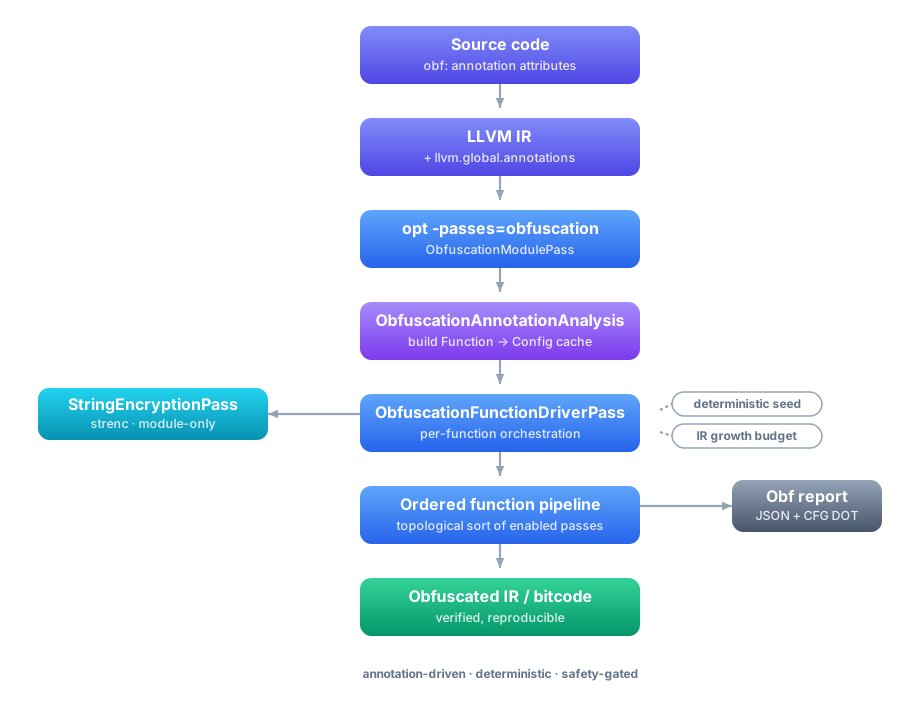
Annotations drive everything. A module analysis parses llvm.global.annotations once into a
cached Function → Config map; the module entry pass then runs module-only fmerge and strenc
and a deterministic, budget-gated per-function pipeline.
Quick start
Option 1 — Download a prebuilt release
Grab from Releases:
| File | What | OS |
|---|---|---|
xollvm-linux-Release.tar.zst | clang/opt with the obfuscator built in | Linux x86_64 |
xollvm-windows-Release.7z | clang/opt with the obfuscator built in | Windows x64 |
Obfuscator-linux-x64.so | loadable -fpass-plugin | Linux x86_64 |
Backends included: X86;AArch64;ARM;RISCV.
Option 2 — Build the toolchain from stock LLVM (static extension)
No fork, no patch — point LLVM's build at this repo. xollvm builds against both
LLVM 22 and LLVM 23 (release/22.x or release/23.x) from the same sources — the
version is detected at compile time, no flags to flip:
git clone --depth 1 --branch release/22.x https://github.com/llvm/llvm-project  # or release/23.x
git clone https://github.com/und3ath/xollvm

cmake -S llvm-project/llvm -B build -G Ninja \
  -DCMAKE_BUILD_TYPE=Release \
  -DLLVM_ENABLE_PROJECTS="llvm;clang" \
  -DLLVM_ENABLE_RTTI=ON -DLLVM_ENABLE_EH=ON \
  -DLLVM_TARGETS_TO_BUILD="X86;AArch64;ARM;RISCV" \
  -DLLVM_EXTERNAL_PROJECTS=Obfuscator \
  -DLLVM_EXTERNAL_OBFUSCATOR_SOURCE_DIR="$PWD/xollvm" \
  -DLLVM_OBFUSCATOR_LINK_INTO_TOOLS=ON

cmake --build build --target install
[!NOTE] Under
LINK_INTO_TOOLSthe AES stub is compiled by an externalclang(the in-tree clang can't be used — it would form a build cycle). Make sure aclangis onPATH.
Option 3 — Build the loadable plugin (.so)
# needs an installed LLVM 22 or 23 (e.g. apt llvm-22-dev / llvm-23-dev)
cmake -S xollvm -B build -G Ninja -DLLVM_DIR=/usr/lib/llvm-22/lib/cmake/llvm  # or .../llvm-23/...
ninja -C build Obfuscator          # -> build/Obfuscator.so
Annotate functions
// Light: expression-level only
__attribute__((annotate("obf: mba(prob=70,maxDepth=3), substitution(loop=2)")))
int light(int x) { return x * 3 + 7; }

// Heavy: structural + post-hardening
__attribute__((annotate("obf: mba(prob=70), bcf(prob=30), flattening(minBlocks=3), shield, adec")))
int heavy(int x, int y) { return x ^ y; }

// Maximum: VM virtualisation (replaces the entire function body)
__attribute__((annotate("obf: vm(hardened=1,useAES=1,regEncrypt=1)")))
int secret(int key, int data) { return key ^ (data + 0xDEAD); }

// Function merging: fold same-group functions into one super-function
__attribute__((annotate("obf: fmerge(group=core,thunk=1,launder=1)")))
int parse_hdr(const char *p, int n) { /* ... */ return n; }
__attribute__((annotate("obf: fmerge(group=core,thunk=1,launder=1)")))
long crc_step(long acc, int b)      { /* ... */ return acc; }
C++: [[clang::annotate("obf: mba(prob=60), bcf(prob=25)")]]. See obf_annotations.h for the full cheat-sheet.
Run it
Prebuilt / static-extension toolchain (obfuscator is built in):
clang -S -emit-llvm -O0 test.c -o test.ll
opt   -passes=obfuscation test.ll -S -o test.obf.ll -obf-seed=1 -obf-deterministic
clang test.obf.ll -O2 -o test.obf
Loadable plugin (.so):
opt -load-pass-plugin=./Obfuscator-linux-x64.so -passes=obfuscation test.ll -S -o test.obf.ll
# or with clang: clang -fpass-plugin=./Obfuscator-linux-x64.so ...
Diagnostics: -passes=obf-dump-config (resolved config), -passes=obf-metrics (JSONL).
Reproducibility
Seeds cascade base → module → function → pass:
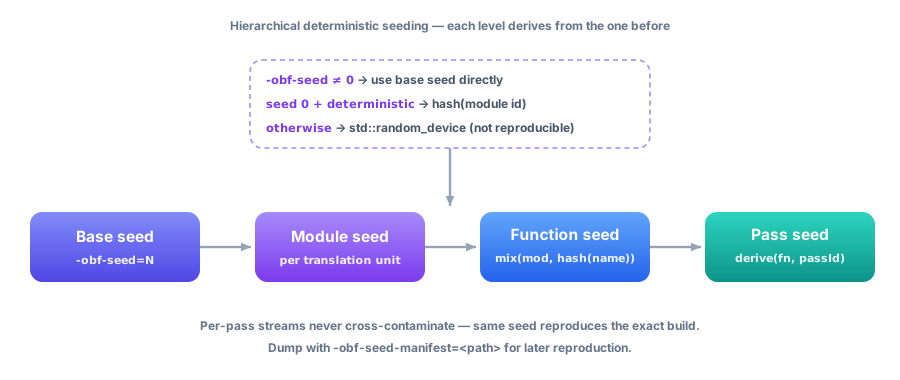
-obf-seed=<N>pins the base seed.-obf-deterministicderives the module seed from a stable hash of the module id (when seed is 0).-obf-seed-manifest=seeds.jsondumps the full manifest.
Documentation
| Document | Purpose |
|---|---|
| BUILD.md | Full compilation guide — static-extension toolchain (Linux/Windows), .so plugin, prerequisites, troubleshooting. |
| USER.md | Annotation grammar, pass reference, global options, reports, troubleshooting. |
| DEV.md | Architecture: registration, annotation cache, pipeline ordering, reporting, adding passes. |
| VM.md | Code-virtualisation reference — ISA, bytecode format, hardening layers. |
| FMERGE.md | Function-merging reference — grouping, memory ABI, dispatch (switch/indirectbr), thunks, selector laundering. |
| TESTS.md | Runtime test harness, categories, debug workflows. |
License
Apache-2.0 WITH LLVM-exception (same as LLVM). See LICENSE.