ComfyUI-MiniMax-H3-LongMedia
Production-oriented ComfyUI nodes for MiniMax H3 long-form video/audio generation, native reference editing, MultiClip planning, camera direction, fixed segmentation, lip-sync/redubbing, latent hi-res refinement, and adaptive low-VRAM execution.
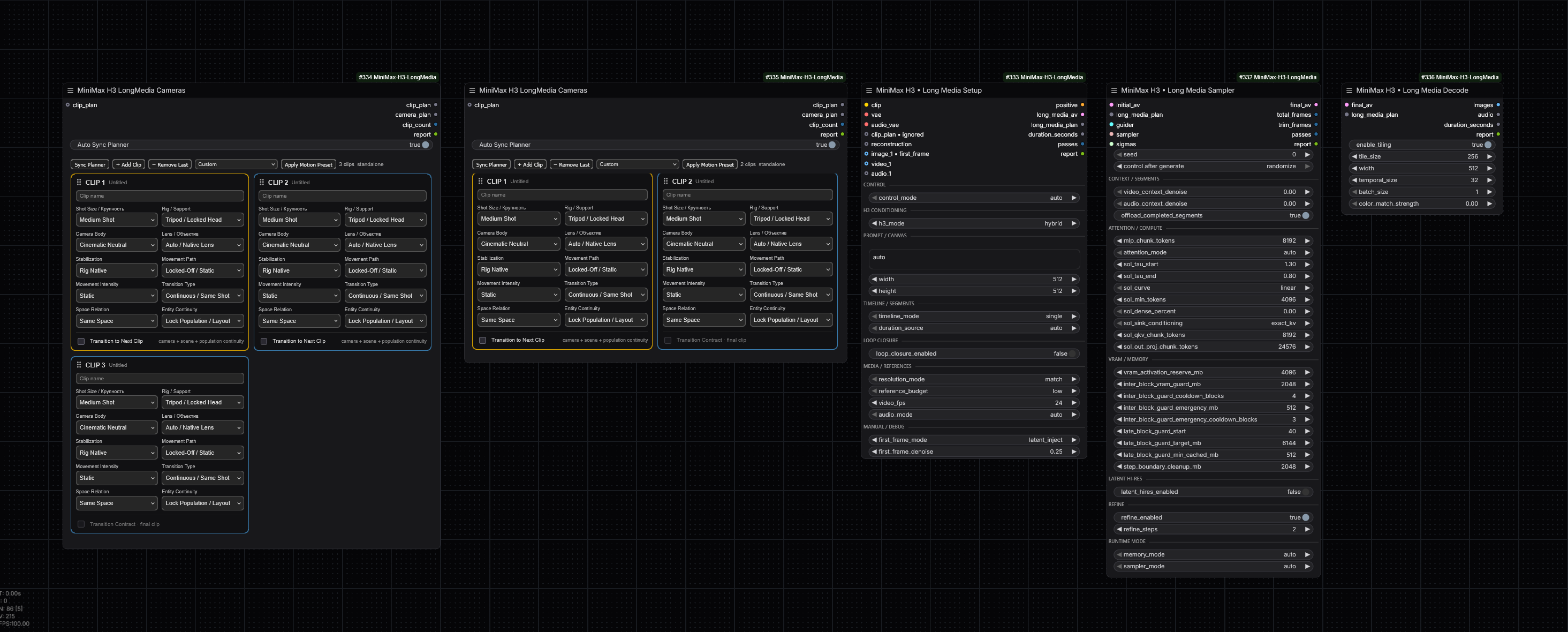
Current release: 0.5.40
Main Nodes
- MiniMax H3 • Long Media Setup
- MiniMax H3 • Long Media Planner
- MiniMax H3 • Long Media Cameras
- MiniMax H3 • Long Media Sampler
- MiniMax H3 • Long Media Decode
- MiniMax H3 • Long Media Video Reconstructor
Legacy internal MiniMaxH3LatentLab... class identifiers remain registered for workflow compatibility.
Installation
Install into:
ComfyUI/custom_nodes/ComfyUI-MiniMax-H3-LongMediaor install the package from the Comfy Registry.
Package identity:
GitHub:             vizart-vj/ComfyUI-MiniMax-H3-LongMedia
Comfy PublisherId:  noise
Restart ComfyUI after installation/update.
Current Setup Model
New workflows use independent semantic controls:
control_mode
h3_mode
timeline_mode
duration_source
audio_mode
This is the main change in how the project should be understood compared with the public 0.4.40 documentation.
See Operating Modes.
H3 Conditioning
t2va
fl2va
ref2va
hybrid
video_ref_edit
Timeline
single
segmented
multiclip
Duration Ownership
auto
video
audio
manual
longest_input
duration_source controls timeline length only. It does not remove audio references or change final-audio policy.
video_ref_edit
Typical source-character replacement:
video_1 = source video frames
image_1 = replacement identity
audio_1 = source soundtrack or new dub
A Video input is an IMAGE batch and never contains soundtrack data.
For preserve-style modes, Video1+Audio1 can be presented as a native paired source-performance reference while Audio1 also owns the target timing/output waveform.
For audio_mode=lip_sync, Audio1 is intentionally independent from Video1's original facial performance so completely new dialogue or singing can drive the replacement character.
Audio2/Audio3 remain prompt-addressable references for music, percussion, bass, ambience, or other semantic timing. In video_ref_edit, they are conditioning references only; Audio1 remains the sole preserved/passthrough source soundtrack.
See Audio Modes and video_ref_edit.
MultiClip + Cameras
Recommended connection:
Long Media Planner
        ↓ clip_plan
Long Media Cameras
        ↓ clip_plan
Long Media Setup
Use:
timeline_mode = multiclipPlanner owns diegetic scene/action prompts, durations, names, and optional seeds. Cameras owns framing, rig/lens, movement, speed, spatial relation, entity continuity, and transitions.
See:
Segmented Long Form
Use:
timeline_mode = segmentedfor one continuous semantic movie split into fixed-duration internal units for VRAM/stability. It is not a storyboard scheduler.
See Fixed Segmentation Prompting.
Two-Stage H3 / Latent Hi-Res
The Long Media Sampler can:
- generate a low-resolution Stage-1 denoised x0;
- learned-upscale the video latent only;
- preserve the audio latent;
- rebuild target-grid conditioning;
- optionally run an independent same-seed fresh-noise high-resolution H3 pass.
Without Latent Hi-Res, the Refiner remains a continuous zero-noise low-sigma tail.
See Two-Stage Sampling, Latent Hi-Res and Refiner.
Sampler / Memory
Production starting point:
sampler_mode   = auto
memory_mode    = auto
attention_mode = auto
Keep ComfyUI Dynamic VRAM enabled.
Current memory-safety work includes exact Comfy Kitchen query streaming for structurally impossible fused-QKV workloads, repeat-run memory isolation, guarded native INT8 VBAR prefetch on constrained GPUs, and RAM-pressure-aware pinned host memory.
See Sampler, VRAM and Performance Guide.
FastH3 / FastVideo VSA
LongMedia includes isolated compatibility paths for supported H3ddle/PulpCut FastH3 VSA and Kijai FastVideo VSA packages.
These paths use strict structural detection and reset their runtime state when switching back to ordinary H3 checkpoints.
Loop Closure
Loop Closure returns the generated tail toward the opening macro-state in latent/H3 space. It is independent from conditioning/timeline mode and does not use an RGB crossfade as its primary mechanism.
Documentation
Start at docs/README.md.
Important guides:
- Operating Modes
- Audio Modes
- Two-Stage Sampling / Latent Hi-Res / Refiner
- Sampler / VRAM
- Architecture
- 0.5.40 changes since 0.4.40
Example Workflows
workflows/MiniMax-H3-LongMedia-SAFE-1080p-15s.jsonworkflows/MiniMax-H3-LongMedia-LatentUpscale-Detailer.json
Release workflows contain neutral media placeholders rather than user media or local preview paths.
See workflows/README.md.
Third-Party Code
This repository contains adapted third-party components under their respective licenses, including:
- Saganaki22/ComfyUI-sol-attn-derived code under Apache-2.0;
- MiniMax H3 latent-upscaler-derived code under Apache-2.0.
See THIRD_PARTY_NOTICE.md and THIRD_PARTY_APACHE_2_0.txt.
Release History
0.5.40 is the release consolidation after public v0.4.40.
Historical release notes remain in docs/ for compatibility/reference. They may use the old workflow_mode terminology.
License
See LICENSE.