ArGue: Attribute-Guided Prompt Tuning for Vision-Language Models (CVPR 2024)
ArGue addresses distribution shift limitations in soft prompt tuning by aligning Vision-Language models with LLM-generated visual attributes, introducing attribute sampling and negative prompting to suppress spurious correlations.



This is the official implementation of the paper 'ArGue: Attribute-Guided Prompt Tuning for Vision-Language Models', accepted at CVPR 2024.
News📰
[2024/06/01]: 🔥 We have released our code.[2024/02/27]: 🎉 Our paper has been accepted to CVPR 2024![2023/11/28]: 🔥 We have released our paper [arXiv].
Methodology📖
Overview
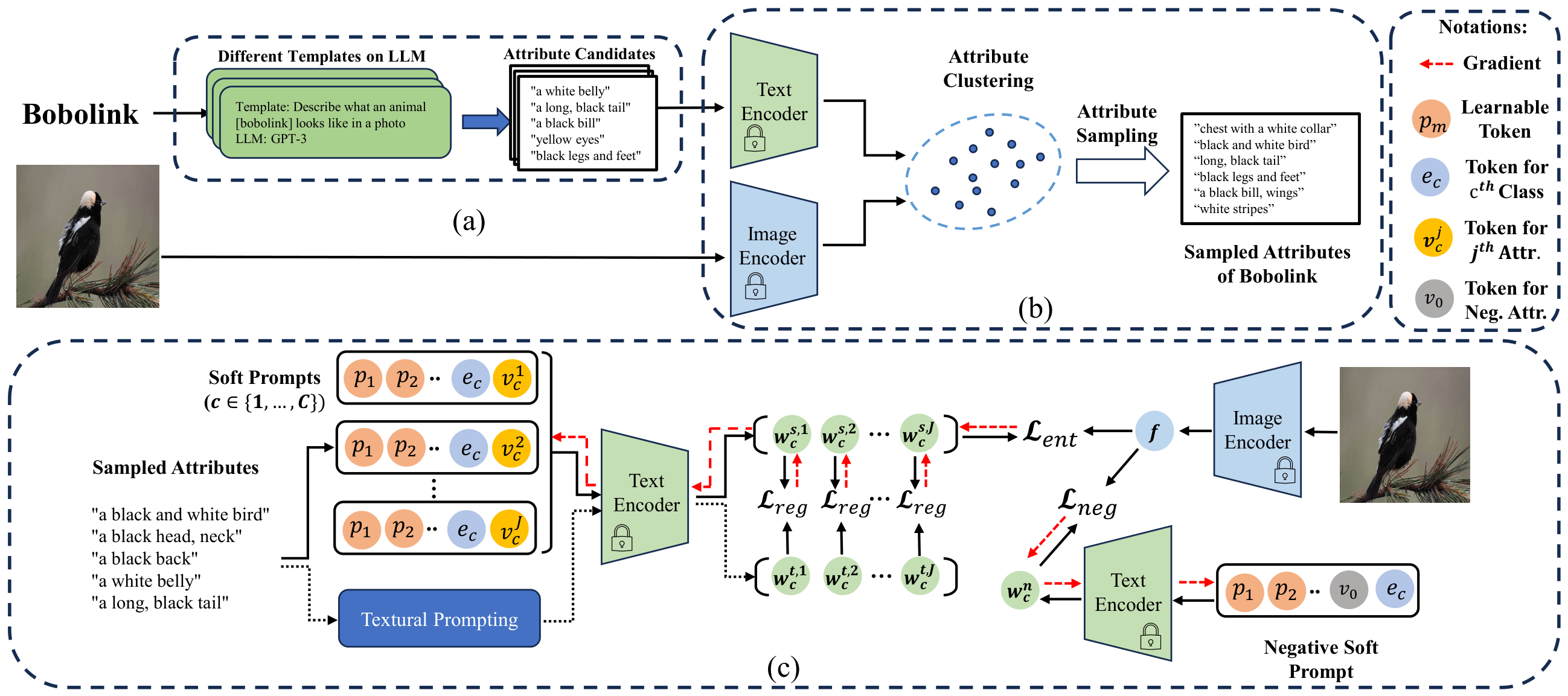
ArGue consists of three key components built on top of soft prompt tuning:
-
Attribute-Guided Prompting: Instead of
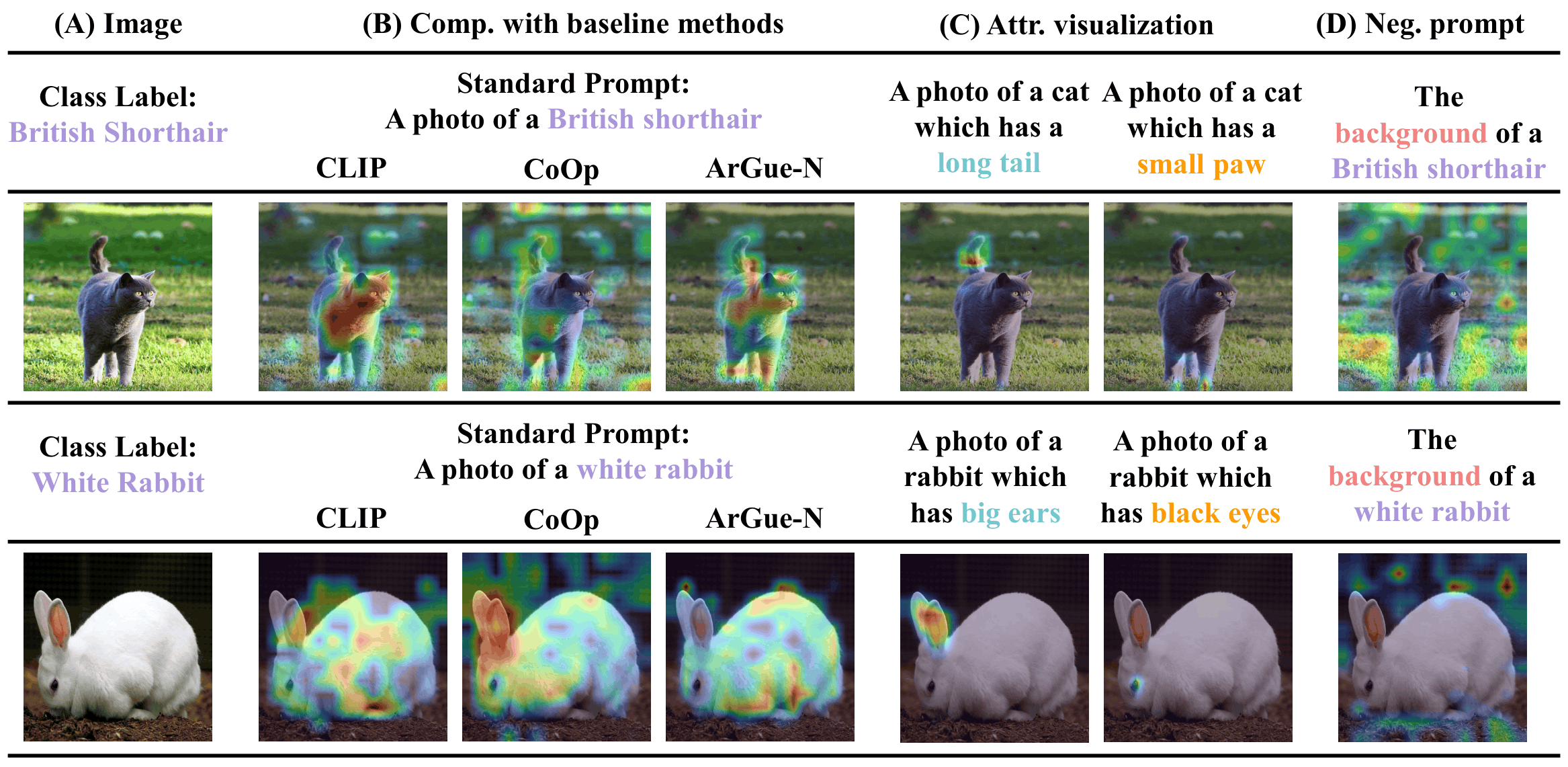
[soft tokens] + [class name], we concatenate a visual attribute appended after the class name:[soft tokens] + [class name] + [attribute]. Attributes are generated by GPT-3 using multiple in-context-learning templates (J=15 per class). The final prediction averages logits over all attributes per class. -
Attribute Sampling: The attribute pool is clustered in CLIP's text feature space. Within each cluster, the attribute with the highest similarity to training images is selected — filtering out non-visual (e.g., edible) and domain-irrelevant (e.g., color attributes for grayscale sketch datasets) attributes. Only N=3 representative attributes per class are kept for training.
-
Negative Prompting (ArGue-N): A negative prompt
[soft tokens] + ["background of"] + [class name]is constructed. Training enforces a uniform predictive distribution under this prompt (maximizing entropy), suppressing background spurious correlations without requiring per-class manual annotation.
Negative Prompting Illustration
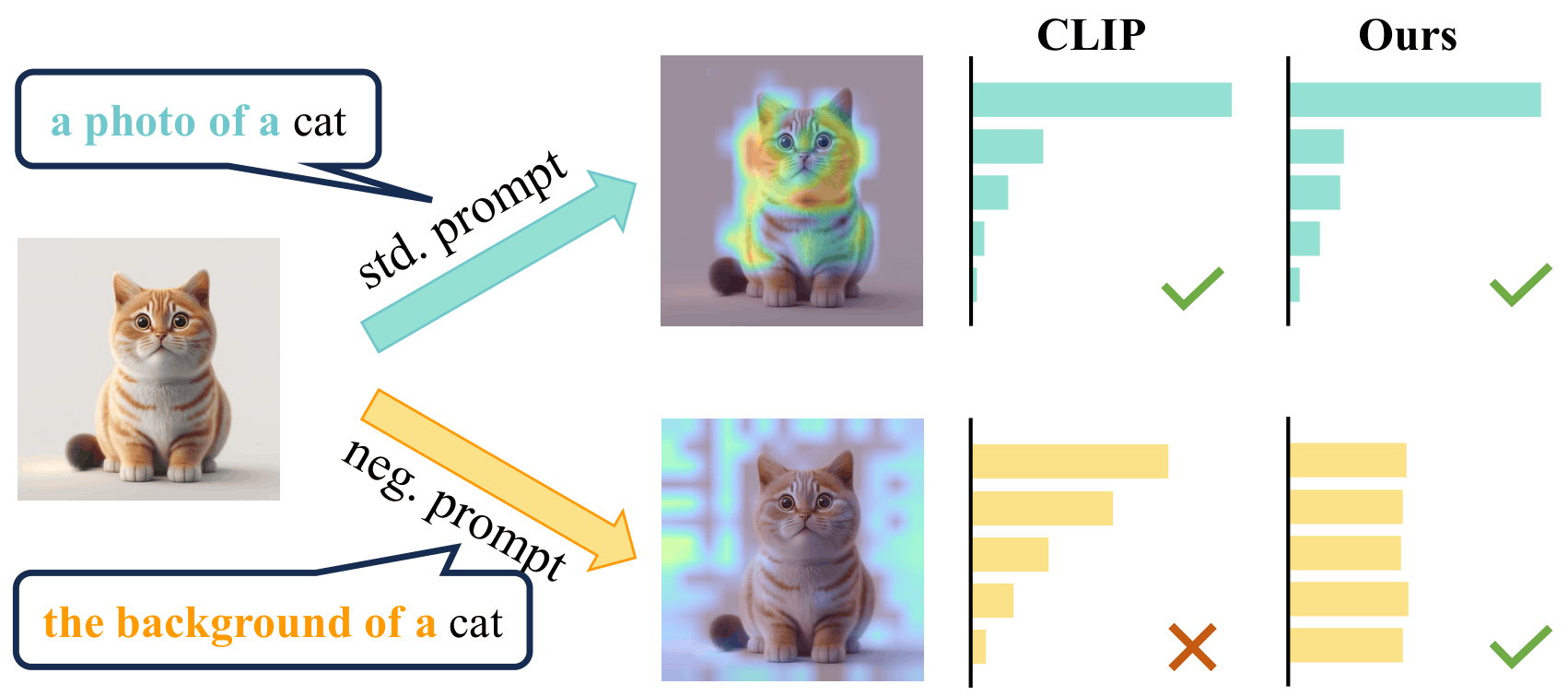
When given a background-activating prompt (e.g., the background of a cat), vanilla CLIP produces biased predictions. ArGue-N is trained to output a uniform distribution under such prompts, forcing the model to focus on class-specific attributes rather than background cues.
Attribute Sampling

LLM-generated attributes vary in their visual relevance. Attribute sampling clusters the pool semantically and selects the attribute most aligned with actual images per cluster — retaining 20% of attributes while improving accuracy.
Main Results🗒️
Novel Class Prediction
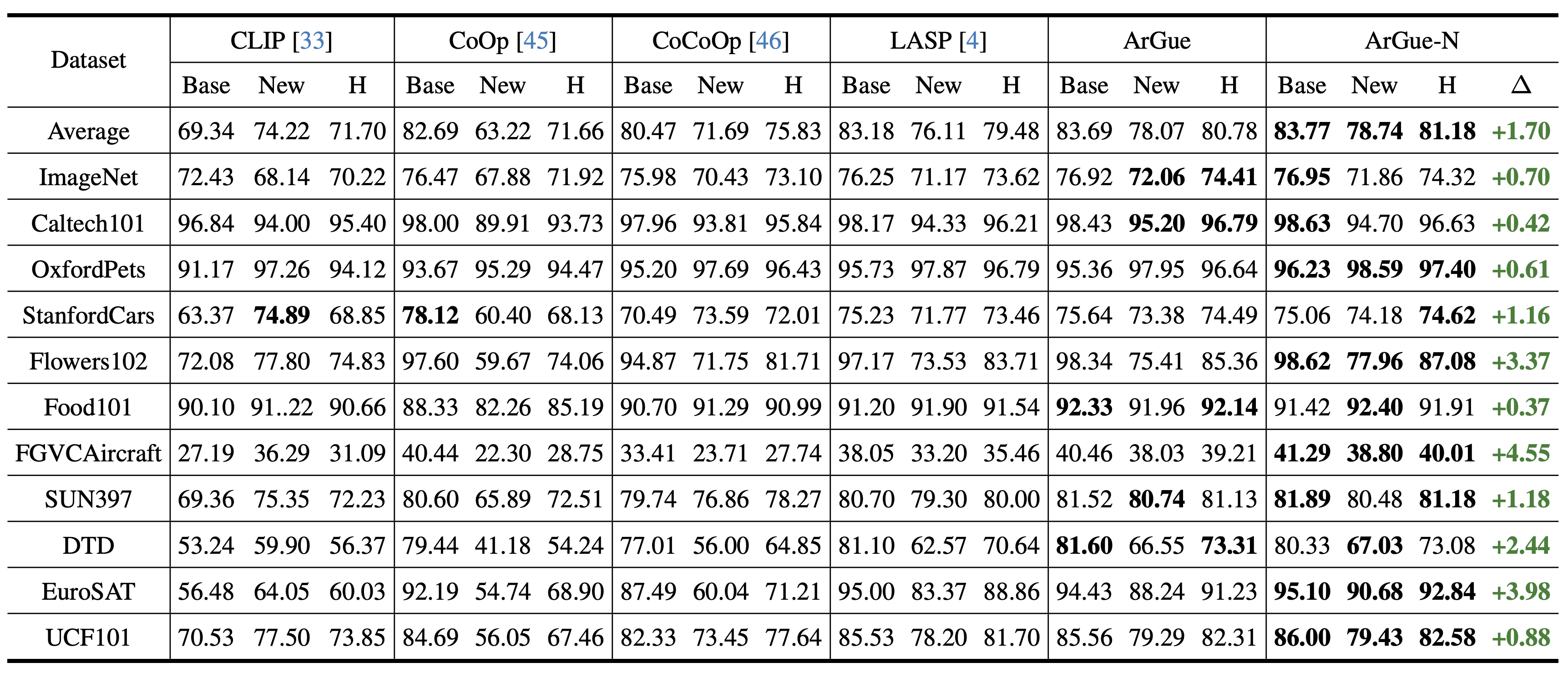
ArGue-N outperforms LASP (previous state-of-the-art) by +1.70% on average harmonic mean across 11 datasets. It is the first prompt tuning method to surpass zero-shot CLIP on novel class accuracy in 10 out of 11 benchmarks.
Out-of-Distribution Generalization
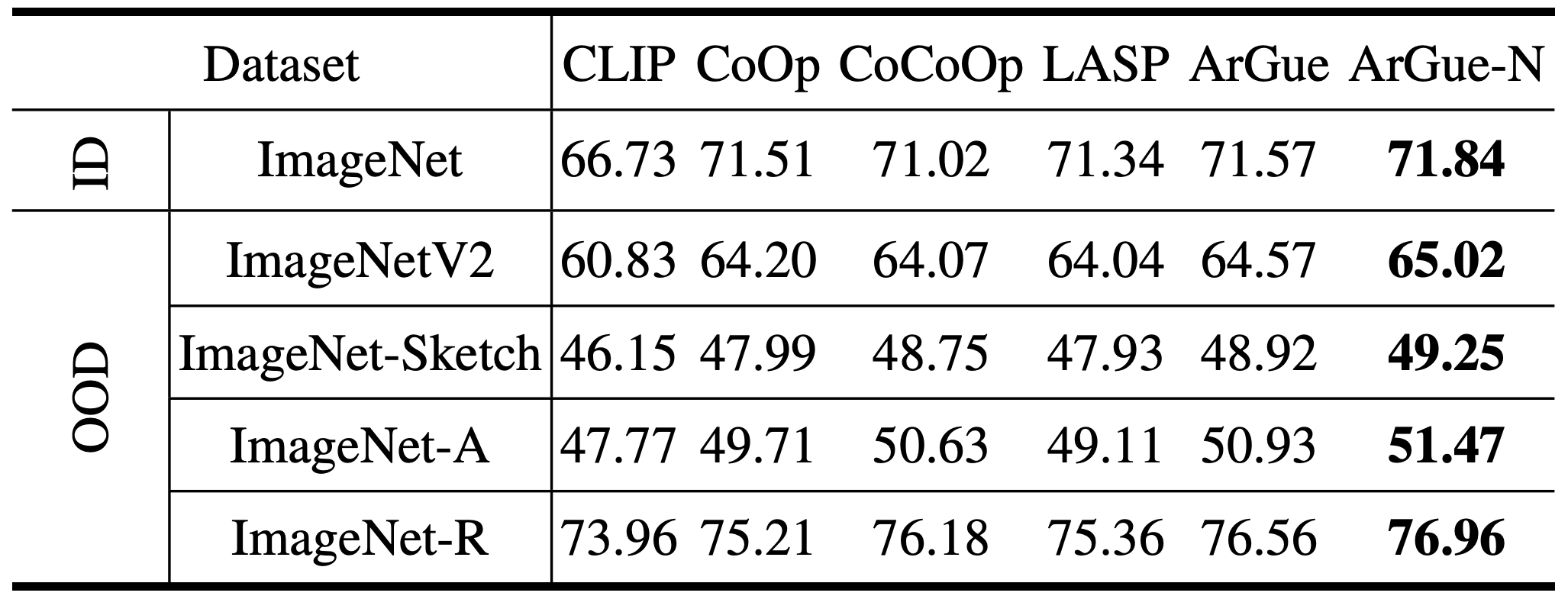
ArGue-N consistently outperforms all baselines across all four OOD variants of ImageNet, with notable gains on ImageNet-A (+1.47%) and ImageNet-Sketch (+0.50%).
Component Analysis
Each component contributes incrementally. Introducing attributes alone improves CoOp by +7.64% on average. Attribute sampling further adds +0.34% while cutting 80% of computation. Negative prompting brings an additional +0.40% with no extra manual annotation.
Getting Started🚀
Installation
Requirements: Python ≥ 3.7, CUDA-compatible GPU, torch, dassl, clip.
git clone https://github.com/xytian1008/ArGue.git
cd ArGue
pip install -r requirements.txt
Install Dassl following the official instructions.
Dataset Preparation
Download datasets following CoOp. Supported datasets:
ImageNet, Caltech101, OxfordPets, StanfordCars, Flowers102, Food101, FGVCAircraft, SUN397, UCF101, DTD, EuroSAT, ImageNetV2, ImageNet-Sketch, ImageNet-A, ImageNet-R.
Attribute Generation
Generate the attribute pool for each dataset using GPT-3:
python generate_descriptors.pyThis calls GPT-3 (text-davinci-003) with multiple in-context-learning templates to produce J=15 attributes per class.
Attribute Sampling
Select representative attributes from the pool using CLIP-guided clustering:
bash scripts/ARGUE/select_attr.shThis runs select_attr.py, which clusters attribute text features and picks the attribute per cluster most similar to training images, retaining N=3 per class.
Training
Novel Class Prediction (Base-to-New)
bash scripts/ARGUE/base2new_train.sh [DATASET] [SEED]Out-of-Distribution Generalization
bash scripts/ARGUE/xd_train.sh [DATASET] [SEED]Evaluation
Novel Class Prediction
bash scripts/ARGUE/base2new_test.sh [DATASET] [SEED]OOD Generalization
bash scripts/ARGUE/xd_test.sh [TARGET_DATASET] [SEED]Acknowledgements🥰
Our work builds upon CoOp / CoCoOp and LASP. We use Dassl as the training framework and CLIP as the backbone. Attributes are generated using GPT-3. We evaluate on 11 benchmark datasets following the standard splits from CoOp and CoCoOp.
Citation🎓
If you find this work useful, please cite our paper:
@inproceedings{tian2024argue,
  title={Argue: Attribute-guided prompt tuning for vision-language models},
  author={Tian, Xinyu and Zou, Shu and Yang, Zhaoyuan and Zhang, Jing},
  booktitle={Proceedings of the IEEE/CVF Conference on Computer Vision and Pattern Recognition},
  pages={28578--28587},
  year={2024}
}
License📄
This project is licensed under the MIT License — see the LICENSE file for details.