HiDeck
Self-hosted console for Qualcomm 4G / LTE / 5G modems
English · 简体中文 · 日本語 · 한국어 · Español · Français · Deutsch · Português · Русский




Manage USB modems, cellular proxy, SMS, WiFi calling / IMS voice, eSIM, and scheduled tasks from a browser.
| Web UI | http://YOUR_IP:7575 |
| Default login | admin / admin (change on first sign-in) |
| Database | SQLite (data/hideck.db) |
Features
- Devices — USB auto-discovery; QMI, MBIM, AT, PC/SC; live radio and SIM identity
- Proxy — SOCKS5 / HTTP bound to the modem with
SO_BINDTODEVICE - SMS — inbox, send, contacts; vcf/csv from iOS, Google, Samsung, Xiaomi, Huawei, OPPO, vivo
- Phone — WiFi calling, cellular software IMS, or native VoLTE; hold, call waiting, listen-only answer
- VoWiFi — SWu / IMS, recordings; country proxy pool, pin a node, or go direct
- Native VoLTE — modem IMS (
phone_mode=volte), no ePDG; unique China MBN mapping only - eSIM — download, enable, disable, rename, delete; activation code or QR / PDF
- Automation & notify — scheduled tasks; Telegram, email, Bark, Feishu, WeCom, WeChat, QQ
Protocol notes: VoWiFi · VoLTE · operators · hardware · module voice troubleshooting
Outgoing call/SMS quotas are per SIM and survive restarts: limits and configuration.
Quick start
Docker (recommended). Needs Linux, curl, Docker Compose, host networking, and USB access. The image includes ADB, ALSA tools, AMR/MP3 libraries, and the embedded module-side voice runtime. The host still needs a USB audio driver; see module voice prerequisites.
curl -fsSL https://raw.githubusercontent.com/yibaiba/hideck/main/deploy.sh | shcurl -fsSL https://raw.githubusercontent.com/yibaiba/hideck/main/deploy.sh | HIDECK_DIR=/opt/hideck shThen open http://YOUR_IP:7575.
With a public hostname (DNS A/AAAA to the host, open 443/TCP and 443/UDP):
curl -fsSL https://raw.githubusercontent.com/yibaiba/hideck/main/deploy.sh | \
  HIDECK_DOMAIN=hideck.example.com \
  HIDECK_DIR=/opt/hideck sh
Image: yibaiba/hideck:latest. Compose uses network_mode: host, privileged: true, /dev, and persists config/, data/, logs/. See DOCKERHUB.md and HTTPS / WebRTC.
For Feiniu fnOS, the optional FPK packaging reuses the Docker image with an application entry and persistent app directories; on-device validation is still required.
docker compose ps
docker compose logs -f hideck
For PC/SC USB smart-card readers, also configure the host service and optional Compose override described in Docker PC/SC setup.
Screenshots
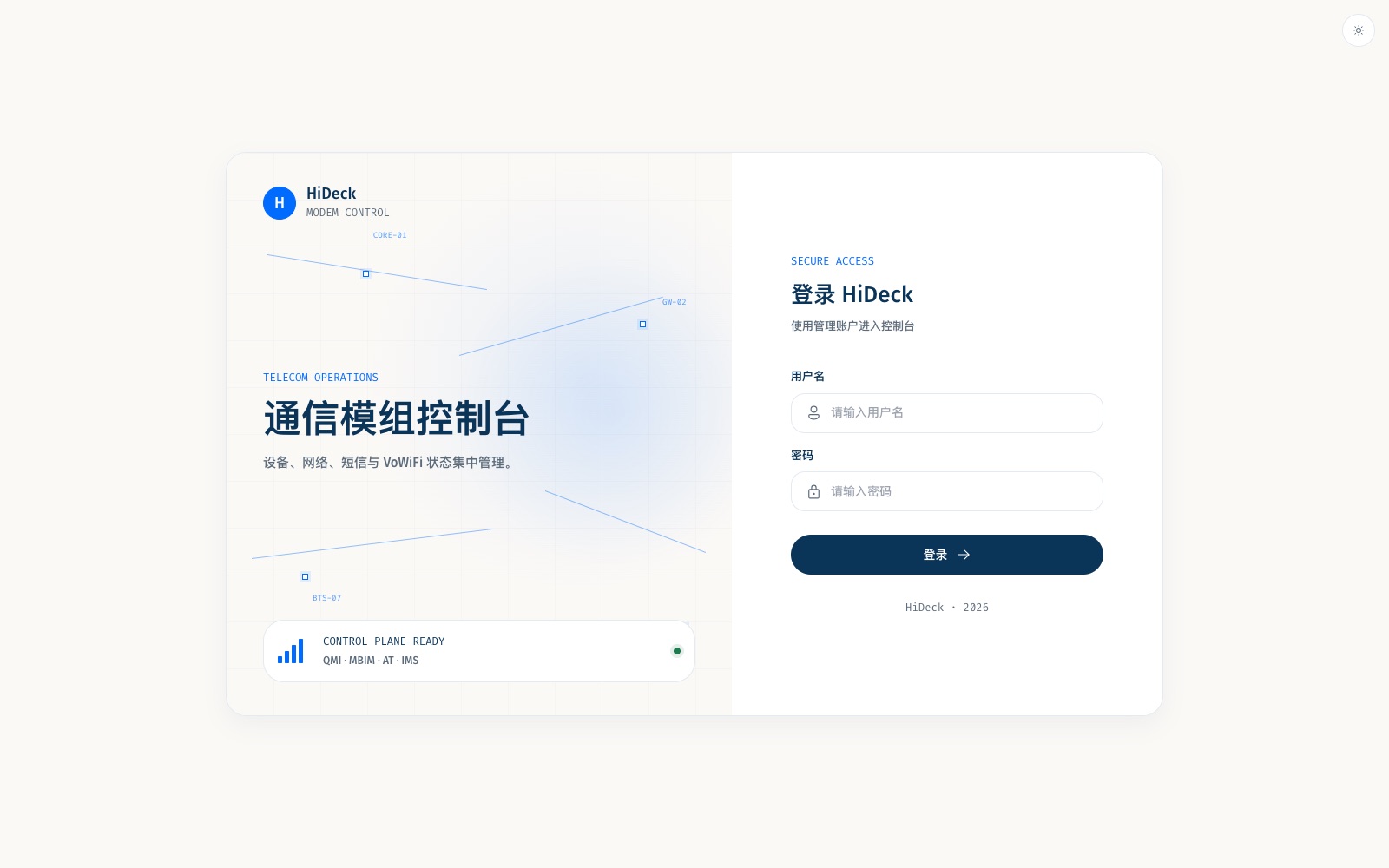
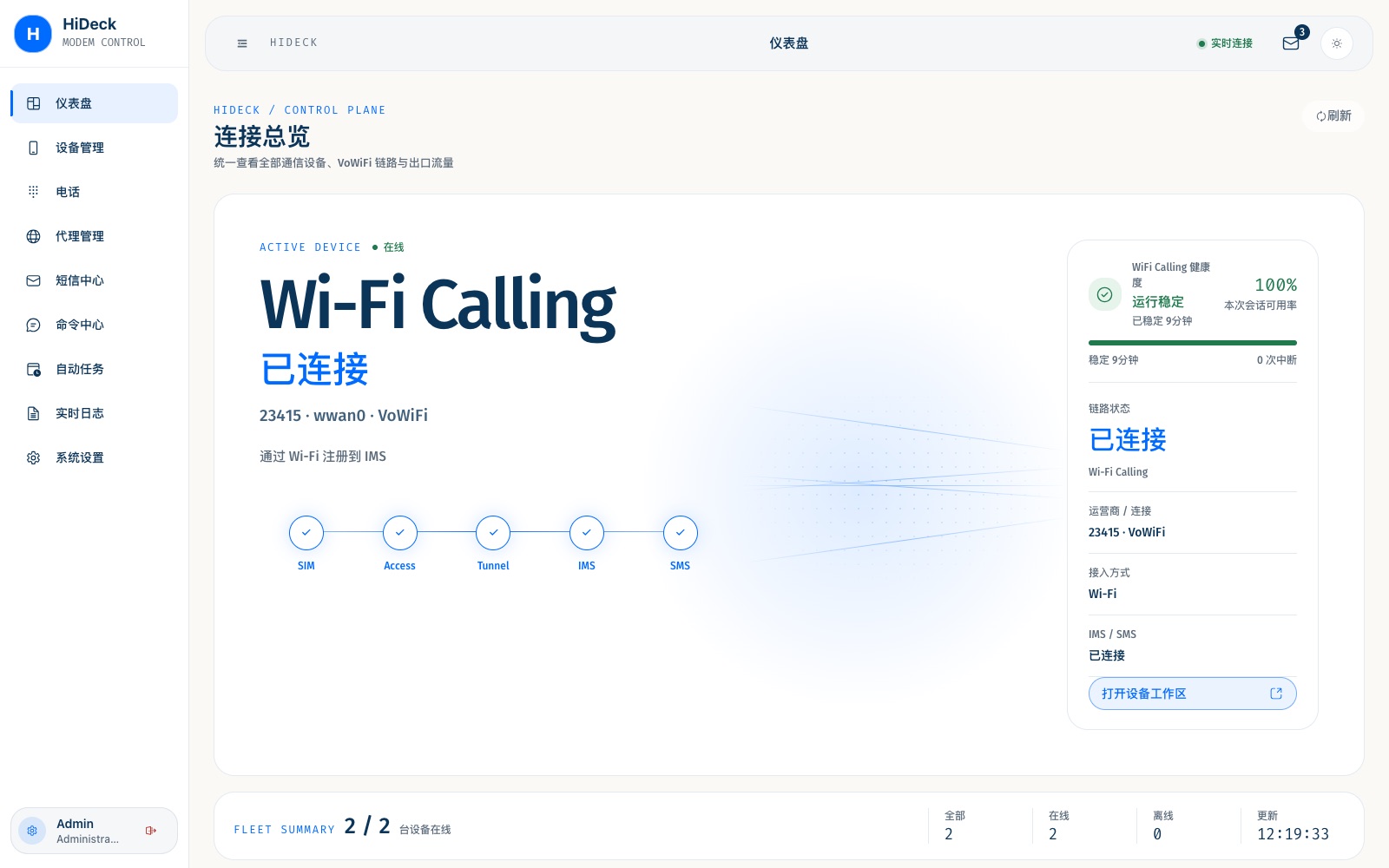
| Devices | Phone |
|---|---|
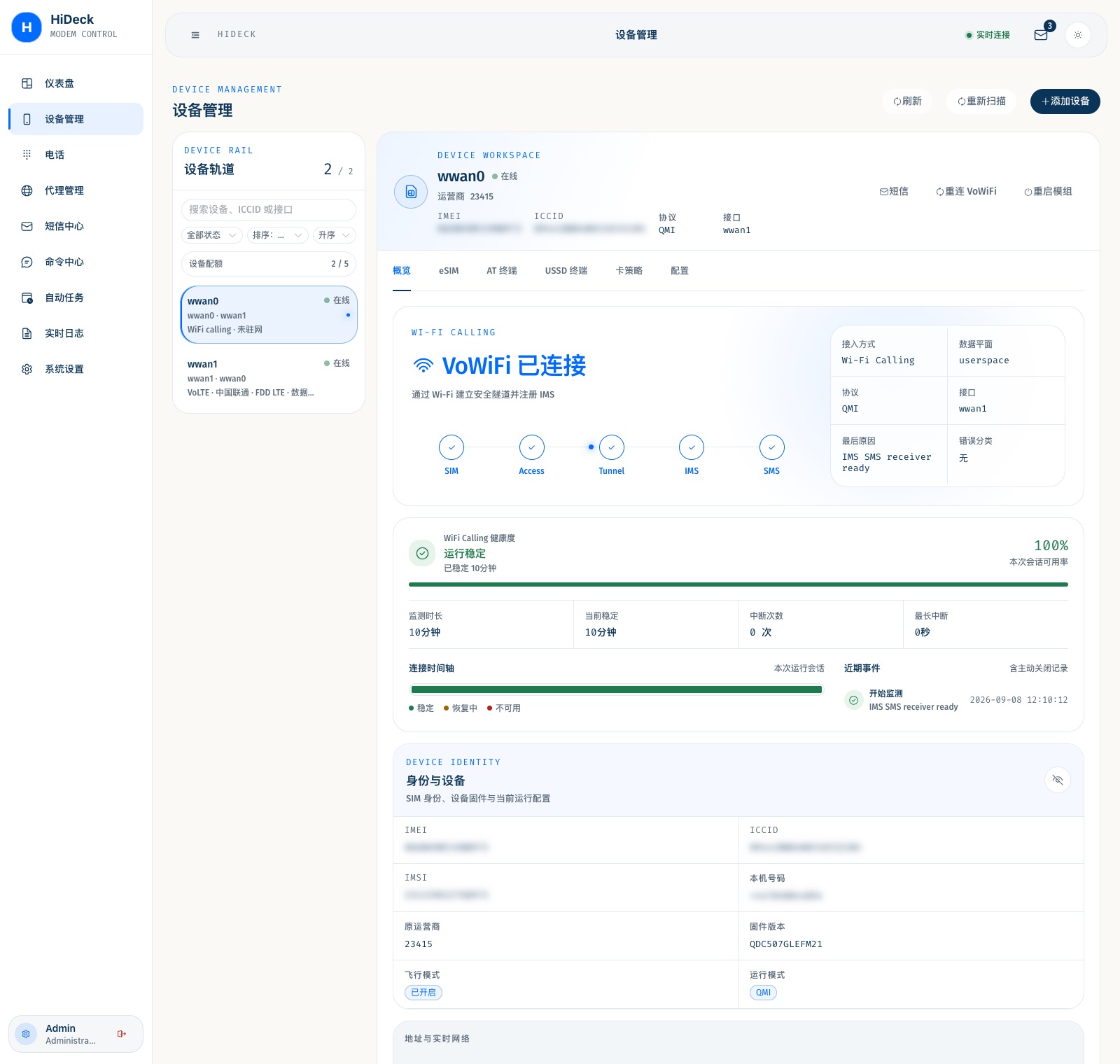 | 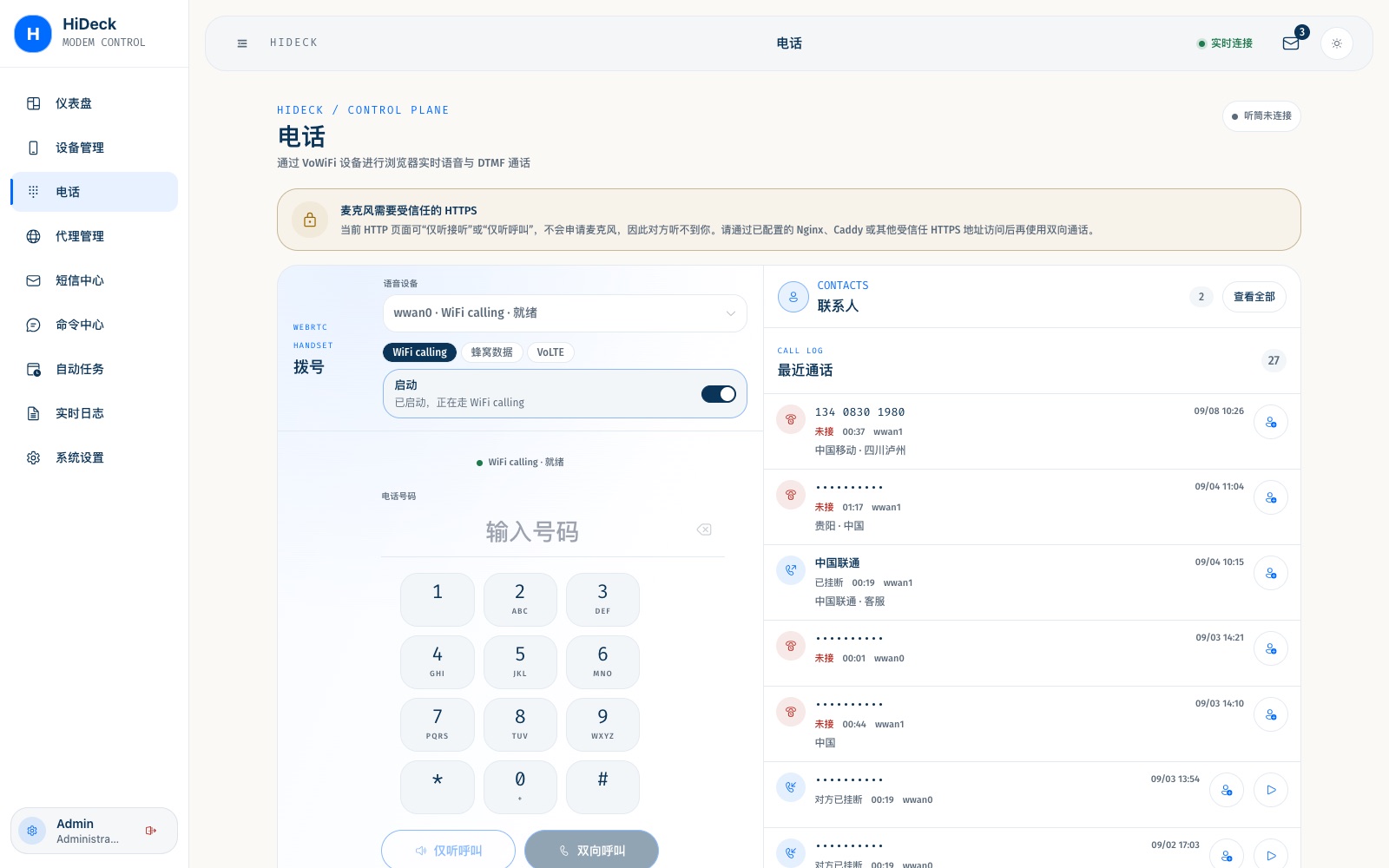 |
| Commands | Proxy |
|---|---|
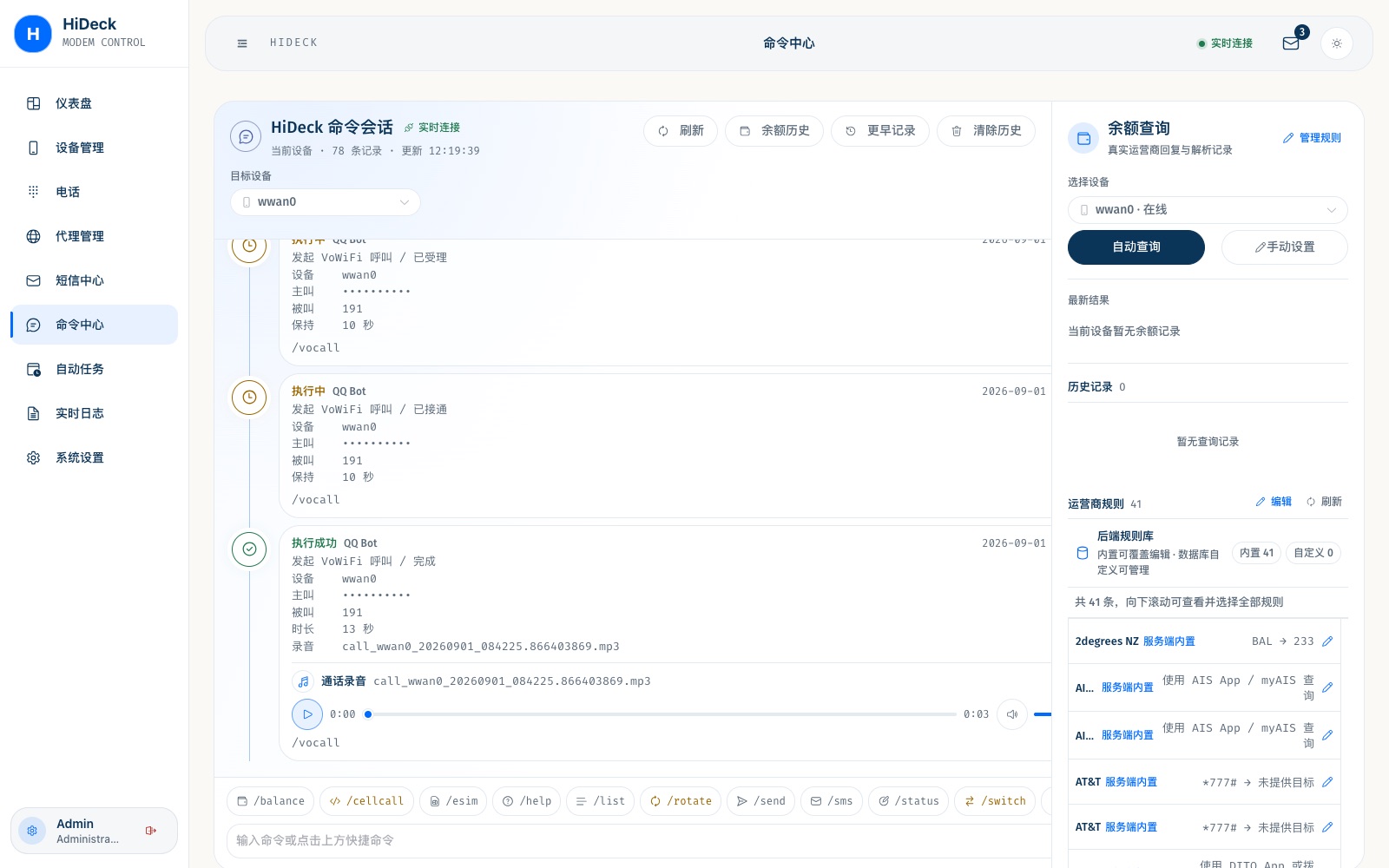 | 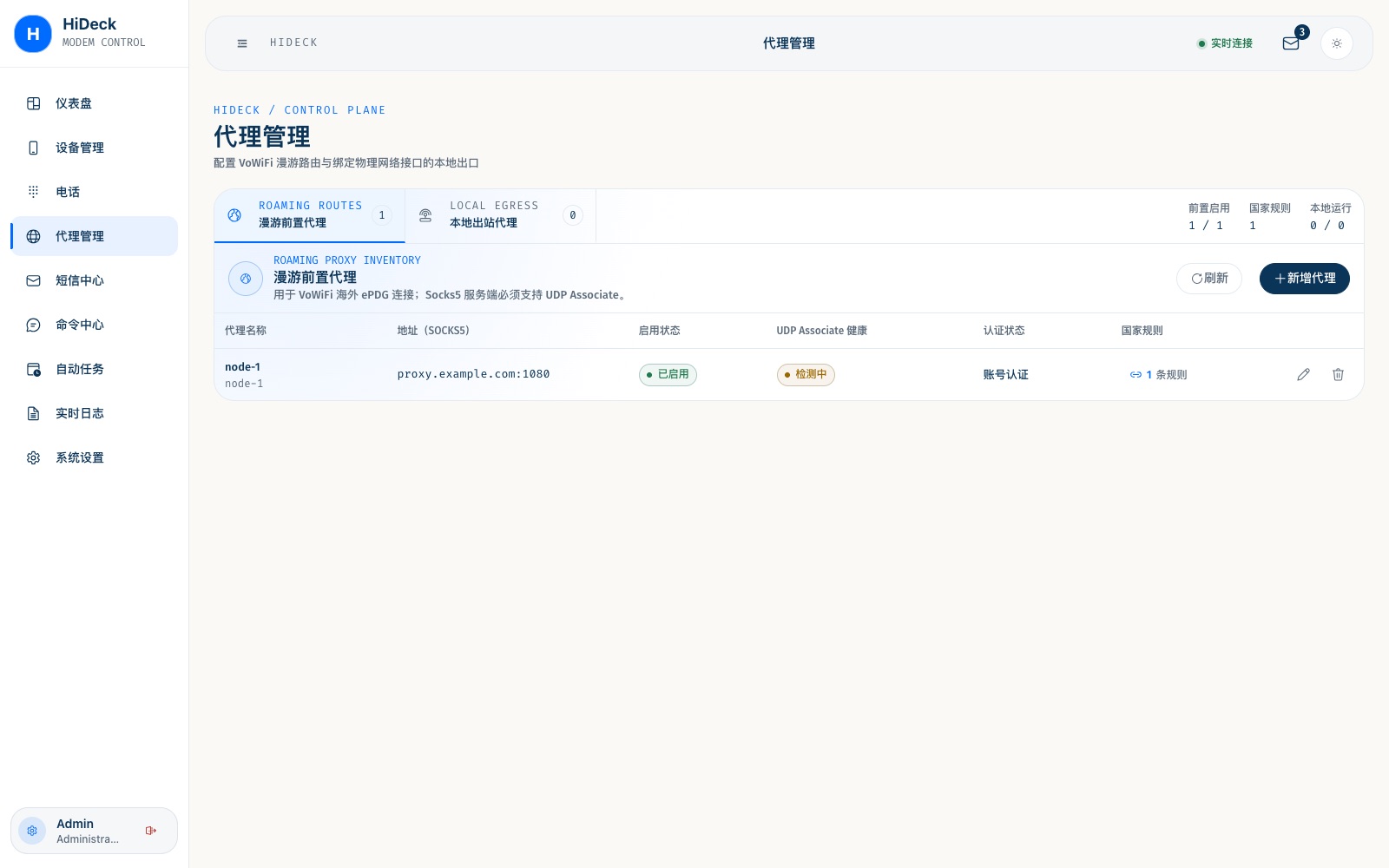 |
Binary install
The installer also installs ADB, ALSA tools and recording libraries, then checks ADB capabilities and host USB audio support. Missing dependencies produce a nonzero exit status even if the HiDeck service was installed; they are not reported as a fully successful deployment. These checks do not connect to or reboot a modem.
OpenWrt keeps module voice optional: use the separate hideck-adb and hideck-modem-voice packages. See OpenWrt packaging for IPK/APK installation and target matching.
curl -fsSL https://raw.githubusercontent.com/yibaiba/hideck/main/deploy-binary.sh | shcurl -fsSL https://raw.githubusercontent.com/yibaiba/hideck/main/deploy-binary.sh | \
HIDECK_DIR=/opt/hideck \
HIDECK_VERSION=v2.1.23 \
HIDECK_ARCH=linux_amd64 sh| Asset | Platform |
|---|---|
hideck_v2.1.23_linux_amd64 | x86_64, glibc + UPX |
hideck_v2.1.23_linux_arm64 | ARM64 / Raspberry Pi OS 64-bit, glibc + UPX |
hideck_v2.1.23_linux_armv7 | 32-bit ARM, glibc + UPX |
hideck_v2.1.23_openwrt_amd64 | OpenWrt x86_64, musl static, no UPX |
hideck_v2.1.23_openwrt_arm64 | OpenWrt aarch64 |
hideck_v2.1.23_openwrt_armv7 | OpenWrt 32-bit ARM |
hideck_v2.1.23_openwrt_dynamic_amd64 | OpenWrt x86_64, dynamic musl, MP3 encoding capable |
hideck_v2.1.23_openwrt_dynamic_arm64 | OpenWrt aarch64, dynamic musl, MP3 encoding capable |
hideck_v2.1.23_openwrt_dynamic_armv7 | OpenWrt 32-bit ARM, dynamic musl, MP3 encoding capable |
On OpenWrt, use openwrt_* only. The package-manager archives and binary installer use the static assets. The dynamic assets require matching runtime libraries and are intended for MP3 call recording; see OpenWrt packaging.
Configuration
Copy config/config.example.yaml to config/config.yaml.
| Key | Default | Notes |
|---|---|---|
server.port | 7575 | HTTP |
server.https_enabled | false | Built-in HTTPS; keep off behind a reverse proxy |
server.https_port | 7576 | Built-in HTTPS port |
server.webrtc_udp_address | :7580 | WebRTC audio UDP |
server.webrtc_public_host | empty | Public ICE host behind NAT |
web.username / web.password | admin | Change immediately |
vowifi.enabled | false | Global VoWiFi |
system.openwrt_dynamic_interfaces | false | OpenWrt netifd mapping |
Do not commit secrets. SIM PIN fields store environment variable names only (HIDECK_SIM_PIN_READER1). PROXY_WEB_PASSWORD overrides the file.
Build
Go 1.26.4+, Node.js / npm. make build-* requires UPX.
make build-amd64 # also: build-arm64, build-armv7, build-allnpm ci --prefix web && npm run build --prefix web
cp -R web/dist internal/web/dist
GOWORK=off CGO_ENABLED=0 GOOS=linux GOARCH=amd64 \
go build -trimpath -tags "with_utls nomsgpack" -o dist/hideck_linux_amd64 ./cmd/hidecknpm test --prefix web && npm run typecheck --prefix web
go test -timeout=60s ./cmd/... ./internal/... ./pkg/...Dev proxy: VITE_API_PROXY_TARGET=http://127.0.0.1:7575 in web/.env.local. API docs: /api/docs.
License
Personal learning, research, and testing. Not a production telephony stack. Independent of Quectel, Qualcomm, and carriers. Follow local law and your operator’s terms.
PolyForm Noncommercial 1.0.0. third_party/vowifi-go is AGPL-3.0. See THIRD_PARTY_NOTICES.md before distributing binaries or images.
Thanks: LINUX DO · iniwex5/vohive-release · boa-z/vowifi-go