
A forward-testing harness for trading with fast classification models: plug a model in, run it on live perpetual markets, and find out honestly whether it has an edge.





[!WARNING] Calibrain Harness is under active development. It trades on the Bybit testnet only (the host is hard-coded; there is no mainnet switch). Interfaces, question sets and defaults change between commits. Nothing here is financial advice.
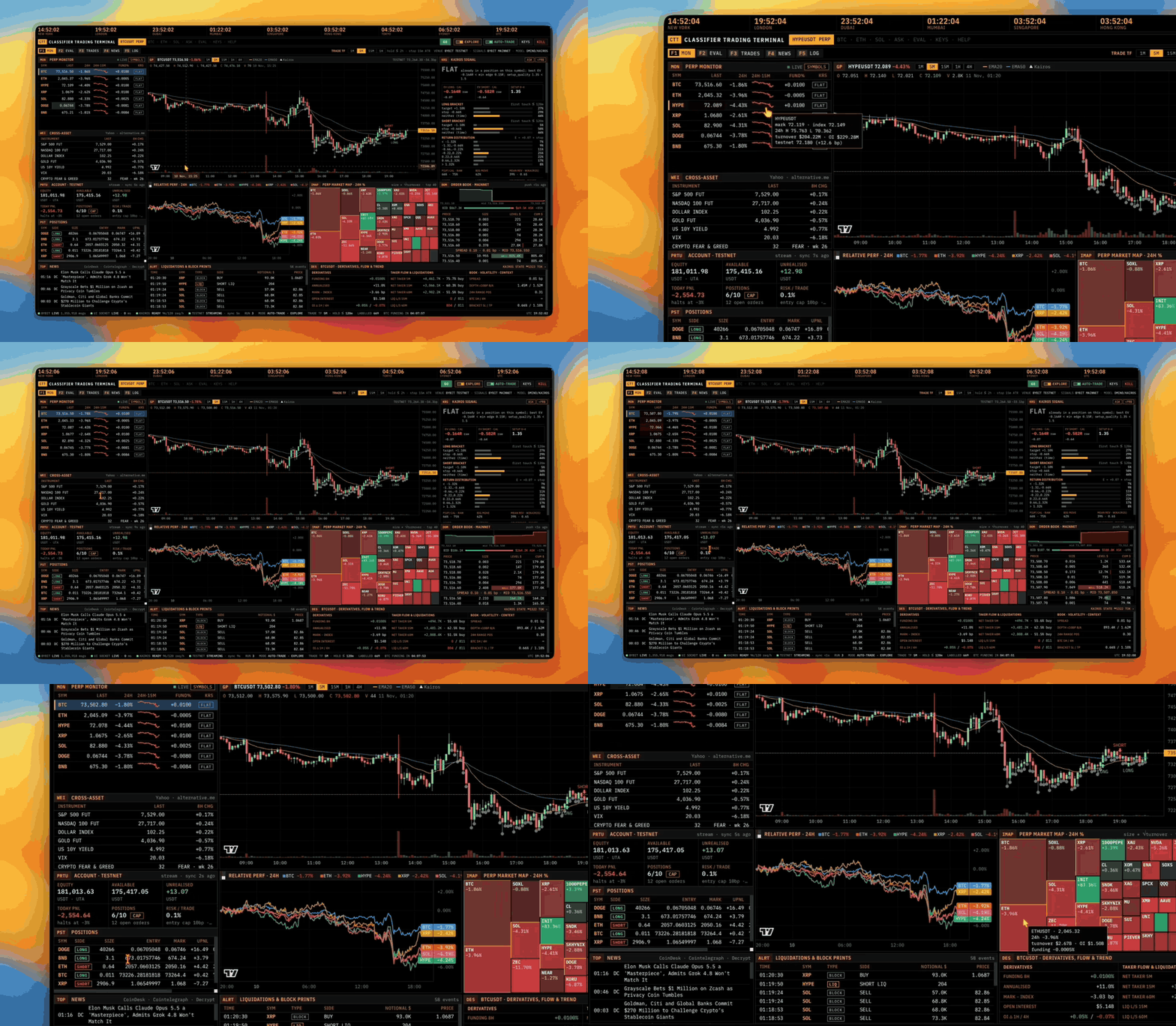
Live terminal: monitor, Kairos signals, evaluation and news. Watch the full 1-minute video.
What it is
Calibrain Harness connects a high-speed classification model to perpetual futures and treats every answer as a forecast that will be checked. On each closed bar it asks the model a small set of labellable questions ("which is touched first in the next 2 h: +1.0% or −0.6%?"), turns the probabilities into expected value in code, trades the ones that clear the gates on Bybit testnet (long and short, with protected stops and targets), and then scores every prediction against what the market actually did, traded or not.
You get two things: a trading bot, and an honest evaluation of the model behind it.
Supported models
Calibrain Harness is built for any fast classifier that returns calibrated probabilities over a fixed set of options. Kairos and Jev are supported today; switch between them live with MODEL in the terminal's function-key bar.
| Model | Provider | Model id | Key | Status |
|---|---|---|---|---|
| Kairos | DMind via Minara Cloud | DMIND/Kairos | KAIROS_API_KEY | Supported (also powers news_return forecasts) |
| Jev | TypeSafe | jev-1.14.0 (pinned; override with CTB_JEV_MODEL) | TYPESAFE_API_KEY | Supported |
| Other System One style models | Add a ModelSpec in ctb/models.py |
Both are called the same way (POST /v1/systemone with a state and typed questions), so the question
set, validation, calibration, policy and evaluation are shared. What is kept per model: every
decision is stamped with the model that made it, calibration weights are fitted per model (and per
trading timeframe), EVAL and reports filter by model, and switching models starts a new run (only
while the bot is flat), so results never mix two models.
Features
- Bloomberg-style terminal. Next.js front end fed by one WebSocket: candles, order book with depth chart and wall detection, market map, liquidation and block tape, derivatives and flow, the model signal with calibrated vs raw expected value, and a decision blotter with the full request and response for every call.
- Multiple models. Kairos and Jev behind one interface, switchable live, evaluated separately.
- Labellable question set with the instrument's own base rates in the state, so the model starts from how often each outcome really happens and is measured against that.
- Calibration layer. Decisions blend the model with the base rates; the weight is fitted on labelled outcomes, so a model that adds nothing stops driving trades.
- Exact execution accounting on thin testnet books. IOC-capped entries, resting take-profits, mainnet-confirmed managed stops with capped IOC exits, and P&L, fees and R summed from every Bybit closed-P&L row.
- Evaluation built in. Brier/RPS skill vs climatology and vs the base rates the model was shown, AUC, reliability diagrams, PIT, EV ranking, repeat and mirror consistency probes, execution quality, and per-run results (Run 1, Run 2, …, Overall).
- Safety. Testnet-only host, keys only in
.env, kill switch, daily loss limit, per-trade, portfolio and same-direction risk caps, venue-divergence gate.
Quick start
Requirements: Python 3.12, Node.js 20+ with npm, a Kairos or Jev API key, and Bybit testnet API keys.
git clone https://github.com/zadescoxp/calibrain-harness.git
cd calibrain-harness

# 1. Python service (data, model calls, execution, API)
python3.12 -m venv .venv && .venv/bin/pip install -r requirements.txt
cp .env.example .env   # add keys here, or later in the terminal (KEYS)

# 2. Terminal UI (Next.js): build once into web-next/out
cd web-next && npm ci && npm run build && cd ..

# 3. Start everything
.venv/bin/python -m ctb.server
Open http://127.0.0.1:8800. The Python service serves the built UI, the API and the live /ws
socket from that one address; there is no separate Node process to run.
- Keys. Kairos keys come from minara.cloud and must belong to a
Kairos-enabled group. Jev keys come from the TypeSafe console.
Choose the model with
CTB_MODEL_PROVIDER=kairos|jevor MODEL in the terminal. Bybit testnet keys come from testnet.bybit.com → API management with Contract → Orders + Positions and no withdrawal permission. - Observe-only first. The bot starts without placing orders. Decisions are made and scored; switch on AUTO-TRADE in the command bar to trade on testnet.
- Kill switch. The KILL button, or
touch KILLin the project folder: closes bot positions, cancels orders and halts.
Working on the UI
| Task | Command | Notes |
|---|---|---|
| Rebuild after pulling or editing UI code | cd web-next && npm run build | Reload the page; no server restart needed. |
| Live-reload development | cd web-next && npm run dev | Open http://localhost:3000 with the Python server still running; the dev UI talks to its API and /ws on 127.0.0.1:8800. |
| Type-check | cd web-next && npx tsc --noEmit |
If the UI has not been built yet, http://127.0.0.1:8800 shows a short page with the build command; the API and the live socket work either way.
Tests and smoke checks
.venv/bin/python -m pytest -q tests                       # unit tests (no network)
.venv/bin/python scripts/kairos_smoke.py SOLUSDT          # one real request to the active model + validation
.venv/bin/python scripts/kairos_smoke.py SOLUSDT --model jev   # same, against a specific model
.venv/bin/python scripts/testnet_smoke.py SOLUSDT long    # min-size testnet open -> verify stop -> close
Using the terminal
| Screen | Key | What it shows |
|---|---|---|
| MON | F1 | Watchlist, chart with model markers, model signal, account and positions, relative performance, market map, order book, news, liquidations, derivatives/flow/trend, decision blotter |
| EVAL | F2 | Findings, calibration, EV ranking, PIT, per-question scores, model vs base rates, probes, operations, testnet P&L, execution quality; filter by model, run, symbol, question set, timeframe |
| VALID | F6 | Validation on independent windows: per-symbol skill with 90% intervals, skill and R by hour, session, regime and market event, walk-forward folds, edge vs cost, drift, execution quality, calibration weights |
| TRADES | F3 | Runs table (Run 1, 2, 3 … and Overall) and every trade with reference price, slippage, fills and exact R |
| NEWS | F4 | Kairos news_return forecasts (Kairos only) and headlines |
| LOG | F5 | System events |
Command line (press /): BTC, ETH … load a symbol · ASK / PRB ask the model now (with
consistency probes) · 1M–4H chart timeframe · TF 5M trading timeframe · UNIV choose symbols
· STRAT strategy settings · VALID validation · POS 10 max positions · KEYS · HELP.
How it works
Bybit mainnet public data (sharded WS + REST)        news RSS · Fear & Greed · macro
  klines 1m–4h, tickers, funding, OI, long/short            │
  accounts, liquidations, taker trades, order book          │
        │                                                   │
        └──► features.py: compact, unit-labelled state + historical base rates for the bracket
                   │
                   ▼
   model (Kairos or Jev, /v1/systemone): 7 labellable questions per closed bar per symbol
   long bracket · short bracket · return distribution · direction · big move · mean reversion · setup quality
                   │
                   ▼
   parse.py: strict contract validation (an error is an error, never a "no")
                   │
                   ▼
   calibration.py: w · model + (1 − w) · base rates, w fitted on labelled outcomes
   policy.py: EV in R = P(target)·RR − P(stop) − cost/stop, gates, risk sizing, portfolio caps
                   │
                   ▼
   executor.py (Bybit TESTNET): IOC-capped entry → bracket anchored to the fill → resting take-profit
                → managed stop triggered on mainnet, exited with capped IOC → mark-price backstop
                → time-stop · reduce-only exits · kill switch · daily loss limit
                   │
                   ▼
   SQLite (every request, answer, label, trade, run) → labeler → metrics → terminal + report
Results so far
Live forward tests on 10 Nov 2026 (5m decisions, 2 h horizon, Bybit testnet). P&L is from Bybit's own closed-P&L records, after fees. Model quality is scored on mainnet prices for every decision.
| Run | Setup | Hours | Model decisions | Trades | Net P&L (USDT) |
|---|---|---|---|---|---|
| 1 | v1 questions · explore · market entries | 3.9 | 235 | 18 | −2,233.49 |
| 2 | v1 questions · explore · IOC entries, managed exits | 0.5 | 35 | 7 | −359.05 |
| 3 (strict) | v2 questions · calibrated strict policy · EXPLORE off | 3.75 | 322 | 0 | 0 |
| 3 (explore) | v2 questions · EXPLORE on | 2.0 | 177 | 15 | −8.48 |
| All | 10.5 | 769 (3 errors) | 40 | −2,601.01 |
What we learned:
- Testnet liquidity dominates testnet P&L. Run 1's −2,041 USDT on SOL came from market orders filling 3–11% away from the price on thin testnet books. Capped IOC entries brought entry slippage to ~0–4 bp; testnet-only crashes of 4–6% are now handled by mainnet-confirmed stops.
- v1 questions lost to simple base rates; v2, which shows the model those base rates, beats them on the short bracket, direction and big-move questions (Brier skill vs base rates +0.09, +0.17, +0.11 over 320 strict-mode decisions) and is level on the long bracket (−0.03).
- Strict mode took no trades in 3 h 45 m. With a 15 bp round trip costing ~0.25R on these stops, the base rates are never positive-EV on their own, so a strict trade needs the model to be clearly more confident than the base rates. That is the point of strict mode, and the reason exploration mode exists for collecting trade data.
Read these as an early sample: one day, one market regime, correlated symbols and overlapping horizons.
Design choices
| Choice | Reason |
|---|---|
| Ask which is hit first within the horizon instead of buy / sell / hold | Every answer is labellable from price data, so calibration and skill are measurable. Code, not the model, decides. |
| Show the model the instrument's base rates | v1 forecasts expected far more movement than happened. Anchoring on measured frequencies fixed most of that, and gives a fair baseline to beat. |
| 7 questions per request | Kairos allows up to 8 (Jev limits by tokens: 64k per request, 32k per question); each question carries the full state, so fewer questions means fewer tokens and lower latency. |
| Relative, unit-labelled features | "0.6% below EMA50" is informative; a raw MA level is not. The state stays well inside the per-question context budget. |
null until a window has data | After a restart a 60-minute flow window holds one minute of trades; reporting it as 60 minutes would mislead the model. |
| Mainnet signals, testnet orders | Testnet flow, OI and funding are synthetic and its prices drift, so signals and labels use mainnet and orders are sized to the testnet book. |
| Label everything, trade a subset | Model skill is measured on every bar (unbiased); trading P&L measures the full system with fees and slippage. |
| Repeat and mirror probes | Measure determinism, and whether a mirrored (bullish ⇄ bearish) market flips the answer. |
Evaluation
- Per question: multiclass Brier / RPS vs climatology and uniform, skill scores, log loss, accuracy vs majority class, AUC, reliability diagrams, ECE, PIT for the return distribution.
- Vs base rates: Brier of the model, of the base rates it was shown, and of the best blend.
- Edge: does predicted EV rank realised R (Spearman, EV buckets)? Signal results vs always-long / always-short.
- Consistency: repeat determinism, mirror symmetry, long/short coherence.
- Operations: errors by kind, contract violations, latency, tokens, retries.
- Trading and execution: net P&L after fees, win rate, profit factor, R, drawdown, exit reasons, entry and exit slippage, fill ratio, entry latency.
- news_return: RPS skill and lean vs realised 15-minute return.
Labels use mainnet 1m bars from the first bar after the decision (no look-ahead). A bar touching both target and stop counts as a stop. EVAL → EXPORT MINARA REPORT writes a Markdown report, which now includes the validation section below.
Validation (VALID screen, /api/validation)
Consecutive decisions on 1m bars with a 30 min horizon share 29 of 30 minutes of outcome, so raw label counts overstate the evidence by roughly the horizon length (Run 5: 1,400 labels were 49 independent windows). Every number on VALID uses independent windows only: per symbol, a decision counts only if it starts after the previous counted decision's horizon has ended.
- Per symbol: Brier skill against the base rates for the bracket, direction, big-move and
return-distribution questions, with a 90% bootstrap interval and a verdict (skill, no skill,
undecided, not enough data). A symbol is validated only when the whole bracket interval is
above 0; strict trades require it (
CTB_REQUIRE_VALIDATED). Until then the harness is effectively shadow-logging: every bar is asked and scored, exploration trades at small size. - By hour (UTC), session, regime and market event: bracket skill, realised R of the model's preferred side, and real trade P&L, win rate and R, so an edge that lives in one session is not averaged away.
- Walk-forward: expanding window; calibration weights are fitted on everything before a fold and scored on the fold, with the policy's trades and a base-rate-only control.
- Edge vs cost: gross edge of the model's side (bp and R) before costs, the cost charged per outcome, the net, and the cost at which the edge would break even.
- Drift: Page-Hinkley test on Brier(model) − Brier(base) in time order, plus rolling skill. On
an alarm the model's weight for that question drops to 0 (
CTB_DRIFT_ACTION=base), or trading pauses (pause). - Execution: implementation shortfall against the mainnet decision price, entry and stop slippage, fees, a market-impact proxy (our size against mainnet depth within 10 bp), markouts 1/5/15 minutes after entry, maker fill rate, wait time and the R of missed maker entries.
Execution on testnet
- Entries (
CTB_ENTRY_MODE):maker(default) rests a post-only limit at the best bid (long) or ask (short) with the backstop stop attached, and cancels whatever is unfilled afterCTB_MAKER_WAIT_S; it pays the maker fee and no slippage, and a missed entry is recorded with its hypothetical result.takersends IOC limit orders cappedCTB_MAX_ENTRY_SLIP_BPpast the best testnet price, sized to the depth inside the cap. The filled quantity is what is recorded. - Sizing (
CTB_DYNAMIC_SIZING): base risk (strict or exploration) × confidence (EV ÷ min edge, 0.5–1.5, strict only) × 0.5 in a high-volatility regime × 0.5 once the run is downCTB_DD_THROTTLE_PCTof equity × 1 ÷ (1 + Σ positive correlations with open same-side positions). Four longs on coins that move with BTC are sized as roughly one bet. Each trade stores how its size was set. - Break-even (
CTB_BE_TRIGGER_R): once a trade is that many R in profit on mainnet, the managed stop moves to entry +CTB_BE_OFFSET_BP. R is still measured against the original stop. - Exits (
CTB_EXIT_MODE=managed): the target rests as a reduce-only limit (fills at it or better). The stop is evaluated on mainnet's executable price from the mainnet decision price; when it is crossed the position is exited on testnet with reduce-only IOC orders wideningCTB_EXIT_CHASE_STEP_BPper step. A testnet-only crossing is logged as a dislocation and held. An exchange stop atCTB_BACKSTOP_MULT× the distance on mark price covers the bot being down. - Booking: P&L, fees, exit price and R are summed from every Bybit closed-P&L row of the exit, with R measured against the stop that was really live.
Question set v2 and calibration
- Anchoring. The state carries
historical_base_rates: how often each outcome happened for the exact bracket on this instrument over the last ~33–40 h of completed windows. - Questions. Long/short bracket, return distribution, direction, big move, mean reversion, setup quality.
- Calibration.
Σ wᵢ · sourceᵢ + (1 − Σ wᵢ) · base ratesper question group; the primary model starts at 0.5 and weights are refitted every 15 minutes once a group has 30 independent labelled windows. Long and short brackets share one weight. - Strict gates. Calibrated EV ≥
CTB_MIN_EDGE_R, setup quality ≥CTB_MIN_SETUP_QUALITY, calibrated direction agreeing with the side byCTB_MIN_DIRECTION_MARGIN, return distribution agreeing, plus the hard gates (existing position, venue divergence, shorts disabled). - Exploration (
CTB_EXPLORATION=1) also trades the model's preferred side when the strict gates block it, at reduced risk, to collect real fills on its directional lean.
Strategy v3: brackets, costs, triggers and filters
Run 5 showed that on 1m bars the old bracket could not work: the ATR stop sat on the 40 bp floor for
most symbols, ~60–80% of windows hit neither stop nor target, and a flat 15 bp cost took 0.375R
before any trade started. If price moves at random, a bracket's expected value is exactly −cost, so
an edge has to beat that first. v3 changes what is traded and when; every setting is in the STRAT
dialog (applies while flat and starts a new run) and in .env.
- Volatility brackets (
CTB_BRACKET_MODE=vol): stop =CTB_SL_SIGMA× the GARCH(1,1) forecast standard deviation of the return over the horizon; target = stop ×CTB_REWARD_RISK. The stop may not be so tight that the expected cost exceedsCTB_MAX_COST_Rof it; when that floor binds the horizon extends (CTB_AUTO_HORIZON, up toCTB_MAX_HORIZON_MULT× the profile horizon) until the stop is again one forecast standard deviation of the move, so the target stays reachable. - Cost per outcome: a resting target pays the maker fee; a stop pays the taker fee plus stop
slippage; a time exit pays the taker fee plus a small slip. Slippage defaults are replaced by the
medians of the bot's own recent trades. EV, labels and the trade plan sent to the model all use it:
EV = P(t)·(RR − c_t/SL) − P(s)·(1 + c_s/SL) − P(n)·c_n/SL. - Mirror averaging (
CTB_SYMMETRIZE): every decision is also asked on the mirrored market and the two are averaged,p_long = (p_long(state) + p_short(mirror)) / 2. A constant long or short lean cancels; anything directional in the data survives because the mirror flips the data too. Doubles the requests (raiseCTB_KAIROS_MAX_RPH; 7 symbols on 1m need ~900/h). - Ensemble (
CTB_ENSEMBLE=kairos): extra models are asked on the real state and blended; calibration fits one weight per source on the simplexΣw ≤ 1, the rest going to the base rates. - Trade on events (
CTB_TRADE_TRIGGER=events): every bar is still asked and scored, but trades happen only on bars with a market event: volume spike (≥ 3σ), close beyond the 60-bar range, rolling VWAP cross, outsized bar, net-flow burst (≥ 3σ), flow/price divergence, liquidation burst, Hawkes-excited flow, GARCH volatility jump. Bar events are replayed over history to givehistorical_base_rates_after_same_events: how this exact bracket did after the same event. - Filters:
CTB_REQUIRE_BIG_MOVEtrades only when the calibrated P(move ≥ 1 stop) is above its base rate (the one question Jev showed some skill on);CTB_DIRECTION_SOURCE=flow|agreetakes the side from order flow or requires model and flow to agree;CTB_ALLOWED_REGIMESrestricts regimes; liquidity gates check mainnet spread (CTB_MAX_SPREAD_BP), testnet spread and mainnet depth within 10 bp against our size (CTB_MIN_DEPTH_MULT). - Calibration on independent windows, with one weight shared by the long and short brackets, fitted once 30 independent windows exist.
New state blocks sent to the model: a 1m trend block, volatility_forecast (GARCH), regime
(volatility percentile × efficiency-ratio trend), flow_dynamics (Hawkes intensities per side,
imbalance, branching ratio, excitation against the fitted baseline), order_book.best_queue
(best-level queue imbalance and the learned P(next mid move up | imbalance), microprice),
market_events_on_last_bar and session. The mirror transform covers all of them.
Market models (ctb/quant.py, ctb/analytics.py)
- GARCH(1,1) by maximum likelihood with variance targeting, refitted every 15 minutes per symbol and rolled forward bar by bar; horizon variance is the sum of the per-step forecasts, which revert to the long-run level at rate α + β.
- Hawkes process with an exponential kernel per aggressor side, fitted by profile likelihood (μ pinned by the mean rate, grid over decay β and branching ratio n) on the last 30 minutes of trades, every 5 minutes in a worker thread. Several fills of one aggressive order count once.
- Queue model: the empirical core of queue-reactive models (Cont & de Larrard; Huang, Lehalle & Rosenbaum): P(next mid move up | best-queue imbalance bucket), learned online from the symbol's own book with decaying counts.
- Regime: GARCH sigma's percentile against the symbol's recent rolling sigma (low / normal / high) × efficiency ratio of the last 60 bars (trend up / down / range).
- Correlation of 5m returns between symbols, for sizing.
Symbols and runs
- Universe.
UNIVlists the top 100 USDT perps by turnover with testnet listing, depth and spread, and flags thin books and stock/commodity perps. Up to 30 symbols; the model request budget is checked; the service restarts itself to apply the change. - Runs. Every decision and trade is stamped with the active run. A new run starts with
POST /api/runs/startonce no bot trade is open, and snapshots its configuration.
Configuration (.env)
| Variable | Default | Meaning |
|---|---|---|
CTB_SYMBOLS | see .env.example | Perps to watch and trade (or use UNIV) |
CTB_DECISION_TF / CTB_HORIZON_BARS / CTB_ATR_TF | 5 / 24 / 15 | Decide on every closed 5m bar; 2 h horizon and time-stop; stop sized from 15m ATR |
CTB_SL_ATR / CTB_TP_ATR | 1.5 / 2.5 | Stop and target in ATR multiples |
CTB_MIN_SL_BP / CTB_MAX_SL_BP | 40 / 300 | Stop distance clamp |
CTB_MIN_EDGE_R / CTB_MIN_SETUP_QUALITY / CTB_MIN_DIRECTION_MARGIN | 0.15 / 1.5 / 0.03 | Strict entry gates |
CTB_EXPLORATION / CTB_EXPLORE_RISK_PCT | 0 / 0.1 | Exploration mode and its risk per trade |
CTB_TAKER_FEE_BP / CTB_SLIPPAGE_BP | 5.5 / 2 | Cost model used in EV and labels |
CTB_RISK_PER_TRADE_PCT | 0.5 | % of equity lost if a stop is hit |
CTB_MAX_POSITIONS / CTB_MAX_SAME_SIDE / CTB_MAX_OPEN_RISK_PCT | 3 (10 in .env.example) / 4 / 2 | Portfolio caps |
CTB_MAX_LEVERAGE / CTB_MAX_NOTIONAL_USDT / CTB_DAILY_LOSS_LIMIT_PCT | 3 / 5000 / 3 | Hard caps |
CTB_MAX_ENTRY_SLIP_BP / CTB_EXIT_MODE | 10 / managed | Entry price cap and exit handling |
CTB_MODEL_PROVIDER | kairos | Which model decides: kairos or jev (or MODEL in the terminal) |
KAIROS_API_KEY / KAIROS_BASE_URL | – / https://minara.cloud | Kairos credentials |
TYPESAFE_API_KEY / CTB_JEV_MODEL | – / jev-1.14.0 | Jev credentials and pinned model version |
CTB_KAIROS_MAX_RPH / CTB_KAIROS_CONCURRENCY | 120 / 6 | Model request budget and parallelism (any model) |
CTB_BRACKET_MODE / CTB_SL_SIGMA / CTB_REWARD_RISK | vol / 1.0 / 1.5 | Volatility bracket |
CTB_MAX_COST_R / CTB_AUTO_HORIZON / CTB_MAX_HORIZON_MULT / CTB_MIN_SL_BP_VOL | 0.2 / 1 / 6 / 10 | Cost floor and horizon extension |
CTB_ENTRY_MODE / CTB_MAKER_WAIT_S / CTB_MAKER_FEE_BP | maker / 20 / 2 | Entries |
CTB_STOP_SLIP_BP / CTB_TIME_EXIT_SLIP_BP | 5 / 2 | Cost defaults until slippage is measured |
CTB_SYMMETRIZE / CTB_ENSEMBLE / CTB_ENSEMBLE_MAX_RPH | 1 / – / 120 | Mirror averaging, extra models |
CTB_TRADE_TRIGGER / CTB_DIRECTION_SOURCE / CTB_MIN_FLOW_SCORE | events / model / 0.25 | When and which side to trade |
CTB_REQUIRE_BIG_MOVE / CTB_BIG_MOVE_MARGIN / CTB_ALLOWED_REGIMES | 1 / 0.03 / – | Filters |
CTB_MAX_SPREAD_BP / CTB_MAX_TESTNET_SPREAD_BP / CTB_MIN_DEPTH_MULT | 5 / 25 / 3 | Liquidity gates |
CTB_REQUIRE_VALIDATED / CTB_DRIFT_ACTION | 1 / base | Validation gate for strict trades; action on drift |
CTB_DYNAMIC_SIZING / CTB_DD_THROTTLE_PCT / CTB_BE_TRIGGER_R / CTB_BE_OFFSET_BP | 1 / 1.0 / 1.0 / 5 | Sizing and break-even |
Safety
- The Bybit host is hard-coded to
api-testnet.bybit.com. There is no mainnet switch. - Keys are read from
.envonly (owner-only permissions, gitignored). They are never logged, stored in the database or sent to the browser, which only sees the last four characters. - The server binds to 127.0.0.1 and refuses cross-origin writes.
- Positions opened by hand on testnet are shown and never touched by the bot (except the kill switch).
Project layout
ctb/                      Python service (internal package name from the project's first version)
  config.py               settings from .env
  market/                 Bybit mainnet/testnet streams, store, news/macro context
  features.py             state builder, brackets, base rates (also after events), mirror transform
  quant.py                GARCH(1,1), Hawkes fits, queue model, regime, correlation (pure Python)
  analytics.py            per-symbol models kept warm, market-event detection
  costs.py                execution cost per outcome, measured slippage, EV
  ensemble.py             mirror symmetrization, multi-source blending
  models.py               supported models (Kairos, Jev): endpoint, model id, key, limits, retries
  kairos/                 System One client, versioned question sets, strict parsing, news_return
  calibration.py          source weights on independent windows, shared bracket weight
  policy.py               EV, hard gates, filters, quality gates, dynamic sizing
  broker/                 signed testnet client, private stream, executor
  evaluation/             labeler, metrics, validation (per symbol, splits, walk-forward, drift), report
  runs.py · universe.py   test runs, symbol validation
  engine.py · server.py   orchestration, API, /ws, serves the UI
web-next/                 terminal UI (Next.js 16, static export to web-next/out)
scripts/                  smoke tests, backfills, run definitions
docs/                     brand assets and demo media
Roadmap
- More models next to Kairos and Jev, and side-by-side runs of two models on the same bars
- Order-flow screener integration (aggregated multi-venue flow, absorption, icebergs, liquidity walls, volume-profile levels) once the current strategy is validated
- Limit-based exchange backstops so a testnet liquidity hole cannot fill a disaster stop
- Offline replay of stored states through new question sets
- Multi-day, multi-regime evaluation runs and published reports
Contributing
Issues and pull requests are welcome while the project is under development. Please run
.venv/bin/python -m pytest -q tests and cd web-next && npx tsc --noEmit before opening a PR, and
never commit .env or anything under data/.
Disclaimer
Calibrain Harness is research software for testnet forward-testing. It is not investment advice, it has not been audited, and past testnet results say nothing reliable about future returns.
License
MIT. Use, modify and redistribute freely; the software comes with no warranty.