Math-To-Manim
Featured: The Mix That Cannot Kill a Pole (film, paper and Lean file)
Watch the film (720p, 264 s) · Paper (PDF) · Lean file · Manim source · Stage artifacts and run record
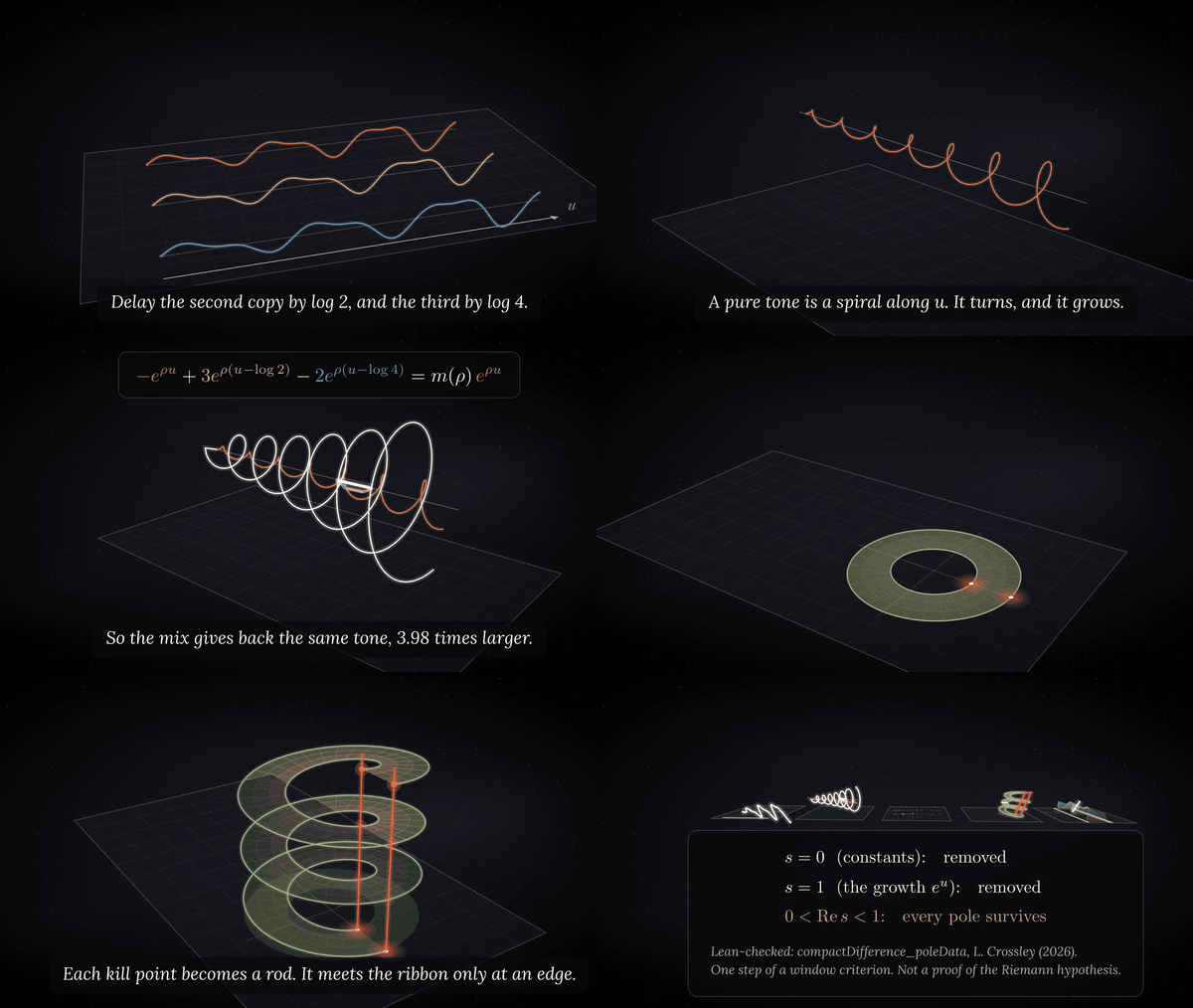
Take a curve g. Make three copies. Delay two of them by log 2 and log 4. Add the copies with weights −1, 3 and −2.
The weights sum to zero, so the mix cancels things. It does not cancel a pole of the transform of g that lies inside the critical strip 0 < Re s < 1.
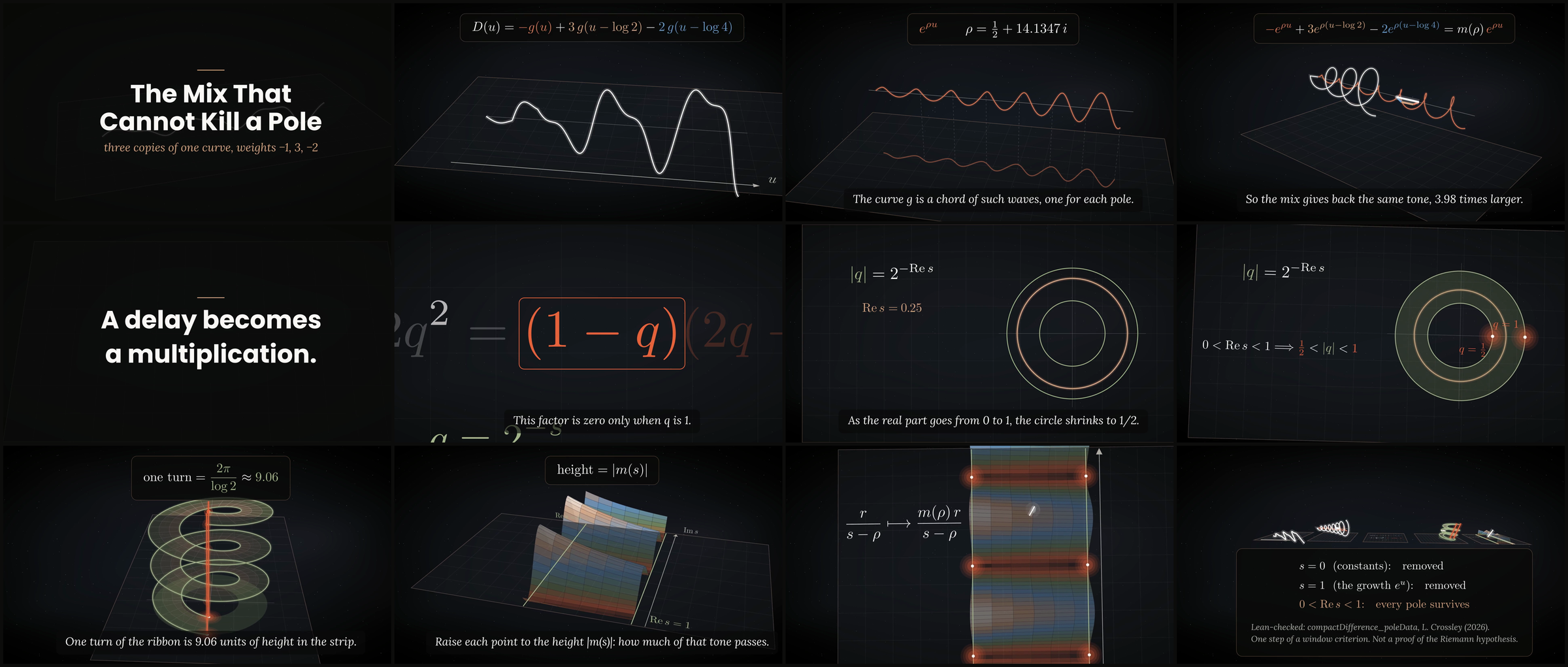
This 4-minute film shows why, in one continuous 3D world with five stations. The run also wrote an 11-page paper and a Lean file that prove the same statement.
Credit. The question and the mathematics are Lee Crossley's. All credit goes to his Lean file DelayedPole.lean in prime-window-rh-criterion. The film, the paper and the Lean file here only explain his result.
His result is one step of a conditional criterion. It is not a proof of the Riemann hypothesis.
The wall: 20 earlier films
Math-To-Manim turns frontier mathematics into verified 3D Manim and Blender films in a single CLI call. The film above is the newest one. These are 20 of the films that came before it.
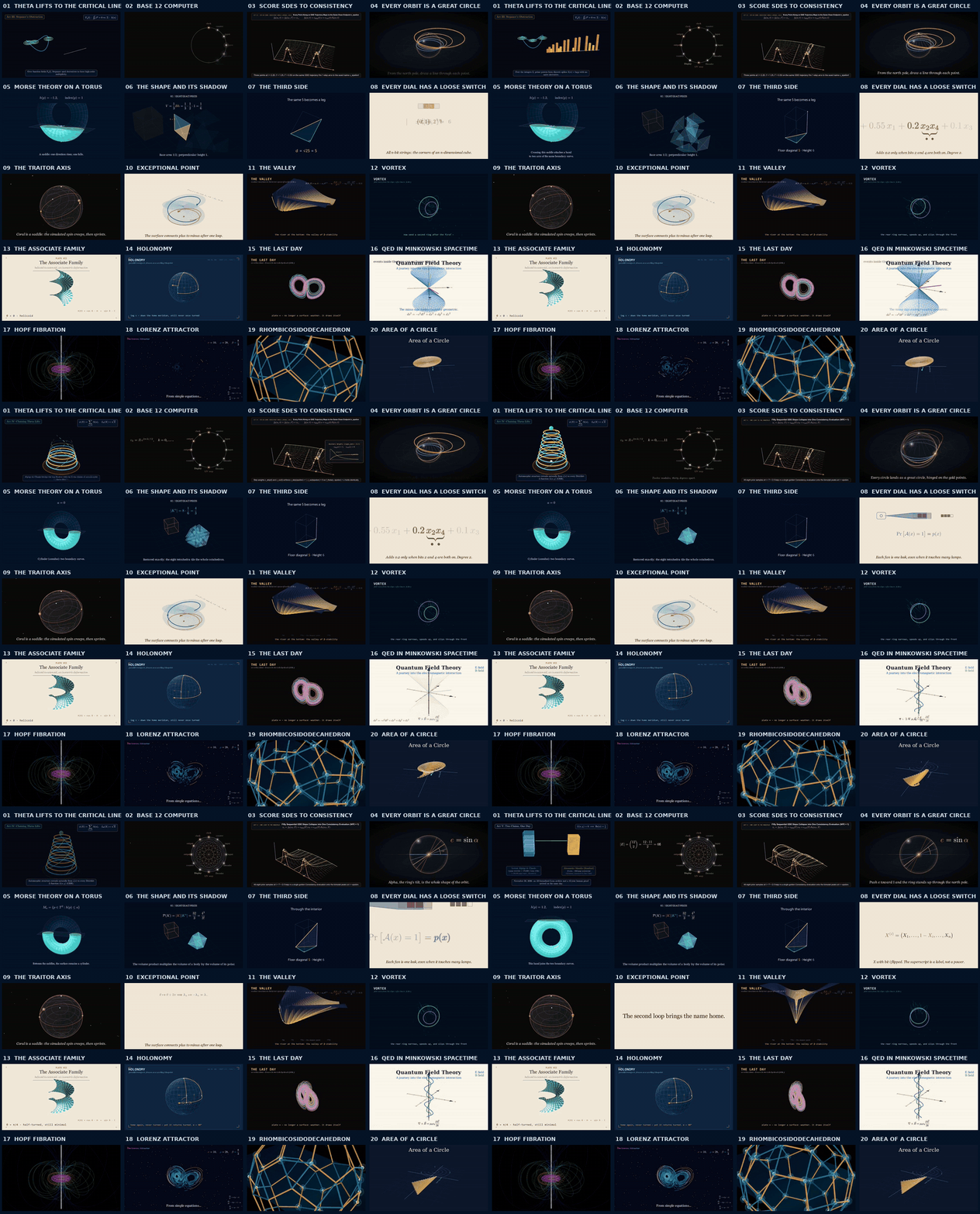
- 01 Chaining Theta Lifts to the Critical Line · 02 Base 12 Computer · 03 From Score SDEs to One-Step Consistency · 04 Every Orbit Is a Great Circle
- 05 Morse Theory on a Torus · 06 The Shape and Its Shadow · 07 The Third Side · 08 Every Dial Has a Loose Switch
- 09 The Traitor Axis · 10 Exceptional-point monodromy · 11 The Valley · 12 Vortex
- 13 The Associate Family · 14 Holonomy · 15 The Last Day · 16 QED in Minkowski Spacetime
- 17 Hopf Fibration · 18 Lorenz Attractor · 19 Rhombicosidodecahedron · 20 Area of a Circle
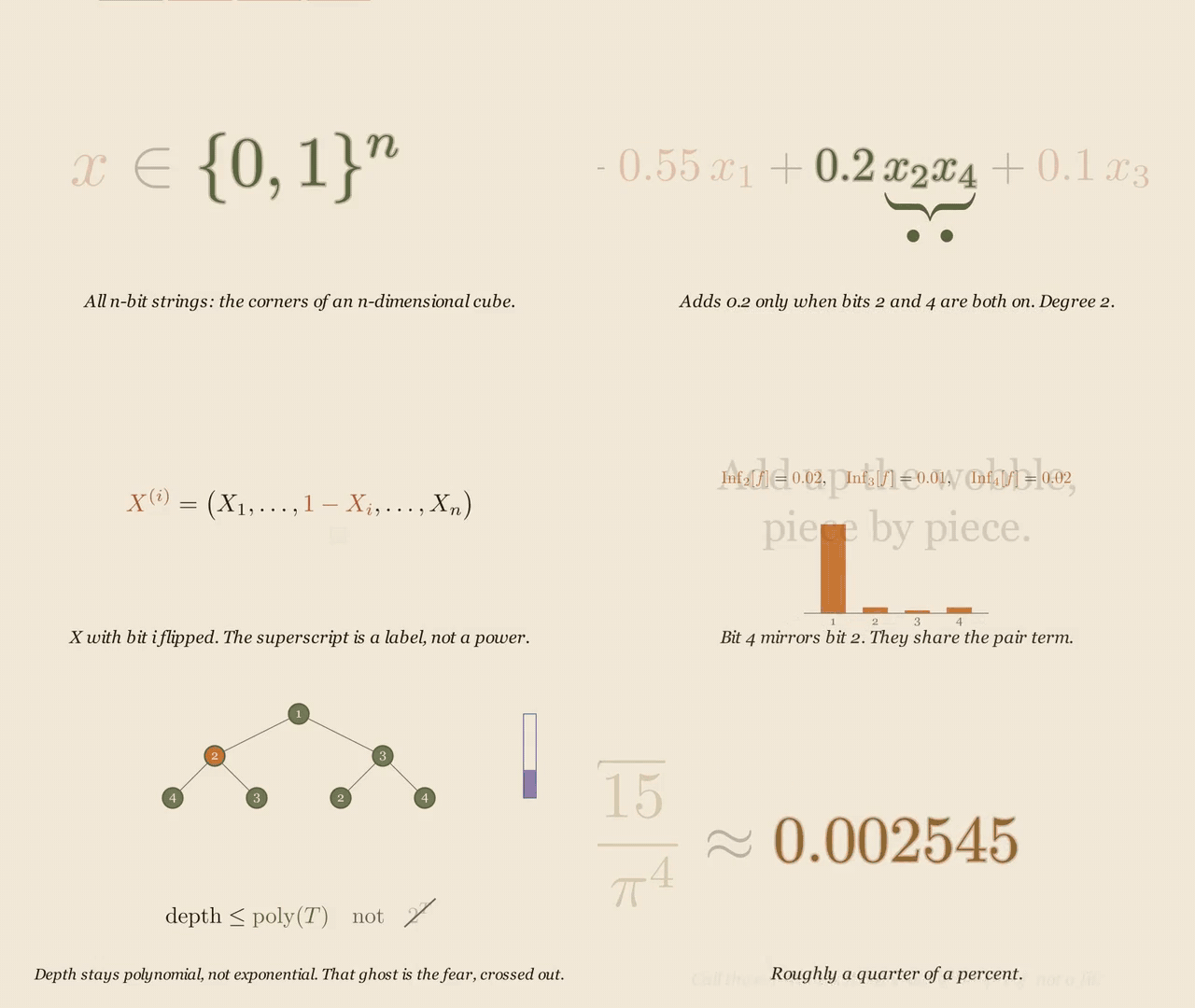

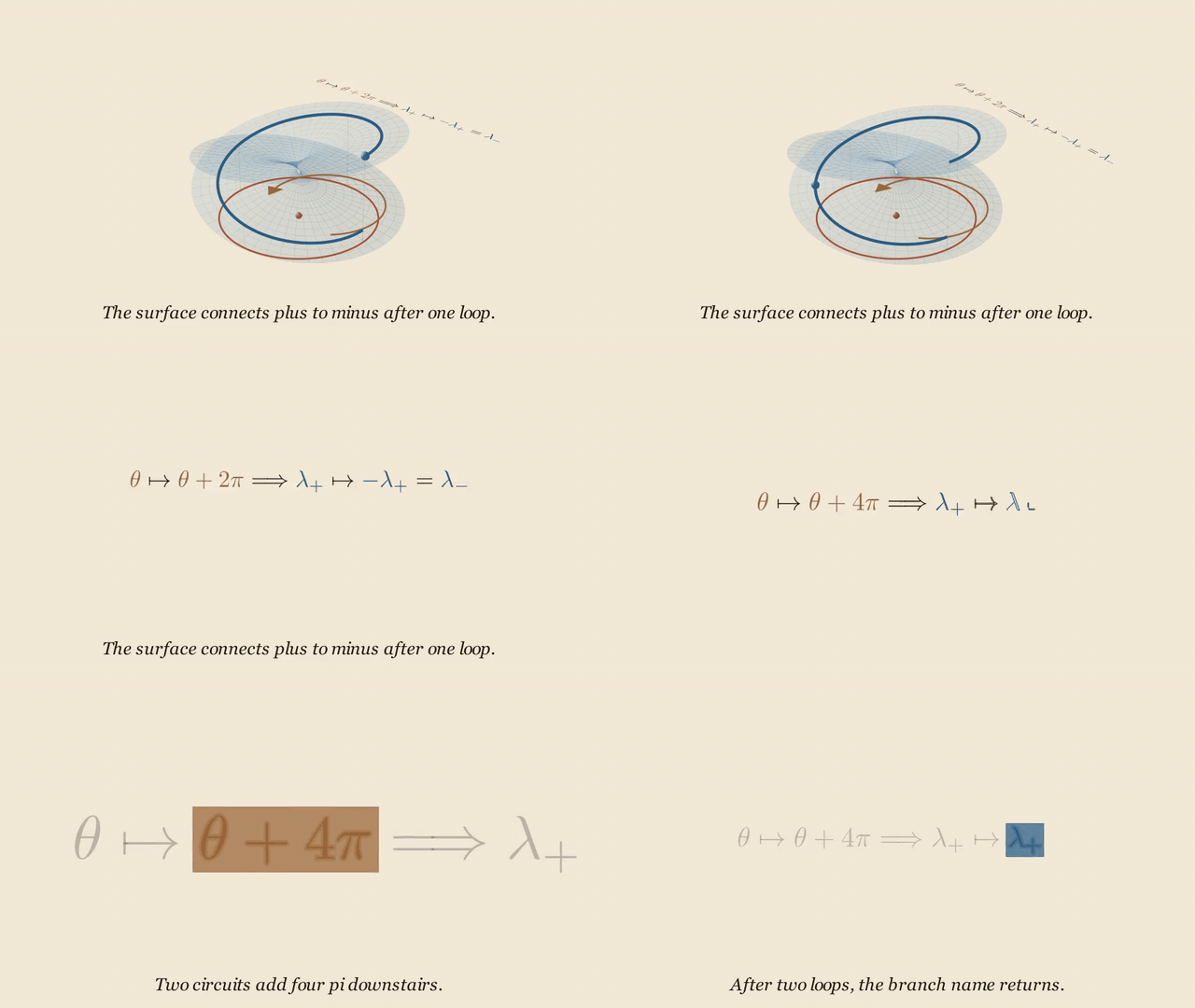





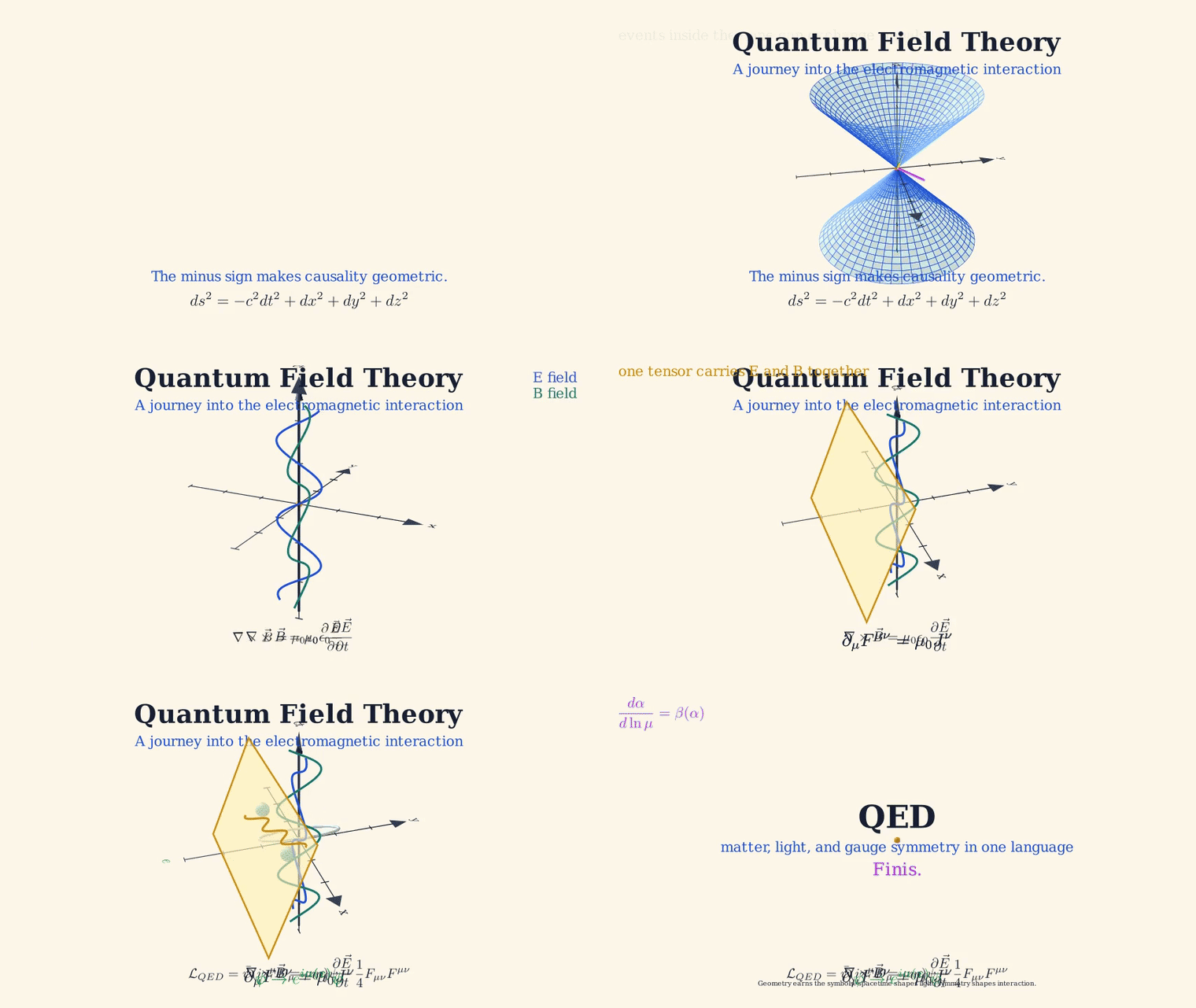
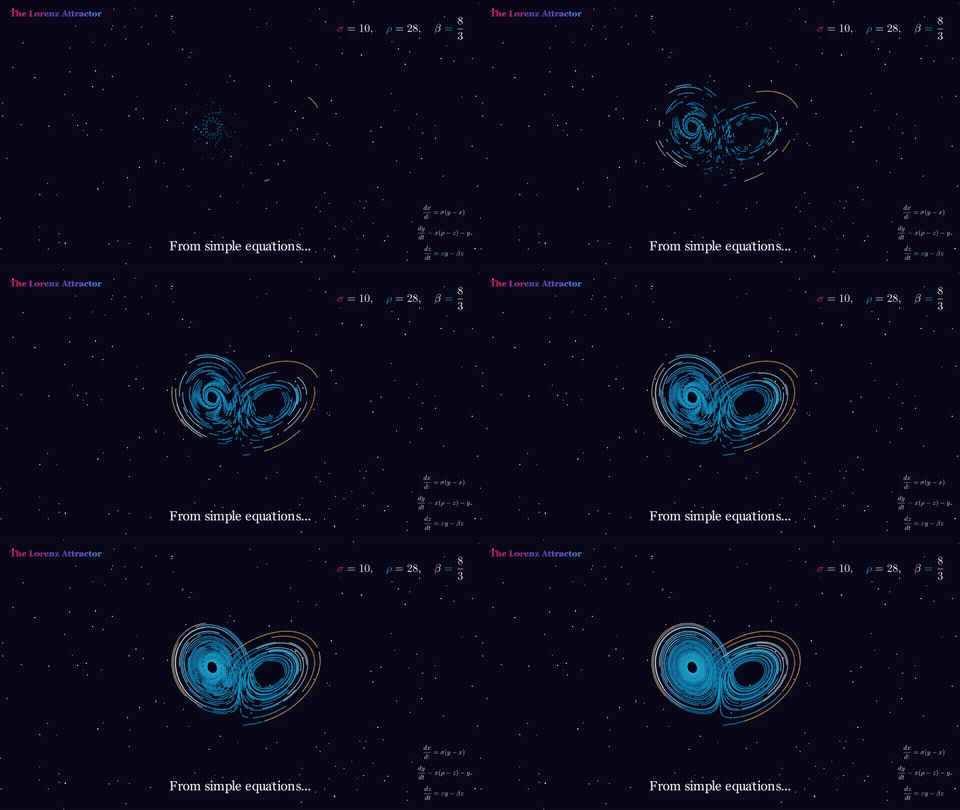
The numbers are the tile numbers. A link opens the full MP4, or the full GIF when the repo has no MP4. Also in the archive: Altermagnetism, Unit Distance Disproof and A Frontier for the Zeros.
The newer films come from separate model silos under src/: Claude Fable 5.2 and Claude Opus 5.5 (mythos, studio), Gemini 4 Neon (neon), Gemini 4 Argon (argon), and GPT-6 Astra with Jev (astra).
See docs/SHOWCASE.md for the complete archive of films, Studio Blender+Manim comparisons, Mythos MCP docs, and installation guides.
To rebuild the wall from the GIFs in the repo, run python scripts/build_gif_wall.py.




The Mix That Cannot Kill a Pole: how it was made, the paper and the Lean file
How it was made
- The input was Lee Crossley's question, with his
DelayedPole.leanas context. The art direction was: one 3D world, and a zoom into every formula. - A Claude Fable 5.2 session answered the six Mythos stages and codegen through
scripts/operate_mythos_chain.py. The harness validated each reply. - The chain wrote one Manim
ThreeDScene,PoleSurvivesTheMixJourney(844 lines). The static check rejected the first version: six\tfrac12fragments had no braces. - The harness rendered 187 animations at 1920 × 1080, 60 fps, in 891 seconds. The film is 264 seconds long. The GIF at the top of this page is 40 seconds of it.
- Two new companion stages wrote the paper and the Lean file (
docs/MYTHOS_COMPANIONS.md). The harness compiled the paper with pdflatex and checked the Lean file with Lean 4.33.1 and Mathlib. - The film has no narration. No independent reviewer checked the film or the paper.
The calculation, in the paper
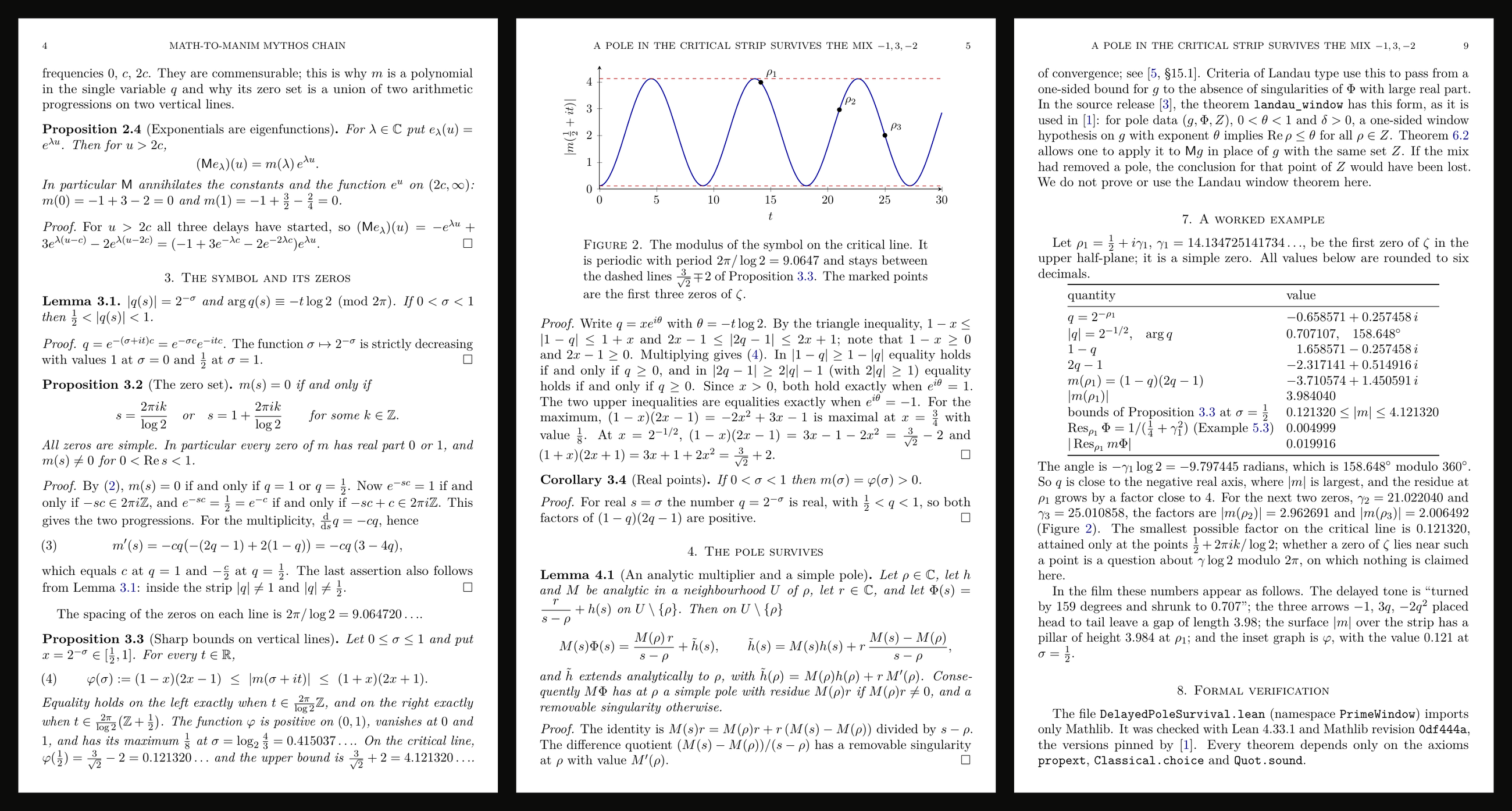
The mix, with delays that are zero before they start:
$$D(u) = -g(u) + 3,g(u-\log 2) - 2,g(u-\log 4)$$
A delay by $a$ multiplies the Laplace transform by $e^{-sa}$. So the mix multiplies the transform by one function, the symbol. Write $q = 2^{-s}$:
$$m(s) = -1 + 3\cdot 2^{-s} - 2\cdot 4^{-s} = -1 + 3q - 2q^2 = (1-q)(2q-1)$$
The symbol is zero only when $q = 1$ or $q = \tfrac{1}{2}$. The size of $q$ depends only on the real part of $s$:
$$|q| = 2^{-\mathrm{Re},s}, \qquad 0 < \mathrm{Re},s < 1 ;\Longrightarrow; \tfrac{1}{2} < |q| < 1$$
So every zero of $m$ is on a wall of the strip, and no zero is inside:
$$m(s) = 0 \iff s = \frac{2\pi i k}{\log 2} \ \text{ or }\ s = 1 + \frac{2\pi i k}{\log 2}, \quad k \in \mathbb{Z}$$
The triangle inequality gives a floor and a ceiling on each vertical line $\mathrm{Re},s = \sigma$, with $x = 2^{-\sigma}$:
$$(1-x)(2x-1) ;\le; |m(\sigma + it)| ;\le; (1+x)(2x+1)$$
Near a pole, the transform is $r/(s-\rho)$ plus an analytic part. The symbol is entire, so the pole stays and only the residue changes:
$$m(s),\frac{r}{s-\rho} = \frac{m(\rho),r}{s-\rho} + r,\frac{m(s)-m(\rho)}{s-\rho}, \qquad m(\rho),r \ne 0$$
The worked example of the paper, at the first zeta zero $\rho_1 = \tfrac{1}{2} + 14.134725,i$:
| Quantity | Value |
|---|---|
| $q = 2^{-\rho_1}$ | $-0.658571 + 0.257458,i$ |
| $\lvert q\rvert = 2^{-1/2}$, $\arg q$ | $0.707107$, $158.648^\circ$ |
| $1 - q$ | $1.658571 - 0.257458,i$ |
| $2q - 1$ | $-2.317141 + 0.514916,i$ |
| $m(\rho_1) = (1-q)(2q-1)$ | $-3.710574 + 1.450591,i$ |
| $\lvert m(\rho_1)\rvert$ | $3.984040$ |
| floor and ceiling on the critical line, $3/\sqrt2 \mp 2$ | $0.121320$ and $4.121320$ |
| residue of the transform at $\rho_1$, $1/(\tfrac{1}{4} + \gamma_1^2)$ | $0.004999$ |
| size of the residue after the mix | $0.019916$ |
The pole of the first zeta zero becomes about 4 times larger. The paper also shows that the two zeros on the walls are necessary: they are what makes the weight of the mix a compact tent on (1, 4).
The same calculation, in Lean
The file DelayedPoleSurvival.lean imports only Mathlib. It has no sorry. Its theorems use the axioms propext, Classical.choice and Quot.sound only.
The Lean reference is Lee Crossley's DelayedPole.lean (CC BY 4.0). Read his file first: it is the original, and it has the application to Dirichlet families that our file does not have.
Our file restates his definitions delay, compactDifference (here mix) and symbol. It adapts his proofs of laplace_delay, symbol_real (here symbol_pos_of_real) and compactDifference_poleData (here mix_poleData).
The three definitions:
/-- Delay `g` by `a`, and put zero where the delayed curve has not started. -/
def delay (a : ℝ) (g : ℝ → ℝ) (u : ℝ) : ℝ := if a < u then g (u - a) else 0

/-- Three copies of `g` with delays `0`, `c`, `2c` and weights `-1`, `3`, `-2`. -/
def mix (c : ℝ) (g : ℝ → ℝ) (u : ℝ) : ℝ :=
  -delay 0 g u + 3 * delay c g u - 2 * delay (2 * c) g u

/-- The multiplier of the mix on the Laplace side. With `c = log 2` and
`q = 2^(-s)` this is `(1 - q)(2q - 1)`. -/
def symbol (c : ℝ) (s : ℂ) : ℂ := (1 - cexp (-s * c)) * (2 * cexp (-s * c) - 1)
The radius of q, and the strip that goes into the annulus:
/-- `|e^(-sc)| = e^(-Re(s) c)`: the radius of `q` depends only on `Re s`. -/
theorem norm_q (c : ℝ) (s : ℂ) : ‖cexp (-s * (c : ℂ))‖ = Real.exp (-s.re * c) := by
  simp [Complex.norm_exp]

/-- The strip `0 < Re s < 1` goes into the open annulus `1/2 < |q| < 1`. -/
theorem q_mem_annulus {s : ℂ} (h0 : 0 < s.re) (h1 : s.re < 1) :
    1 / 2 < ‖cexp (-s * (Real.log 2 : ℂ))‖ ∧ ‖cexp (-s * (Real.log 2 : ℂ))‖ < 1 := by
  rw [norm_q]; exact radius_bounds h0 h1
The floor (statement only; the proof is 12 lines), and the theorem that the symbol has no zero inside the strip:
/-- The quantitative floor: on the line `Re s = σ`, `0 < σ < 1`,
`|m(s)| ≥ (1 - 2^(-σ)) (2·2^(-σ) - 1) > 0`. -/
theorem symbol_norm_lower {s : ℂ} (h0 : 0 < s.re) (h1 : s.re < 1) :
    (1 - Real.exp (-s.re * Real.log 2)) * (2 * Real.exp (-s.re * Real.log 2) - 1)
      ≤ ‖symbol (Real.log 2) s‖

/-- **No blind spot inside the strip.** The symbol has no zero with `0 < Re s < 1`. -/
theorem symbol_ne_zero {s : ℂ} (h0 : 0 < s.re) (h1 : s.re < 1) :
    symbol (Real.log 2) s ≠ 0 :=
  norm_pos_iff.mp (lt_of_lt_of_le (floor_pos h0 h1) (symbol_norm_lower h0 h1))
The pole survives:
/-- **The pole survives the mix.** A simple pole of `Φ` at a point `ρ` of the
open strip, with residue `r ≠ 0`, is a simple pole of `m·Φ` with the nonzero
residue `m(ρ) r`. -/
theorem pole_survives_mix {Φ h : ℂ → ℂ} {ρ r : ℂ} (h0 : 0 < ρ.re) (h1 : ρ.re < 1)
    (hr : r ≠ 0) (hh : AnalyticAt ℂ h ρ)
    (hΦ : ∀ᶠ s in 𝓝[≠] ρ, Φ s = r / (s - ρ) + h s) :
    symbol (Real.log 2) ρ * r ≠ 0 ∧ ∃ h' : ℂ → ℂ, AnalyticAt ℂ h' ρ ∧
      ∀ᶠ s in 𝓝[≠] ρ, symbol (Real.log 2) s * Φ s =
        (symbol (Real.log 2) ρ * r) / (s - ρ) + h' s :=
  ⟨mul_ne_zero (symbol_ne_zero h0 h1) hr,
    pole_transfer (symbol_differentiable _) hh hΦ⟩
The file also evaluates the numbers in floating point. This is a test, not a proof. The comment on each #eval line is the value that Lean printed:
/-- `q = 2^(-s)` at `s = σ + i t`: radius `2^(-σ)`, angle `-t log 2`. -/
def q (σ t : Float) : Cx :=
  let r := Float.exp (-(σ * log2))
  ⟨r * Float.cos (t * log2), -(r * Float.sin (t * log2))⟩

/-- The symbol `m(s) = (1 - q)(2q - 1)` at `s = σ + i t`. -/
def symbolF (σ t : Float) : Cx :=
  let z := q σ t
  Cx.mul ⟨1 - z.re, -z.im⟩ ⟨2 * z.re - 1, 2 * z.im⟩

#eval (q 0.5 gamma1).re                     -- -0.658571
#eval (q 0.5 gamma1).im                     -- 0.257458
#eval (q 0.5 gamma1).abs                    -- 0.707107
#eval (symbolF 0.5 gamma1).re               -- -3.710574
#eval (symbolF 0.5 gamma1).im               -- 1.450591
#eval (symbolF 0.5 gamma1).abs              -- 3.984040
#eval floorF 0.5                            -- 0.121320
#eval gridMinRatio                          -- 1.000000
#eval gridMinAbs                            -- 0.003454
#eval 2 * 3.141592653589793 / log2          -- 9.064720
More theorems are in the file: laplace_delay and laplace_mix (a delay, and the mix, are multiplications on the Laplace side), symbol_zero_left and symbol_zero_right (both walls carry zeros), tent_eq (the tent weight), and mix_poleData, a Mathlib-only version of Crossley's compactDifference_poleData.
The numbers of the scene are tested in tests/test_pole_survives_the_mix.py.
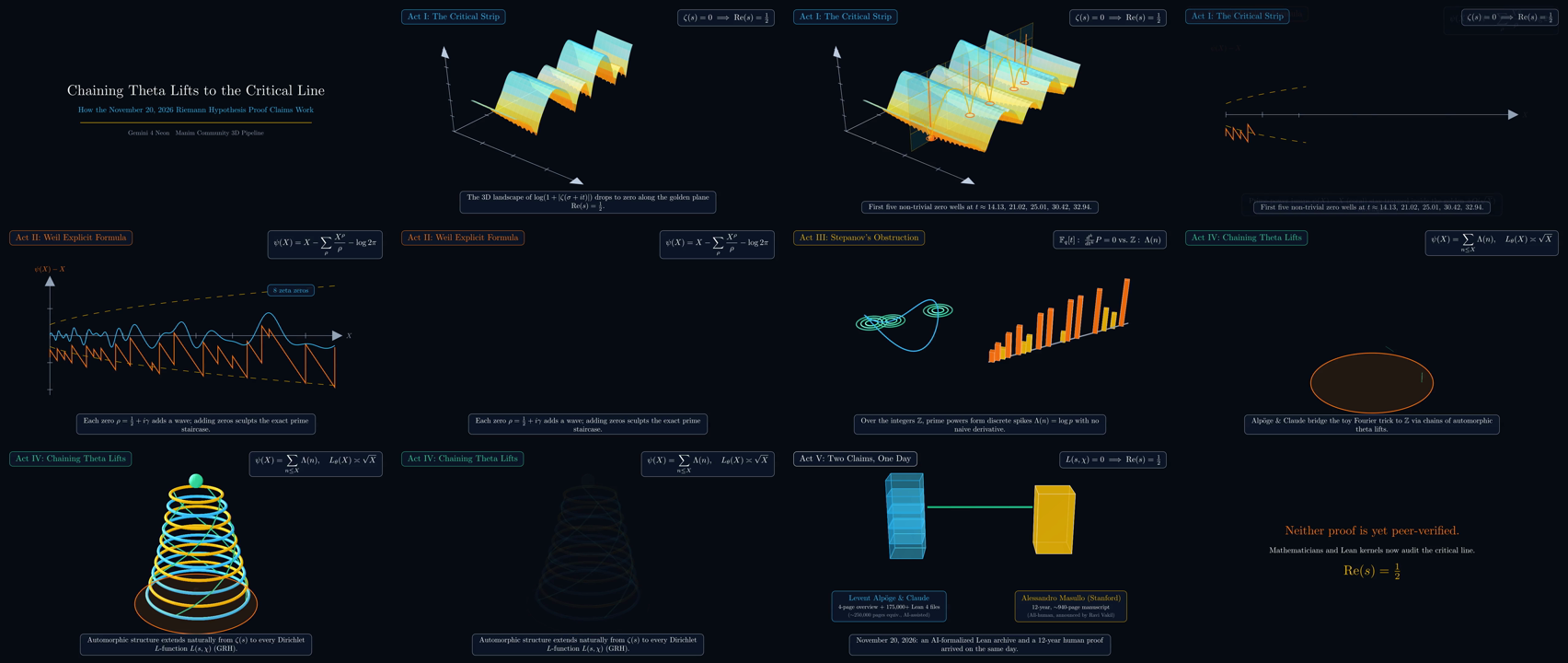
Featured: Chaining Theta Lifts to the Critical Line (math-to-manim-neon)
On November 20, 2026, two separate claimed proofs of the Generalized Riemann Hypothesis were announced on the same day:
- Levent Alpöge & Claude (Anthropic): 4-page overview + 175,000+ Lean 4 files (~250,000 pages equivalent) bypassing the missing integer derivative in Stepanov's method by chaining roughly $\sqrt{X}$ automorphic theta lifts for a von Mangoldt sum of length $X$.
- Alessandro Masullo (Stanford, announced by Ravi Vakil): 12-year, ~940-page all-human manuscript vetted by Brian Conrad.
Both claims are newly announced and await independent peer and formal-kernel verification.
How the Gemini 4 Neon-first CLI (src/neon/) works
Instead of splitting reasoning across six sequential JSON-handoff stages, math-to-manim-neon unifies planning, numerical verification, codegen, static scene checks, Manim rendering, and showcase publishing into one CLI call:
- Pluggable Neon backends (
src/neon/backends.py): nativegoogle-genaiSDK (gemini-4-neonwithThinkingConfig+ live function calling), officialgemini-apiCLI, or session-drivenoperatormode. - First-class toolbelt (
src/neon/tools.py):verify_math: sandboxed real & complex NumPy/AST numerical evaluator.check_scene: AST syntax,ThreeDScenecamera discipline, and banned-import guard.render_scene: secret-scrubbed Manim render +ffprobe+ 12-frame contact sheet & highlights GIF.publish_film: writes showcase assets and production logs (01_neon_plan.json,tool_calls.jsonl,validation.json,manifest.json).
- This film:
RiemannThetaLiftJourney(421 lines) passed all 5verify_mathchecks andcheck_scenewith 0 repairs (outcome: film_published).
Featured: Base 12 Computer — From a Notebook Sketch
Watch the complete film (104 s, 720p30) · Original pencil sketch · Generated ThreeDScene (316 lines)
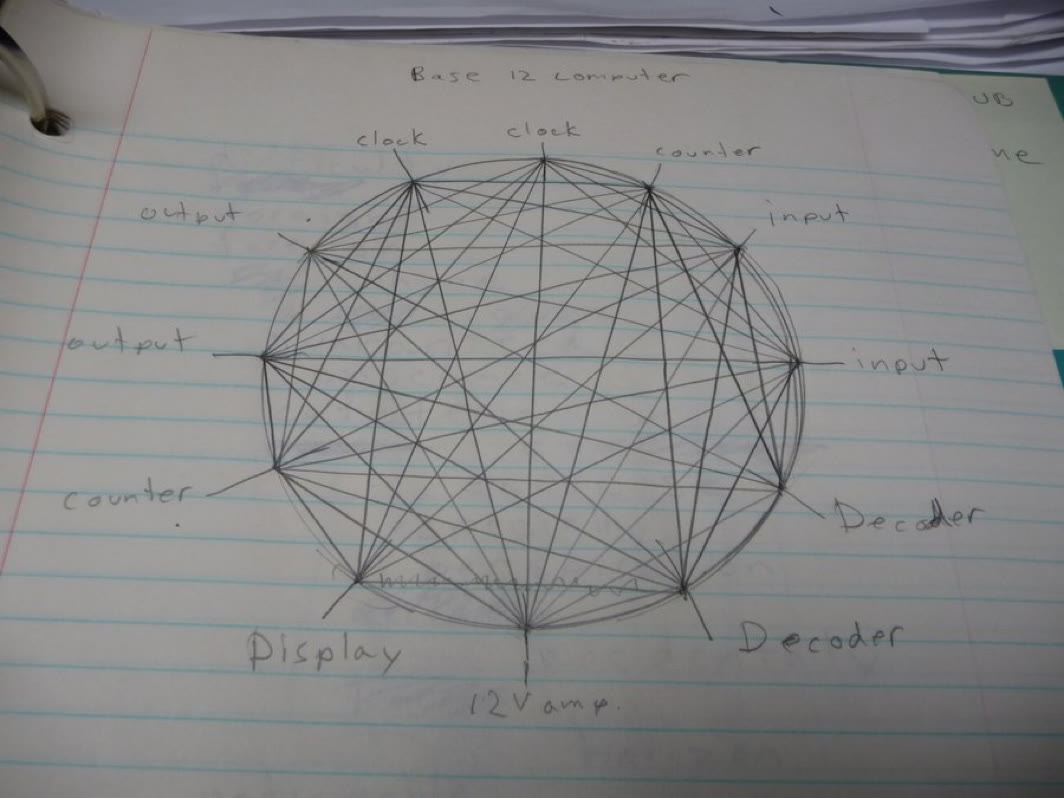
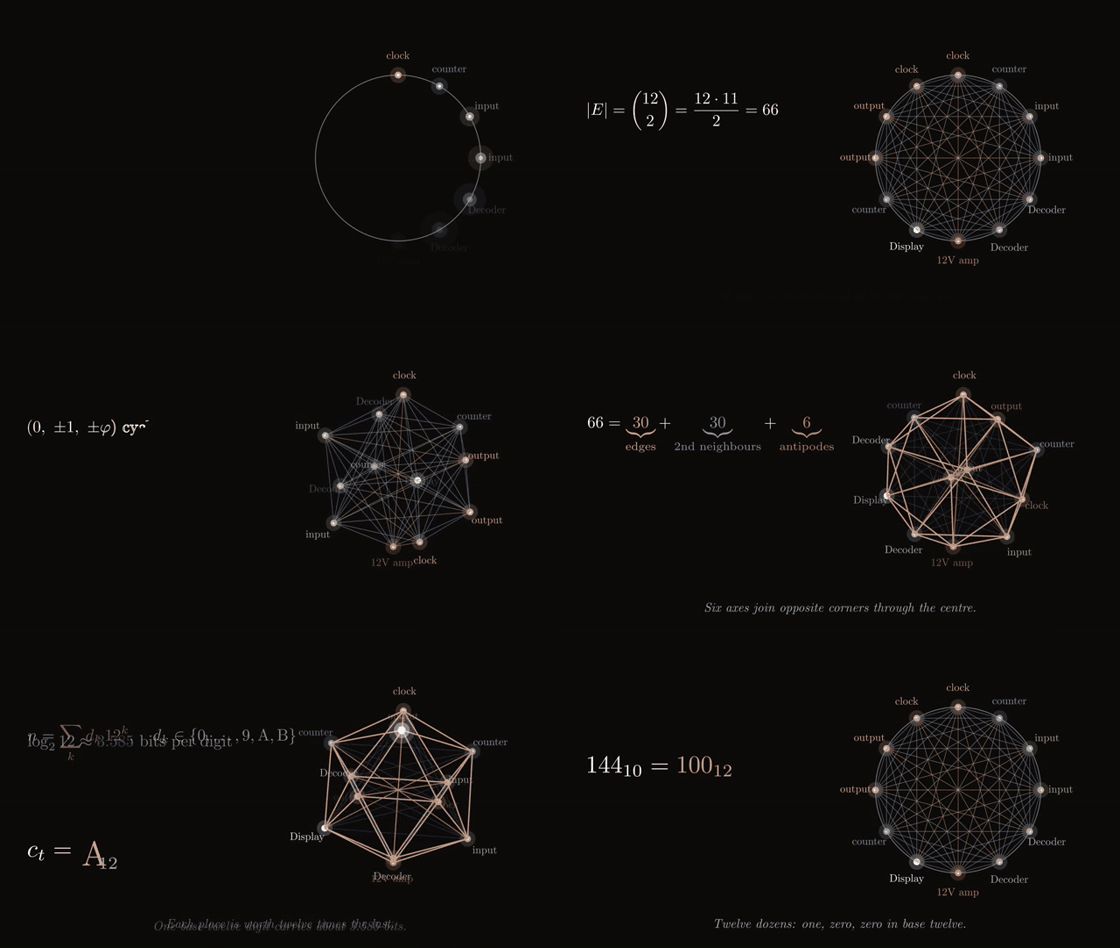
Made from a single photograph of a notebook page with zero formulas written on it: Claude Fable 5.2 recognized $K_{12}$ with $\binom{12}{2}=66$ wires, folded it onto an icosahedron ($66 = 30 + 30 + 6$), and rendered a base-12 counter on the first attempt with zero repairs.
Architecture & Testing
Every provider lives in an independent silo under src/ (neon, studio, mythos, argon, astra, grok, glm, mimo, sol) with strict zero-cross-import boundaries:
pytest tests/test_silo_boundaries.py tests/test_neon_silo.pyFull documentation for all silos, Studio (Blender EEVEE + Manim), Mythos MCP, and Astra+Jev lives in docs/SHOWCASE.md.
License
MIT — see LICENSE.