📄 Paper | arXiv | 🌐 Project Page | 🤗 Discussion | 简体中文
Haojian Huang1,2 , Zexi Li1,3 , Junhao Guo1 , Yehang Zhang1,2 , Wenxuan Peng1,4 , Bohan Zhou1,3 ,1,3 , Leyi Wu1,2 , Chenxu Wang1,5 , Jianchong Su1,2 , Binghui Xie1,3 , Wosong Chen1,2 ,1,2 , Tianhao Zhou1,2 , Suzeyu Chen1,2 , Pukun Zhao1 , Jiaqi He1 , Xinyi Li1,3 ,7 , Peiran Dong1,3 , Shaoxiang Dang1 , Jing Huang1 , Yingbing Chen1 , Yifan Chang1 ,1 , Shiyuan Deng1 , Haozhi Wang1 , Yangkai Wei1 , Wenqian Li1 , Han Yang1 ,1 , Huaping Liu5 , James Cheng3 , Rui Shao6 , Donglin Wang7 , Yaochu Jin7 ,8 , Ying-Cong Chen1,2,* , Yinchuan Li1,*
1 Knowin AI · 2 HKUST(GZ) · 3 The Chinese University of Hong Kong4 Tongji University · 5 Tsinghua University6 Harbin Institute of Technology, Shenzhen · 7 Westlake University · 8 Tianjin University
* Corresponding authors
This is the official repository for In-Context Learning for Robots: Methods and Applications
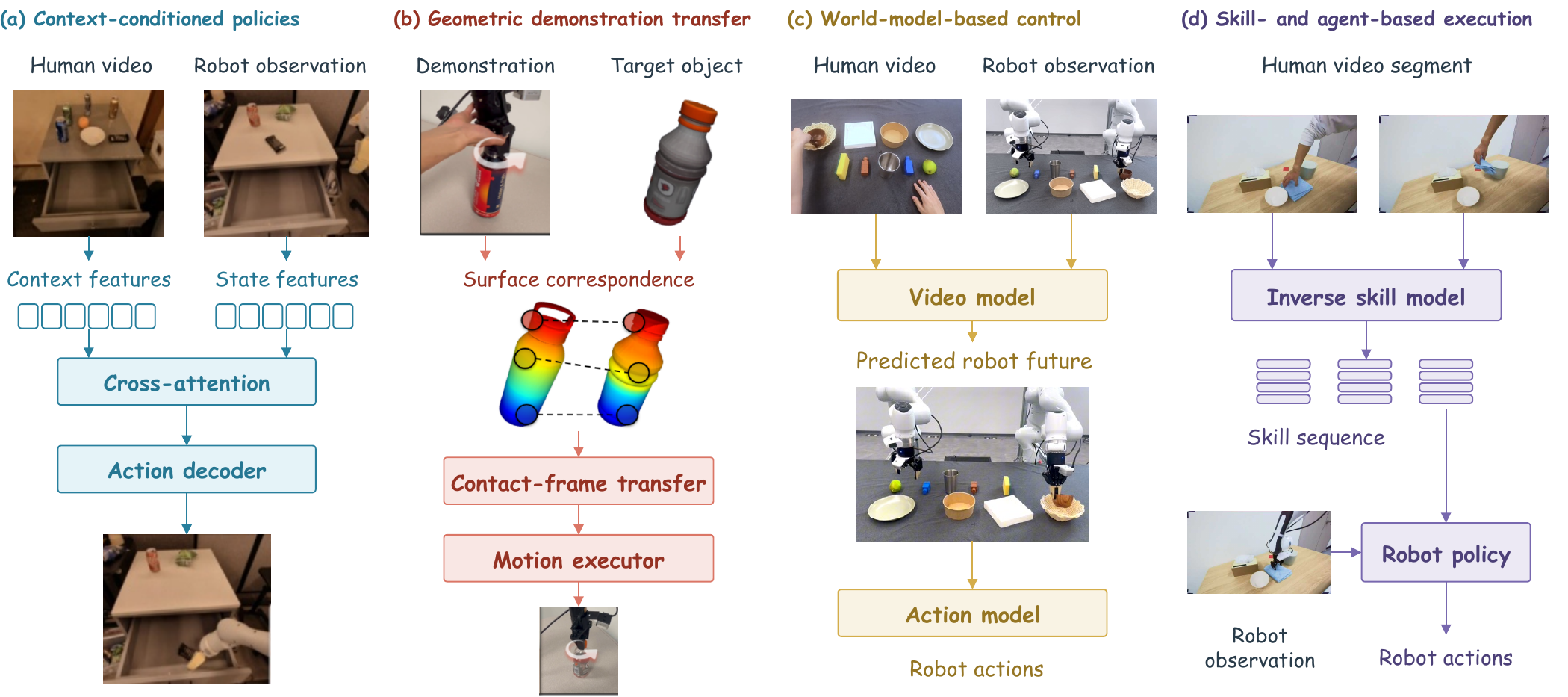
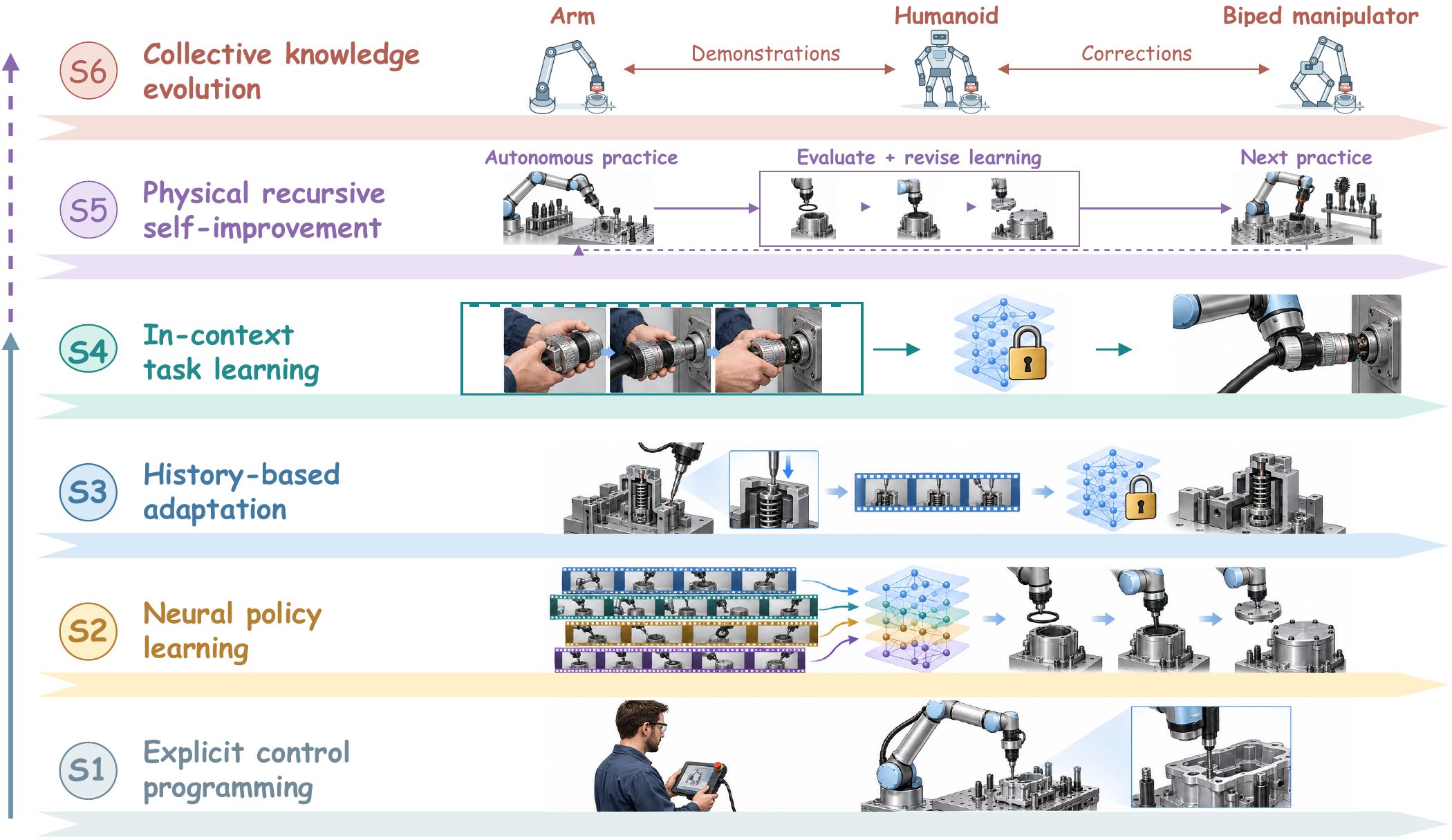
How can robots use demonstrations, instructions, and interaction to perform new tasks without retraining for each one? Our survey organizes this question around how context becomes action : through conditioned policies, geometric transfer, world-model-based control, or skill and agent execution. We compare the transfer assumptions behind these interfaces and the roles of training, correspondence, and memory. The discussion connects manipulation and navigation to execution feedback, experience reuse, and evaluation. This repository maintains the accompanying collection of papers, technical reports, datasets, and code, currently covering 582 works .
Reading guide
This robotics in-context learning survey follows how contextual evidence becomes physical action. The project-page guide introduces the definition, adaptation regimes, and evaluation questions.
Why context? Demonstrations specify a task; interaction reveals hidden state or dynamics. Section 2 distinguishes these information sources from prior motor competence and task-specific fine-tuning.How does it change action? Section 3 compares action distributions, motion references, predicted futures, and executable procedures, together with their correspondence and memory requirements.When does it help? Section 7 connects responsiveness to teaching, physical transfer, and retained-experience benefits to measurable evaluation conditions.How can learning improve? Section 8.5 connects active coaching with verified self-reflection: choosing useful teaching and retaining transferable skills, with RoboCoach and RoboRSI as concrete starting points.
The paper information page contains the complete abstract of the current author revision and citation exports. The catalogue is updated independently of published paper versions; comparison branches include neighboring methods where they clarify a context-learning mechanism.
📢 Latest News
Survey Overview
The four families differ in where contextual evidence enters the control process. This makes their transfer assumptions comparable: what must survive a change of scene—the taught requirement, a geometric relation, a predicted outcome, or an executable procedure?
Method family What does context determine? Main operations Context-conditioned policies Action distribution Condition, retrieve, refine Geometric demonstration transfer Poses, contacts, and motion references Align, retarget, track World-model-based control Predicted or simulated futures Predict, plan, decode Skill- and agent-based execution Skills, programs, and tool calls Select, compose, verify
Navigation is organized by route demonstrations, environment observations, decision examples, and outcome feedback. Physical self-improvement is organized by what experience changes. Supporting sections cover correspondence and memory , data acquisition , training , failure assessment , and evaluation , with foundations and related surveys providing historical context.
📚 Paper List
Within each subcategory, papers are ordered by first public release, newest first ; a year alone indicates an unconfirmed month. Entries link to the original paper or technical report and available code. Foundation models, training methods, and parameter adaptation appear as comparisons in their relevant branches; subcategory headings identify these different roles.
01 · Context-conditioned policies
Demonstration-conditioned action generation · Spatial correspondence and action representations · Action retrieval and refinement · Interaction history and physical adaptation · Memory and long-context policies · Pretrained policies and cross-task competence · Parameter adaptation and policy improvement
Demonstration-conditioned action generation
Date Title Paper Code 2026‑09 GLOW: A Generative Learning Framework for General-Purpose Embodied Intelligence — 2026‑09 RoboICL: Embodied In-Context Learning with GPT-6 Astra Code 2026‑09 ICI-VLA: In-Context Imitation with Spatiotemporally Aligned Demonstrations for Vision-Language-Action Models — 2026‑09 ContextFlow: In-Context Flow Matching for Robot Manipulation Code 2026‑08 PonderPounce: A Pretrained MLLM as an Episode Context Engine for Robot Control Code 2026‑08 GEN-1.5: Embodied Foundation Models are One-Shot Learners — 2026‑08 Introducing S1: In-Context Learning for Robotics — 2026‑08 Task-Prototype Guided Flow Matching for Few-Shot Generalization in Vision-Language Robot Manipulation — 2026‑08 StellaVLA: In-Context Structured Demonstration for Generalizable Vision-Language-Action Models — 2026‑06 What Enables In-Context Behavior Prompting for Manipulation? Code 2026‑06 SynthICL: Scalable In-context Imitation Learning with Synthetic Data — 2026‑06 Instant-Fold: In-Context Imitation Learning for Deformable Object Manipulation Code 2026‑06 SeeTraceAct: Visibility-Aware Latent Planning from Cross-Embodiment Demonstration Videos — 2026‑04 A Hierarchical Spatiotemporal Action Tokenizer for In-Context Imitation Learning in Robotics — 2026‑03 ICLR: In-Context Imitation Learning with Visual Reasoning Code 2026‑02 Mimic Intent, Not Just Trajectories Code 2025‑12 See Once, Then Act: Vision-Language-Action Model with Task Learning from One-Shot Video Demonstrations — 2025‑09 RoboSSM: Scalable In-context Imitation Learning via State-Space Models Code 2025‑09 MimicDroid: In-Context Learning for Humanoid Robot Manipulation from Human Play Videos Code 2025‑08 RICL: Adding In-Context Adaptability to Pre-Trained Vision-Language-Action Models (CoRL 2025) Code 2025‑05 Learning Generalizable Robot Policy with Human Demonstration Video as a Prompt — 2025‑03 Action Tokenizer Matters in In-Context Imitation Learning Code 2024‑09 One-Shot Imitation under Mismatched Execution Code 2024‑08 In-Context Imitation Learning via Next-Token Prediction Code 2024‑03 Vid2Robot: End-to-end Video-conditioned Policy Learning with Cross-Attention Transformers — 2022‑10 VIMA: General Robot Manipulation with Multimodal Prompts Code 2022‑02 BC-Z: Zero-Shot Task Generalization with Robotic Imitation Learning — 2021‑10 Towards More Generalizable One-shot Visual Imitation Learning Code 2020‑11 Transformers for One-Shot Visual Imitation Code 2020‑10 Path-Following Navigation Network Using Sparse Visual Memory — 2019‑11 Learning One-Shot Imitation from Humans without Humans — 2018‑12 Visual Memory for Robust Path Following — 2018‑10 Task-Embedded Control Networks for Few-Shot Imitation Learning — 2018‑04 Zero-Shot Visual Imitation Code 2017‑03 One-Shot Imitation Learning —
Spatial correspondence and action representations
Date Title Paper Code 2026‑08 MatchingPolicy: Correspondence-Aware Policy Enables Cross-Object In-Context Learning — 2026‑08 VLAff: Vision-Language-Affordance Model for Unified Actionable Affordances — 2026‑04 Bimanual Robot Manipulation via Multi-Agent In-Context Learning (CoRL 2026) Code · Data 2025‑06 Robust Instant Policy: Leveraging Student's t-Regression Model for Robust In-context Imitation Learning of Robot Manipulation — 2025‑02 Point Policy: Unifying Observations and Actions with Key Points for Robot Manipulation Code 2025‑01 SpatialVLA: Exploring Spatial Representations for Visual-Language-Action Model Code 2024‑11 Instant Policy: In-Context Imitation Learning via Graph Diffusion Code 2024‑10 In-Context Learning Enables Robot Action Prediction in LLMs Code 2024‑10 Keypoint Abstraction using Large Models for Object-Relative Imitation Learning Code 2024‑08 NOLO: Navigate Only Look Once Code 2024‑03 Keypoint Action Tokens Enable In-Context Imitation Learning in Robotics —
Action retrieval and refinement
Date Title Paper Code 2026‑10 RESETTLE: Robotic Recovery through Disagreement-Triggered Retrieval and Efficient Corrective Control — 2026‑10 RoboPrompt: Intuitive Robot Policy Steering with Sparse Human Input Code 2026‑09 Causeway: Restoring Task Accessibility for Instruction Switching in VLA Policies — 2026‑09 Training-free Behavior Cloning — 2026‑09 TraceFlow: Guiding Frozen Flow-Matching Robot Policies with Success and Failure Traces — 2026‑09 SkipVLA: Skipping VLA Steps with Classical Planning for Fast Robot Manipulation — 2026‑09 UniMPA: A Unified Memory-Prediction-Action Model via Action-Grounded Transition Modeling Code 2026‑08 Retrieve in Time, Correct in Frequency — 2026‑03 SAIL: Test-Time Scaling for In-Context Imitation Learning with VLM — 2025‑06 DemoDiffusion: One-Shot Human Imitation using pre-trained Diffusion Policy Code 2025‑06 RoboMonkey: Scaling Test-Time Sampling and Verification for Vision-Language-Action Models — 2025‑06 Adapting by Analogy: OOD Generalization of Visuomotor Policies via Functional Correspondence — 2024‑12 REGENT: A Retrieval-Augmented Generalist Agent That Can Act In-Context in New Environments Code 2021‑12 The Surprising Effectiveness of Representation Learning for Visual Imitation Code
Interaction history and physical adaptation
Date Title Paper Code 2026‑10 CAPABLE: Capability-Aware Policy Adaptation via Behavioral Latent Encoding — 2026‑09 Test-Time Adaptation of Manipulation Policies Under Actuator Degradation Code 2026‑09 HIRE: History-Conditioned Interaction Reasoning and High-Rate Execution for Visually Aliased Precision Manipulation — 2026‑09 Self-Adaptive VLA for Robust Robot Deployment — 2026‑09 Zeva-Ego: Egocentric Mid-Training with In-Context Causal Learning for Robot Manipulation Code 2026‑09 RopeFormer: Cross-Trial Adaptation from Interaction History for Dynamic Rope Manipulation — 2026‑09 TEMPO: Learning Temporal Context for Dynamic Robot Manipulation Code 2026‑09 CR-VLA-Force: Learning Control-aware Compliance VLA Model for Robust Contact-rich Robotic Manipulation — 2026‑08 Zeva: In-Context Causal Learning for Generalizable Embodied Manipulation Code 2026‑08 TacForcing: Streaming Action Generation with Execution-Time Tactile Feedback — 2026‑06 In-Context World Modeling for Robotic Control — 2026‑04 AdaTracker: Learning Adaptive In-Context Policy for Cross-Embodiment Active Visual Tracking — 2026‑04 Gated Memory Policy: In-Context Memorization and Adaptation Code 2025‑09 LocoFormer: Generalist Locomotion via Long-context Adaptation — 2025‑07 Behavioral Exploration: Learning to Explore via In-Context Adaptation — 2024‑10 ReLIC: A Recipe for 64k Steps of In-Context Reinforcement Learning for Embodied AI Code 2023‑10 AMAGO: Scalable In-Context Reinforcement Learning for Adaptive Agents Code 2022‑10 In-context Reinforcement Learning with Algorithm Distillation — 2022‑06 Prompting Decision Transformer for Few-Shot Policy Generalization Code 2022‑06 Robust Task Representations for Offline Meta-Reinforcement Learning via Contrastive Learning Code 2021‑07 RMA: Rapid Motor Adaptation for Legged Robots Code 2020‑11 Modeling Task Uncertainty for Safe Meta-Imitation Learning — 2020‑10 FOCAL: Efficient Fully-Offline Meta-Reinforcement Learning via Distance Metric Learning and Behavior Regularization Code 2020‑06 MetaCURE: Meta Reinforcement Learning with Empowerment-Driven Exploration — 2019‑10 VariBAD: A Very Good Method for Bayes-Adaptive Deep RL via Meta-Learning Code 2019‑06 Watch, Try, Learn: Meta-Learning from Demonstrations and Reward — 2019‑03 Efficient Off-Policy Meta-Reinforcement Learning via Probabilistic Context Variables Code 2017‑07 A Simple Neural Attentive Meta-Learner — 2017‑02 Preparing for the Unknown: Learning a Universal Policy with Online System Identification — 2016‑11 RL²: Fast Reinforcement Learning via Slow Reinforcement Learning —
Memory and long-context policies
DeltaWAM is listed here for its deployed history-conditioned action stream: future-delta prediction supplies training supervision, while Streaming Delta Memory caches observed changes.
Date Title Paper Code 2026‑10 PMTRM: Pseudo-Memory Temporal Re-encoding Module for Embodied Policy Learning — 2026‑10 EvoMem-VLA: State-Evolution Memory for Long-Horizon Robot Manipulation — 2026‑10 Divide-and-Remember: Recursive Action-Relevant Memory for Long-Horizon VLA Policies — 2026‑10 TacitVLA: Reasoning Vision-Language-Action Models Without Reasoning Latency — 2026‑10 Physical Time as a Missing Dimension of Robot Policy Memory Dynamics — 2026‑10 Dual-Stream Memory for Vision-Language-Action Policies — 2026‑09 ECoMEM: Explicit Concept Memory for Memory-Dependent Robot Control — 2026‑09 Remember What You Did: Action-History Memory with Dual-Expert Denoising for Long-Horizon Vision-Language-Action Policies — 2026‑09 ReCAT: Remember, Count, and Time: Structured Recurrent Memory for Robot Manipulation — 2026‑09 DRAM: Delta-rule Recurrent Associative Memory for Robot Manipulation Policies — 2026‑09 DeltaWAM: Delta World Action Models for Bimanual Manipulation Code 2026‑09 Watch, Recall, Act: Always-On Robots in Concurrent Embodied Streams — 2026‑09 MemBodied: Recurrent Associative Memory for Vision-Language-Action Models Code 2026‑09 Workspace Models: Lightweight Robotic Memory via Saliency-Driven Supervision — 2026‑09 LIFD: Anchored Diffusion for 3D-Aware Scene Memory in Robotic Manipulation — 2026‑09 SimpleMemVLA: A Simple but Effective Native-Video Memory for Vision-Language-Action Models Code 2026‑08 TemporalFlow-VLA: Learning Physically Grounded Execution History for Long-Horizon Robot Manipulation — 2026‑06 Memory Retrieval in Visuomotor Policies for Long-Horizon Robot Control Code 2026‑06 EventVLA: Event-Driven Visual Evidence Memory for Long-Horizon Vision-Language-Action Policies — 2026‑06 μVLA: On Recurrent Memory for Partially Observable Manipulation in VLA Models Code 2026‑03 ReMem-VLA: Empowering Vision-Language-Action Model with Memory via Dual-Level Recurrent Queries — 2026‑03 MEM: Multi-Scale Embodied Memory for Vision Language Action Models — 2025‑10 MemER: Scaling Up Memory for Robot Control via Experience Retrieval Code 2025‑08 MemoryVLA: Perceptual-Cognitive Memory in Vision-Language-Action Models for Robotic Manipulation Code 2025‑05 Learning Long-Context Diffusion Policies via Past-Token Prediction Code
Pretrained policies and cross-task competence
Date Title Paper Code 2026‑07 Xiaomi-Robotics-1: Scaling Vision-Language-Action Models with over 100K Hours of Real-World Trajectories Code 2026‑05 Wall-OSS-0.5 Technical Report — 2026‑04 π₀.₇: a Steerable Generalist Robotic Foundation Model with Emergent Capabilities — 2026‑01 Fast-ThinkAct: Efficient Vision-Language-Action Reasoning via Verbalizable Latent Planning — 2025‑12 Emergence of Human to Robot Transfer in Vision-Language-Action Models — 2025‑08 Galaxea Open-World Dataset and G0 Dual-System VLA Model — 2025‑03 GR00T N1: An Open Foundation Model for Generalist Humanoid Robots Code 2024‑10 π₀: A Vision-Language-Action Flow Model for General Robot Control Code 2024‑10 RDT-1B: a Diffusion Foundation Model for Bimanual Manipulation Code 2024‑09 Scaling Proprioceptive-Visual Learning with Heterogeneous Pre-trained Transformers Code 2024‑08 Scaling Cross-Embodied Learning: One Policy for Manipulation, Navigation, Locomotion and Aviation Code 2024‑06 OpenVLA: An Open-Source Vision-Language-Action Model Code 2024‑05 Octo: An Open-Source Generalist Robot Policy Code 2023‑10 Open X-Embodiment: Robotic Learning Datasets and RT-X Models Code 2023‑09 RoboAgent: Generalization and Efficiency in Robot Manipulation via Semantic Augmentations and Action Chunking Code 2023‑07 RT-2: Vision-Language-Action Models Transfer Web Knowledge to Robotic Control — 2023‑04 Learning Fine-Grained Bimanual Manipulation with Low-Cost Hardware Code 2022‑12 RT-1: Robotics Transformer for Real-World Control at Scale Code
Parameter adaptation and policy improvement
SCOUT uses action-outcome prediction errors to optimize a shared belief latent by gradient descent; its policy and dynamics network weights remain fixed at deployment.
Date Title Paper Code 2026‑10 PEARS: Physical-Prior-Guided Efficient Adaptation via Failure Reasoning and Diffusion Steering for Tactile Manipulation — 2026‑10 Adapting Vision-Language-Action Models to Unknown Visual Disruptions During Execution — 2026‑10 PACE: Stage-Consistent Long-Horizon Robot Manipulation via Progress-Aligned Context for Execution — 2026‑10 Test-Time Training as Residual Memory for Robot Policies — 2026‑09 Scouting the Dynamics Gap: Test-Time Policy Adaptation via Action-Outcome Feedback — 2026‑09 F4R: Failure-Driven Recognition, Reconstruction, Refinement, and Redeployment for Continual Robot Self-Improvement — 2026‑09 RecastVLA: From Past Interaction to Future Control with Adaptive Policy States — 2026‑09 HIL-UMI: Bringing Human-in-the-Loop Post-Training of Vision-Language-Action Models to Universal Manipulation Interface — 2026‑09 Scaling Bimanual Household Manipulation from 1,500 hours of Demonstrations to On-Policy Corrections — 2026‑09 TaskAnchor: Grounding Task State in Reactive VLAs for Long-Horizon Manipulation — 2026‑08 Beyond Imitation: Self-Improving Robot Policies via Off-Policy Q-Planning — 2026‑08 In-Context VLA: Endowing Vision-Language-Action Models with Language via In-Context Post-Training and Agentic Tool Use — 2026‑07 RoboTTT: Context Scaling for Robot Policies — 2026‑06 Robotic Policy Adaptation via Weight-Space Meta-Learning — 2026‑03 Learning Actionable Manipulation Recovery via Counterfactual Failure Synthesis — 2026‑02 VLAW: Iterative Co-Improvement of Vision-Language-Action Policy and World Model — 2026‑02 World-VLA-Loop: Closed-Loop Learning of Video World Model and VLA Policy — 2025‑11 π*₀.₆: a VLA That Learns From Experience — 2023‑06 RoboCat: A Self-Improving Generalist Agent for Robotic Manipulation — 2018‑02 One-Shot Imitation from Observing Humans via Domain-Adaptive Meta-Learning — 2017‑09 One-Shot Visual Imitation Learning via Meta-Learning —
↑ Back to top · Category page
02 · Geometric demonstration transfer
Visual alignment and reference tracking · Trajectory reconstruction and retargeting · Functional correspondence and object substitution · Multi-stage transfer and reusable repertoires
Visual alignment and reference tracking
Date Title Paper Code 2026‑10 RAGrasp: Geometry-Semantic Template Retrieval and Grasp Transfer — 2024‑05 One-Shot Imitation Learning with Invariance Matching for Robotic Manipulation — 2024‑02 DINOBot: Robot Manipulation via Retrieval and Alignment with Vision Foundation Models — 2023‑10 One-Shot Imitation Learning: A Pose Estimation Perspective — 2023‑08 RoboTAP: Tracking Arbitrary Points for Few-Shot Visual Imitation Code 2022‑04 Demonstrate Once, Imitate Immediately (DOME): Learning Visual Servoing for One-Shot Imitation Learning — 2021‑05 Coarse-to-Fine Imitation Learning: Robot Manipulation from a Single Demonstration — 2020‑07 FlowControl: Optical Flow Based Visual Servoing —
Trajectory reconstruction and retargeting
Date Title Paper Code 2026‑09 V2-STRep: VLM-Grounded Structured Task Representations for Reusable Robot Skills Acquired from Generated Videos — 2026‑09 CosmoH2G: A Hand-to-Gripper Transfer Dataset and Baseline Method for Object Manipulation with Complex Spatial Movements — 2026 Demonstrate once, execute on many: Kinematic intelligence for cross-robot skill transfer — 2025‑10 HRT1: One-Shot Human-to-Robot Trajectory Transfer for Mobile Manipulation Code 2025‑03 Elastic Motion Policy: An Adaptive Dynamical System for Robust and Efficient One-Shot Imitation Learning Code 2024‑07 R+X: Retrieval and Execution from Everyday Human Videos Code 2024‑05 ScrewMimic: Bimanual Imitation from Human Videos with Screw Space Projection Code 2024‑03 DITTO: Demonstration Imitation by Trajectory Transformation Code 2023‑06 One-shot Imitation Learning via Interaction Warping —
Functional correspondence and object substitution
Date Title Paper Code 2026‑09 POIL: Point-based One-Shot Imitation Learning with Stable Dynamical Systems — 2026‑08 Sparse Meets Dense: Correspondence Guided Robotic Manipulation with Rigid-Deformable Interactions — 2026‑07 SemAnCorr: Semantic Anchored Correspondence for Zero-Shot Manipulation Skill Transfer Code 2026‑04 One-Shot Cross-Geometry Skill Transfer through Part Decomposition — 2025‑03 GIFT: Geometry-Induced Functional Transfer for Category-level Object Manipulation — 2025‑02 FUNCTO: Function-Centric One-Shot Imitation Learning for Tool Manipulation — 2024‑11 One-Shot Manipulation Strategy Learning by Making Contact Analogies Code 2023‑10 Few-Shot In-Context Imitation Learning via Implicit Graph Alignment Code 2023‑02 Local Neural Descriptor Fields: Locally Conditioned Object Representations for Manipulation Code 2022‑11 SE(3)-Equivariant Relational Rearrangement with Neural Descriptor Fields Code 2021‑12 Neural Descriptor Fields: SE(3)-Equivariant Object Representations for Manipulation Code
Multi-stage transfer and reusable repertoires
Date Title Paper Code 2026‑09 SAKI: Skill Assembly and Kinematic Imitation from Human Videos for Long-Horizon Mobile Manipulation — 2026‑09 VLBiMan++: Expanding the Generalization Boundary of Vision-Language Anchored One-Shot Bimanual Manipulation Code 2026‑09 Continual Field-Adaptive Models (CFAMs) for Post-Deployment Physical AI — 2025‑12 ManiLong-Shot: Interaction-Aware One-Shot Imitation Learning for Long-Horizon Manipulation — 2025‑11 Learning a Thousand Tasks in a Day Code 2025‑09 Annotation-Free One-Shot Imitation Learning for Multi-Step Manipulation Tasks — 2025‑03 One-Shot Dual-Arm Imitation Learning Code
↑ Back to top · Category page
03 · World-model-based control
Demonstration-conditioned future generation · Predictive planning, memory, and recovery · Model adaptation and self-improvement
Demonstration-conditioned future generation
Date Title Paper Code 2026‑10 Keep the Effect, Drop the Actor: Programmable Effect-to-Execution World-Action Models — 2026‑10 Learning Transferable World-Action Models from Task-Paired Human Videos — 2026‑09 In-context Robot Learning Made Simple: A Democratized Recipe for Manipulation Tasks — 2026‑09 TADreamer: Zero-Shot Language-Guided 3D Navigation for Terrestrial-Aerial Bimodal Robots via Video Imagination — 2026‑09 Memory as Plans: World-Action Modeling with Memory-Grounded Planning Code 2026‑09 Modality-Autoregressive World-Action Models — 2026‑08 Zero-WAM: In-Context World-Action Modeling from Human Videos for Open-Ended Task Generalization Code 2026‑07 HOST: Robots Acquire Manipulation Skills in Seconds from a Single Human Video Code 2026‑07 WorldScape Policy 2.0: Empowering Steerable World Action Modeling with Reasoning-Augmented Memory — 2026‑06 Retrieve, Don't Retrain: Extending Vision Language Action Models to New Tasks at Test Time Code 2026‑06 VICX: Generalizable Robot Manipulation via Video Generation and In-Context Operator Network — 2026‑05 Demo-JEPA: Joint-Embedding Predictive Architecture for One-shot Cross-Embodiment Imitation — 2025‑05 OSVI-WM: One-Shot Visual Imitation for Unseen Tasks using World-Model-Guided Trajectory Generation Code 2025‑02 Human2Robot: Learning Robot Actions from Paired Human-Robot Videos Code
Predictive planning, memory, and recovery
World models can take the form of learned predictors or explicit physics simulators. In SIMPACT , a scene reconstructed from RGB-D supports simulated action rollouts; their images and states enter the VLM context to refine candidate plans without additional training. This places simulation in the decision loop, with predicted consequences guiding the next proposal.
Date Title Paper Code 2026‑10 LeWAM: A JEPA World Action Model with Diffusion-Steering-Based MPC — 2026‑10 Long-WAM: Scaling the Context of World-Action Models Code 2026‑10 Rethinking World-Action Model for Compositional and In-Context Robotic Manipulation Code 2026‑09 DeepJEPA: Scaling World Models from Within — 2026‑09 Test-Time Spatial Reasoning for Robot Manipulation Using Generative Real-to-Sim — 2026‑09 GAVEL: Graph World Models for Verified and Efficient Long-Horizon LLM Task Planning — 2026‑09 Causal-History Test-Time Scaling for Failure Recovery in Autoregressive World-Action Models — 2026‑09 SyncWorld: Visual Calibration Enables World Models as Zero-Shot Simulators — 2026‑08 τ₀-VLA: a Hierarchical Robot Foundation Model with World-Model-Guided Test-Time Computation Code 2026‑08 Imagining Recovery: Inference-Time Counterfactual Realignment for Vision-Language-Action Models — 2026‑08 ZimaBlue: Evolving Generalizable World Action Models through Scalable Video Pre-training — 2026‑06 MemoryVLA++: Temporal Modeling via Memory and Imagination in Vision-Language-Action Models Code 2025‑12 SIMPACT: Simulation-Enabled Action Planning using Vision-Language Models (CVPR 2026) Code 2023‑05 MetaDiffuser: Diffusion Model as Conditional Planner for Offline Meta-RL — 2022‑10 Decomposed Mutual Information Optimization for Generalized Context in Meta-Reinforcement Learning — 2018‑10 Robustness via Retrying: Closed-Loop Robotic Manipulation with Self-Supervised Learning Code 2018‑04 Universal Planning Networks —
Model adaptation and self-improvement
Date Title Paper Code 2026‑10 World Models Dream of Success: Diagnosing and Repairing Failure Insensitivity in Robot World Models Code 2026‑09 RoboCoach: World Models as Active Coaches for Compositional Robot Skills CoachWorld code · Weights 2026‑09 Online Sim-to-Real Adaptation via Closed-Loop System Modeling — 2026‑09 Sandwich-Residuals: Parameter-Efficient Test-time Adaptation of World Models — 2026‑09 MetaPusher: Meta Learning and Planning for Nonprehensile Manipulation of Unseen Objects with Rapid Online Adaption — 2026‑09 Amortized Low-Rank Adaptation for Model-Based Reinforcement Learning — 2026‑08 Motus2: A Self-Evolving General World Model for Dexterous Manipulation — 2026‑07 WAM-TTT: Steering World-Action Models by Watching Human Play at Test Time — 2026‑06 OpenWAM: An Open Framework for Composable World-Action Models Code 2025‑06 Self-Improving Loops for Visual Robotic Planning Code
↑ Back to top · Category page
04 · Skill- and agent-based execution
Skill sequences and task structure · Programs, tools, and hierarchical control · Retained guidance and reusable knowledge · Grounding, feedback, and failure recovery · Agent-directed learning and self-improvement
Skill sequences and task structure
Date Title Paper Code 2026‑10 SkillWeave: Weaving Heterogeneous Demonstrations into Long-Horizon Manipulation Skills — 2026‑09 StageGuard: Learning Stage Transitions for Long-Horizon Robot Tasks via Agentic Distillation — 2026‑09 Real2Gym: Building Gyms from Videos, Bringing Skills to Robots — 2026‑09 EmbodiedSkills: A Unified Framework for Orchestrating, Training, and Deploying VLA Agents — 2025‑05 UniSkill: Imitating Human Videos via Cross-Embodiment Skill Representations Code 2025 Enabling Long(er) Horizon Imitation for Manipulation Tasks by Modeling Subgoal Transitions Code 2024‑05 Vision-based Manipulation from Single Human Video with Open-World Object Graphs — 2023‑07 XSkill: Cross Embodiment Skill Discovery Code 2023‑02 MimicPlay: Long-Horizon Imitation Learning by Watching Human Play Code 2023‑02 One-shot Visual Imitation via Attributed Waypoints and Demonstration Augmentation Code 2018‑03 Semi-parametric Topological Memory for Navigation Code 2017‑10 Neural Task Programming: Learning to Generalize Across Hierarchical Tasks Code
Programs, tools, and hierarchical control
Date Title Paper Code 2026‑10 NavGPT-3: Harnessing Context in a Hierarchical Navigation Runtime Code · 8B weights 2026‑10 CIRRA: Dual-Level Continual Instruction Reconciliation with Ongoing Execution for Embodied Robot Agents in Interactive Household Tasks — 2026‑10 OpenRUA: Robot-Use Agents Are Zero-Shot Visuomotor Policies Code 2026‑10 Cracking Mobile Manipulation: From Failure Diagnosis to Agentic Robot System — 2026‑09 HomeBody: A Humanoid That Explores, Remembers, and Acts on Its Own Code 2026‑09 Representation-Guided Generation and Integration of Executable Programs for Robot Manipulation — 2026‑09 Actively Resolving Contextual Uncertainty for Underspecified Tasks in Natural Language — 2026‑09 RAPID: Robot Agentic Programming from Demonstrations — 2026‑09 Coding Agents for Generalized Task and Motion Planning Problems Code 2026‑09 Robo-Harness K1: Harnessing Robot-Use Agents via Perception Augmentation — 2026‑09 EmbodiedSWE: Coding Agents for Long Horizon Dexterous Robotics Code 2026‑09 Generalizing Manipulation Skills with a Local Coding Agent — 2026‑09 Transferring the Intelligence of VLMs to Robotic Control Code 2026‑09 VABench: Measuring Embodied Spatial Intelligence through Visual Demonstrations, Active Perception, and Metric Control Code 2026‑09 Navi-Agent: Unlocalized Monocular Navigation Agent — 2026‑09 WetRobo: A Reproducible Robot Kit for Coding Agents in Biological Laboratories Code 2026‑09 In-Context Robot Learning with VLM Agents Code 2026‑09 Show-Harness: Just a VLM Agent Can Play Robots Code 2026‑09 Agent as Policy for Robotic Manipulation — 2026‑09 Systematically Exploring the Capabilities of GPT-6 Astra as Embodied Policies — 2026‑09 Encore: Few-Shot Agentic Discovery of Manipulation Strategies — 2026‑08 ETA: A New Agentic Paradigm for Embodied Tasks Code 2026‑07 A Few Words Go a Long Way: Language Guided Robot Policy Synthesis Code 2026‑07 Addressing the Orchestration Gap in Generalist Robots via Physical Agency — 2026‑07 Harness VLA: Steering Frozen VLAs into Reliable Manipulation Primitives via Memory-Guided Agents Code 2026‑06 Guava: Distilling Frontier VLM Agents into a Compact Model with a Manipulation Harness Code 2026‑06 What Matters in Orchestrating Robot Policies: A Systematic Study of Hierarchical VLA Agents — 2026‑05 When Robots Do the Chores: A Benchmark and Agent for Long-Horizon Household Task Execution — 2026‑03 CaP-X: A Framework for Benchmarking and Improving Coding Agents for Robot Manipulation Code 2026‑03 RoboClaw: An Agentic Framework for Scalable Long-Horizon Robotic Tasks Code 2026‑02 Steerable Vision-Language-Action Policies for Embodied Reasoning and Hierarchical Control Code 2024‑11 MALMM: Multi-Agent Large Language Models for Zero-Shot Robotics Manipulation — 2024‑11 Select2Plan: Training-Free ICL-Based Planning Through VQA and Memory Retrieval Code 2024‑06 Trust the PRoC3S: Solving Long-Horizon Robotics Problems with LLMs and Constraint Satisfaction Code 2024‑03 MOKA: Open-World Robotic Manipulation through Mark-Based Visual Prompting Code 2023‑08 A²Nav: Action-Aware Zero-Shot Robot Navigation by Exploiting Vision-and-Language Ability of Foundation Models — 2023‑07 VoxPoser: Composable 3D Value Maps for Robotic Manipulation with Language Models Code 2023‑07 RoCo: Dialectic Multi-Robot Collaboration with Large Language Models Code 2023‑06 SayTap: Language to Quadrupedal Locomotion — 2022‑09 ProgPrompt: Generating Situated Robot Task Plans using Large Language Models Code 2022‑09 Code as Policies: Language Model Programs for Embodied Control Code 2022‑07 Inner Monologue: Embodied Reasoning through Planning with Language Models — 2022‑07 LM-Nav: Robotic Navigation with Large Pre-Trained Models of Language, Vision, and Action Code 2022‑04 Do As I Can, Not As I Say: Grounding Language in Robotic Affordances Code
Retained guidance and reusable knowledge
Date Title Paper Code 2026‑10 Rephrase Before You Act: Characterizing and Mitigating Language Sensitivity in Vision-Language-Action Models Artifacts 2026‑10 COOL: Curiosity-Driven Object Ownership Learning for Personalized Robotic Assistance Code 2026‑10 Recursive Video In-Context Learning for Agentic Robot — 2026‑10 MarvisNav: Making Memory Visible on Route Choices for Zero-Shot Object Navigation — 2026‑10 ProactiveVLA: Augmenting Embodied Memory through Proactive Environment Exploration — 2026‑10 RobotUse: Allocating Computation, Context, and Decisions Code 2026‑09 Simple Agentic Memory for Generalist Robot Policies — 2026‑09 Where Memory Belongs: Ledger, an Object Ledger for Memory-Augmented VLAs — 2026‑09 NavHarness: Towards Lifelong Embodied Navigation Code 2026‑09 Recursive Harness Distillation across Agents for Robot Manipulation — 2026‑09 Robot Manipulation with GPT-6-Astra: Body Knowledge, Experience Reuse, Emergent Skills, and Sim2Real Transfer Code 2026‑09 World Action Agent: Harnessing VLMs for Robot Manipulation via World Action Rehearsal — 2026‑09 RACaP: Agentic Reasoning, Acting, and Coding as Policies for Evolvable Robot Learning — 2026‑09 ADM-Planner: LLM-Guided Long-Horizon Planning for Mobile Manipulators with Attention-Enhanced Dynamic Memory — 2026‑09 AdaHVLA: Adaptive Harnesses for Long-Horizon Vision-Language-Action Execution Code 2026‑09 OCC4M: Object-Centric 4D Memory for Spatiotemporal Reasoning in Long-Horizon Manipulation — 2026‑09 Know Your Body: A Harness for Direct and Self-Improving Robot Control with VLMs — 2026‑09 Learning and Transferring Closed-Loop Robot Software — 2026‑09 CoreSense: Traceable Failure Recall and Conflict-Aware Belief Gating for Auditable Robot Decisions — 2026‑09 MessyMem: Learning-from-Doing Memory for Mobile Manipulation — 2026‑09 2AM: Grounding Agent-Side Memory as Guidance for Steerable Action Models in Long-Horizon Manipulation — 2026‑09 Safe Task Planning with Long-Term Graph Memory for Embodied Agents Code 2026‑09 Beyond the Current Scene: Event-Referential Grasping with Active View Selection — 2026‑08 Mimir: A Neuro-Symbolic Memory System with Dynamic Grounding for Embodied Agents in Interactive Environments — 2026‑08 AGM: Achievement-Grounded Memory for Closed-Loop Agents with Frozen VLA Policies — 2026‑07 HAM-VLN: Harnessing Hierarchical Agentic Memory for Zero-Shot Vision-and-Language Navigation — 2026‑07 RoboHarness: Memory-Driven Orchestration of Heterogeneous Robot Policies for Long-Horizon Planning — 2026‑06 ASPIRE: Agentic /Skills Discovery for Robotics Code 2026‑05 EmbodiSkill: Skill-Aware Reflection for Self-Evolving Embodied Agents — 2026‑03 CMMR-VLN: Vision-and-Language Navigation via Continual Multimodal Memory Retrieval — 2026‑03 Uni-Skill: Building Self-Evolving Skill Repository for Generalizable Robotic Manipulation — 2026‑03 Act-Observe-Rewrite: Multimodal Coding Agents as In-Context Policy Learners for Robot Manipulation — 2025‑09 Growing with Your Embodied Agent: A Human-in-the-Loop Lifelong Code Generation Framework for Long-Horizon Manipulation Skills — 2024‑06 Lifelong Robot Library Learning: Bootstrapping Composable and Generalizable Skills for Embodied Control with Language Models — 2024‑06 VLM Agents Generate Their Own Memories: Distilling Experience into Embodied Programs of Thought Code 2024‑02 Learning to Learn Faster from Human Feedback with Language Model Predictive Control — 2023‑11 Distilling and Retrieving Generalizable Knowledge for Robot Manipulation via Language Corrections Code
Grounding, feedback, and failure recovery
Date Title Paper Code 2026‑10 SpatialHarness: Test-Time Spatial Scaffolding for Fine Robotic Manipulation — 2026‑10 iAm.md: Robot Skill Self-Assessment through Agentic Introspection for Unknown Open-Vocabulary Domains — 2026‑10 TacZero: Training-Free Peg Insertion Using a General-Purpose Vision-Language Model with Tactile Feedback — 2026‑10 Future Anchored Verification and Online Recovery for World Action Models — 2026‑09 DualManip: Agentic Dynamic Manipulation via Dual-Path Semantic Reasoning and Geometric Adaptation — 2026‑09 Body-Grounded Replanning for Physically Adaptive Manipulation — 2026‑08 Training-Free Action Correction for VLA Model Failures via Language Feedback Code 2026‑08 PhysCaP: Grounding Code-as-Policy Agent with Physics-Informed Exploration — 2026‑08 PROBE: Manipulation-Grounded Visual Question Answering with VLM Agents — 2026‑06 VoLo: A Physical Orchestrator for Open-Vocabulary Long-Horizon Manipulation Code 2026‑05 Affordance Agent Harness: Verification-Gated Skill Orchestration — 2026‑05 Where to Look: Can Foundation Models Reach a Target Viewpoint Through Active Exploration? Code 2026‑05 From Reaction to Anticipation: Proactive Failure Recovery through Agentic Task Graph for Robotic Manipulation Code 2025‑08 In-Context Iterative Policy Improvement for Dynamic Manipulation — 2025‑08 In-situ Value-aligned Human-Robot Interactions with Physical Constraints Code 2024‑09 VLM-GroNav: Robot Navigation Using Physically Grounded Vision-Language Models in Outdoor Environments — 2024‑09 RACER: Rich Language-Guided Failure Recovery Policies for Imitation Learning Code 2024‑02 Introspective Planning: Aligning Robots' Uncertainty with Inherent Task Ambiguity Code 2023‑07 Robots That Ask For Help: Uncertainty Alignment for Large Language Model Planners Code 2023‑06 REFLECT: Summarizing Robot Experiences for Failure Explanation and Correction Code
Agent-directed learning and self-improvement
Date Title Paper Code 2026‑10 Embodied Turing Machines: Stateful Code for Robot Recursive Self-Improvement — 2026‑10 Co-Evolving Robot Orchestrators and Policies through Deployment — 2026‑10 PhysEvo: Astra Can Act, Let It — 2026‑10 Skill2Real: Agentic Skill Learning for Zero-Shot Sim-to-Real Robot Manipulation — 2026‑10 RoboBridge: A Self-Evolving Embodied Agent Framework for Sim-to-Real Transfer — 2026‑10 Reconstruct, Practice, Go Real: Guided Self-Improvement for Embodied Agents — 2026‑10 InterEvolve: Test-Time Evolution of Reward Programs for Humanoid Loco-Manipulation — 2026‑09 RoboFoundry: System-as-Policy Evolution for Self-Learning Embodied Agents — 2026‑09 What Stops Recursive Self-Improvement in Robotics? Lessons from 123 Rounds of Agentic Skill Discovery — 2026‑09 HuGo: LLMs as Whole-Body Policy Code Designers for Humanoid Loco-Manipulation — 2026‑09 Privacy-Preserving Prompted Policy Search for Robotic Control — 2026‑09 HarnessPAI: An Evolving Harness for Physical AI — 2026‑09 REVOLVE: An Automated Closed-Loop Framework for Evolving Robot Manipulation with Minimal Human Intervention — 2026‑09 RoboRSI: Stable, Efficient, and Reusable Robot Self-Evolution in Complex Real-World Environments Code 2026‑08 SUN: Persistent Programs For Language-Grounded Control-to-Learning-to-Real Policies — 2026‑08 EXIMO: VLM Guided Exploration of VLA Policies — 2026‑08 Zetta ζ: An Efficient Closed-Loop Embodied Harness for Self-Evolving Physical Intelligence — 2026‑08 Teach and Grow: An Agent-Centered Architecture for General Robot Learning Code 2026‑08 Self-Evolving Embodied Agents via Skill-Harness Evolution — 2026‑06 ENPIRE: Agentic Robot Policy Self-Improvement in the Real World — 2026‑06 Playful Agentic Robot Learning Code 2024‑01 AutoRT: Embodied Foundation Models for Large Scale Orchestration of Robotic Agents —
↑ Back to top · Category page
05 · Navigation: four context types
Route demonstrations · Environment observations · Instruction and decision examples · Outcome feedback
Route demonstrations
Date Title Paper Code 2020‑10 Path-Following Navigation Network Using Sparse Visual Memory — 2018‑12 Visual Memory for Robust Path Following — 2018‑04 Zero-Shot Visual Imitation Code
Environment observations
Date Title Paper Code 2026‑10 Lifelong small-object navigation in changing object layouts: a benchmark and method Benchmark code 2026‑10 COOL: Curiosity-Driven Object Ownership Learning for Personalized Robotic Assistance Code 2026‑10 MarvisNav: Making Memory Visible on Route Choices for Zero-Shot Object Navigation — 2026‑10 MemoryVLN: From Ego-Aware Memory Representation to Cross-Context Memory Reuse in Vision-Language Navigation — 2026‑09 HomeBody: A Humanoid That Explores, Remembers, and Acts on Its Own Code 2026‑09 Retrospective Open-Vocabulary Memory for Long-Term Object Search — 2026‑09 Actively Resolving Contextual Uncertainty for Underspecified Tasks in Natural Language — 2026‑09 NavProbe: Evidence-Grounded Reasoning with Active Memory Retrieval for Zero-Shot Navigation — 2026‑09 SparseNav: Instruction-conditioned Sparse Semantic Perception for Training-Free Vision-Language Navigation — 2026‑09 Systematic Multi-Agent Vision-and-Language Navigation: Formulation, Benchmark, and Method — 2026‑08 LightNav-0: Eliciting VLM Spatial Intelligence for Generalist Embodied Navigation — 2026‑08 Scaffolding Foundation Models into Physical-World Agents Pushes the Frontier of Long-Horizon Navigation — 2024‑10 ReLIC: A Recipe for 64k Steps of In-Context Reinforcement Learning for Embodied AI Code 2024‑08 NOLO: Navigate Only Look Once Code 2018‑03 Semi-parametric Topological Memory for Navigation Code
Instruction and decision examples
Date Title Paper Code 2024‑11 Select2Plan: Training-Free ICL-Based Planning Through VQA and Memory Retrieval Code 2023‑08 A²Nav: Action-Aware Zero-Shot Robot Navigation by Exploiting Vision-and-Language Ability of Foundation Models — 2022‑07 LM-Nav: Robotic Navigation with Large Pre-Trained Models of Language, Vision, and Action Code
Outcome feedback
Date Title Paper Code 2026‑10 NavGPT-3: Harnessing Context in a Hierarchical Navigation Runtime Code · 8B weights 2026‑09 NavHarness: Towards Lifelong Embodied Navigation Code 2026‑09 Talk2Escape: Conversational Grounding for Vision-and-Language Navigation — 2026‑09 HarnessVLN: Unifying Training-Free Embodied Navigation through an Agent Harness — 2026‑07 HAM-VLN: Harnessing Hierarchical Agentic Memory for Zero-Shot Vision-and-Language Navigation — 2026‑03 CMMR-VLN: Vision-and-Language Navigation via Continual Multimodal Memory Retrieval — 2024‑09 VLM-GroNav: Robot Navigation Using Physically Grounded Vision-Language Models in Outdoor Environments —
↑ Back to top · Category page
06 · Physical self-improvement
Interaction context · Executable artifacts · Neural components · Acquisition procedures
Interaction context
Date Title Paper Code 2026‑10 ProactiveVLA: Augmenting Embodied Memory through Proactive Environment Exploration — 2026‑10 RobotUse: Allocating Computation, Context, and Decisions Code 2026‑09 Recursive Harness Distillation across Agents for Robot Manipulation — 2026‑09 Zeva-Ego: Egocentric Mid-Training with In-Context Causal Learning for Robot Manipulation Code 2026‑09 RopeFormer: Cross-Trial Adaptation from Interaction History for Dynamic Rope Manipulation —
Executable artifacts
Date Title Paper Code 2026‑10 Embodied Turing Machines: Stateful Code for Robot Recursive Self-Improvement — 2026‑10 PhysEvo: Astra Can Act, Let It — 2026‑10 Skill2Real: Agentic Skill Learning for Zero-Shot Sim-to-Real Robot Manipulation — 2026‑10 RoboBridge: A Self-Evolving Embodied Agent Framework for Sim-to-Real Transfer — 2026‑10 Reconstruct, Practice, Go Real: Guided Self-Improvement for Embodied Agents — 2026‑10 InterEvolve: Test-Time Evolution of Reward Programs for Humanoid Loco-Manipulation — 2026‑10 EmbodiedEvo: Self-Evolving Coding Agent For Physical Intelligence — 2026‑10 ChunkAct: Action Chunking for Agentic Robotics — 2026‑09 RoboFoundry: System-as-Policy Evolution for Self-Learning Embodied Agents — 2026‑09 What Stops Recursive Self-Improvement in Robotics? Lessons from 123 Rounds of Agentic Skill Discovery — 2026‑09 HuGo: LLMs as Whole-Body Policy Code Designers for Humanoid Loco-Manipulation — 2026‑09 RoboRSI: Stable, Efficient, and Reusable Robot Self-Evolution in Complex Real-World Environments Code 2026‑06 ENPIRE: Agentic Robot Policy Self-Improvement in the Real World —
Neural components
Acquisition procedures
Date Title Paper Code 2026‑10 Bridging Frontier Reasoning and Robot Execution: From Autonomous Demonstration Generation to Dense Language Supervision — 2026‑10 From Failures to Learnable Worlds: Policy-Conditioned Environment Generation for Navigation Agents — 2026‑09 CAPEX: Efficiently Distilling Foundation Model Behavior into Deployable Robot Policies through Experience-Adaptive Reasoning — 2024‑06 DrEureka: Language Model Guided Sim-To-Real Transfer Code 2024‑02 Learning to Learn Faster from Human Feedback with Language Model Predictive Control — 2023‑10 Eureka: Human-Level Reward Design via Coding Large Language Models Code
↑ Back to top · Category page
07 · Shared correspondence and memory mechanisms
Cross-embodiment representations · Persistent scene and world representations
Cross-embodiment representations
Date Title Paper Code 2024‑06 RoboPoint: A Vision-Language Model for Spatial Affordance Prediction for Robotics Code 2021‑06 XIRL: Cross-embodiment Inverse Reinforcement Learning Code 2017‑04 Time-Contrastive Networks: Self-Supervised Learning from Video —
Persistent scene and world representations
LTE (ST-Mem) compresses object motion histories into language descriptions, sparse spatial anchors, and visual anchors for long-horizon trajectory and object retrieval.
Date Title Paper Code 2026‑09 Retrospective Open-Vocabulary Memory for Long-Term Object Search — 2026‑09 Linguistic Trajectory Encoding for Efficient Long-Horizon Spatial Memory in Embodied Agents Code · Project 2026‑09 HitMem: Hierarchical Temporal 3D Memory with Multi-Modal Context-Aware Retrieval for Dynamic Environments — 2026‑09 DSG: Dynamic 3D Scene Graph Construction for Embodied Agents in Changing Indoor Environments — 2026‑08 LT-Mem: Volatility-Aware Spatio-Temporal Memory for Lifelong Scene Understanding — 2026‑06 Mem-World: Memory-Augmented Action-Conditioned World Models for Persistent Robot Manipulation — 2026‑01 Flow Equivariant World Models: Memory for Partially Observed Dynamic Environments Code 2024‑11 DynaMem: Online Dynamic Spatio-Semantic Memory for Open World Mobile Manipulation Code
↑ Back to top · Category page
08 · Data and acquisition interfaces
Robot demonstrations and teleoperation · Handheld and universal manipulation interfaces · Human video and egocentric data · Simulation and demonstration synthesis
Robot demonstrations and teleoperation
Date Title Paper Code 2026‑09 DITTO-X: Forward and Reverse Teleoperation for Dexterous Manipulation and Human Intervention — 2026‑09 AGIBOT WORLD 2026 Theme 3: Reinforcement Learning — 2026 AgiBot World 2026 — 2025‑12 RoboMIND 2.0: A Multimodal, Bimanual Mobile Manipulation Dataset for Generalizable Embodied Intelligence — 2025‑11 RoboCOIN: An Open-Sourced Bimanual Robotic Data Collection for Integrated Manipulation — 2025‑03 AgiBot World Colosseo: A Large-scale Manipulation Platform for Scalable and Intelligent Embodied Systems Code 2024‑12 RoboMIND: Benchmark on Multi-embodiment Intelligence Normative Data for Robot Manipulation — 2024‑03 DROID: A Large-Scale In-The-Wild Robot Manipulation Dataset Code 2023‑08 BridgeData V2: A Dataset for Robot Learning at Scale Code 2023‑07 RH20T: A Comprehensive Robotic Dataset for Learning Diverse Skills in One-Shot Code 2021‑09 Bridge Data: Boosting Generalization of Robotic Skills with Cross-Domain Datasets —
Handheld and universal manipulation interfaces
Date Title Paper Code 2026‑07 HiFi-UMI: Learning Deployable Manipulation Policies from High-Fidelity UMI Data Alone — 2026‑06 YUBI: Yielding Universal Bidigital Interface for Bimanual Dexterous Manipulation at Scale Code 2026‑04 OmniUMI: Towards Physically Grounded Robot Learning via Human-Aligned Multimodal Interaction — 2024‑09 FastUMI: A Scalable and Hardware-Independent Universal Manipulation Interface with Dataset — 2024‑07 UMI on Legs: Making Manipulation Policies Mobile with Manipulation-Centric Whole-body Controllers Code 2024‑02 Universal Manipulation Interface: In-The-Wild Robot Teaching Without In-The-Wild Robots Code
Human video and egocentric data
Date Title Paper Code 2026‑07 ACE-Data-0: Human-Centric Ambient Capture as Embodied Data Engine — 2026‑07 Open-AoE: An Open Egocentric Manipulation Dataset and Toolchain for Embodied Learning — 2026‑06 ACE-Ego-0: Unifying Egocentric Human and Robotic Data for VLA Pretraining — 2026‑04 EgoVerse: An Egocentric Human Dataset for Robot Learning from Around the World Code 2026‑02 EgoScale: Scaling Dexterous Manipulation with Diverse Egocentric Human Data — 2025‑05 EgoDex: Learning Dexterous Manipulation from Large-Scale Egocentric Video Code 2024‑11 HOT3D: Hand and Object Tracking in 3D from Egocentric Multi-View Videos — 2023‑11 Ego-Exo4D: Understanding Skilled Human Activity from First- and Third-Person Perspectives — 2023‑09 HoloAssist: an Egocentric Human Interaction Dataset for Interactive AI Assistants in the Real World Code 2022‑03 Assembly101: A Large-Scale Multi-View Video Dataset for Understanding Procedural Activities Code 2022‑03 HOI4D: A 4D Egocentric Dataset for Category-Level Human-Object Interaction — 2021‑10 Ego4D: Around the World in 3,000 Hours of Egocentric Video Code 2020‑06 Rescaling Egocentric Vision — 2017‑06 The "something something" video database for learning and evaluating visual common sense —
Simulation and demonstration synthesis
Date Title Paper Code 2026‑09 CAPEX: Efficiently Distilling Foundation Model Behavior into Deployable Robot Policies through Experience-Adaptive Reasoning — 2026‑09 KnowDemo: Knowledge-Guided Robot Demonstration Generation from Human Videos — 2026‑09 HuRo: Robotizing Human Videos for Scalable VLA Pretraining Code 2026‑09 RoboTok: A Scalable Data Engine for Internet Demonstration Video Retrieval and Dexterous Manipulation Learning Code 2026‑08 SiMDex: Mining Similar Egocentric Videos for Cross-Embodiment Dexterous Manipulation — 2026‑08 Ego2Robot: Scalable Robot Data Synthesis from Egocentric Human Data — 2026‑05 SimWorld Studio: Automatic Environment Generation with Evolving Coding Agent for Embodied Agent Learning — 2026‑03 RoboCasa365: A Large-Scale Simulation Framework for Training and Benchmarking Generalist Robots — 2025‑12 One-Shot Real-World Demonstration Synthesis for Scalable Bimanual Manipulation Code 2025‑04 Novel Demonstration Generation with Gaussian Splatting Enables Robust One-Shot Manipulation Code 2025‑01 You Only Teach Once: Learn One-Shot Bimanual Robotic Manipulation from Video Demonstrations Code 2024‑12 VideoGen-of-Thought: Step-by-step generating multi-shot video with minimal manual intervention — 2024‑06 RoboCasa: Large-Scale Simulation of Everyday Tasks for Generalist Robots Code 2024‑05 OMNI-EPIC: Open-endedness via Models of human Notions of Interestingness with Environments Programmed in Code — 2024‑03 EnvGen: Generating and Adapting Environments via LLMs for Training Embodied Agents Code 2023‑10 MimicGen: A Data Generation System for Scalable Robot Learning using Human Demonstrations Code
↑ Back to top · Category page
09 · Training and improvement
Training coverage and scaling · Learning from observation and embodiment transfer · Interactive supervision and predictive training · Autonomous learning and self-improvement
Training coverage and scaling
Learning from observation and embodiment transfer
Date Title Paper Code 2026‑10 Dex-One2Many: Learning Dexterous Manipulation from a Single Human Demonstration — 2026‑09 PHASE: Compliance-Enabled Tactile Phase Retrieval for Few-Shot Insertion Learning — 2026‑07 A Minimalist Retargeting-Guided Reinforcement Learning Recipe for Dexterous Manipulation Code 2022‑06 Human-to-Robot Imitation in the Wild — 2022‑02 REvolveR: Continuous Evolutionary Models for Robot-to-robot Policy Transfer Code 2018‑05 Behavioral Cloning from Observation —
Interactive supervision and predictive training
Date Title Paper Code 2026‑09 Beyond Future Prediction: Denoising as Generative Adaptation for Robot Control — 2026‑09 What Makes World Action Models Generalize? An Empirical Study of Test-Time Future Modeling — 2026‑09 EVO-WAM: Evolving World Action Models through Video-Action Verification — 2026‑05 PhyWorld: Physics-Faithful World Model for Video Generation — 2026‑04 Hi-WM: Human-in-the-World-Model for Scalable Robot Post-Training — 2026‑04 World Action Verifier: Self-Improving World Models via Forward-Inverse Asymmetry Code 2026‑04 STAR: Mitigating Cascading Errors in Spatial Reasoning via Turn-point Alignment and Segment-level DPO — 2026‑04 Find, Fix, Reason: Context Repair for Video Reasoning — 2024‑07 Video In-context Learning: Autoregressive Transformers are Zero-Shot Video Imitators — 2021‑09 ThriftyDAgger: Budget-Aware Novelty and Risk Gating for Interactive Imitation Learning — 2017‑03 DART: Noise Injection for Robust Imitation Learning — 2010‑11 A Reduction of Imitation Learning and Structured Prediction to No-Regret Online Learning —
Autonomous learning and self-improvement
Compare context, programs, neural components, and acquisition procedures →
Date Title Paper Code 2026‑10 Bridging Frontier Reasoning and Robot Execution: From Autonomous Demonstration Generation to Dense Language Supervision — 2025‑09 Self-Improving Embodied Foundation Models — 2024‑06 DrEureka: Language Model Guided Sim-To-Real Transfer Code 2023‑10 Eureka: Human-Level Reward Design via Coding Large Language Models Code 2023‑03 Self-Improving Robots: End-to-End Autonomous Visuomotor Reinforcement Learning Code
↑ Back to top · Category page
10 · Grounding and failure assessment
Progress, uncertainty, and failure detection
Progress, uncertainty, and failure detection
Date Title Paper Code 2026‑09 When Reasoning Helps Action: Monitoring and Steering Chain-of-Thought in Vision-Language-Action Policies — 2026‑09 RoboMonitor: Label-Efficient Runtime Monitoring of Robot Task Execution via Predictive Representation Learning — 2026‑09 ProgressCompass: Embodied Progress Reward Models Are Lost Without the Right Context — 2026‑06 Foresight: Failure Detection for Long-Horizon Robotic Manipulation with Action-Conditioned World Model Latents — 2025‑03 Can We Detect Failures Without Failure Data? Uncertainty-Aware Runtime Failure Detection for Imitation Learning Policies — 2024‑11 Vision Language Models are In-Context Value Learners — 2024‑10 Unpacking Failure Modes of Generative Policies: Runtime Monitoring of Consistency and Progress — 2024‑10 AHA: A Vision-Language-Model for Detecting and Reasoning Over Failures in Robotic Manipulation Code 2012‑03 Designing Robot Learners that Ask Good Questions —
↑ Back to top · Category page
11 · Benchmarks and evaluation
Demonstration use and task transfer · Memory and physical adaptation · Physical execution and predictive evaluation
Demonstration use and task transfer
Date Title Paper Code 2026‑10 Encoded but Not in Control: Revealing the Grounding Gap in Vision-Language Robot Policies — 2026‑10 When Does Retrieval Help? A Study of In-Context Adaptation in Vision-Language-Action Models — 2026‑09 RoboFollow: Unveiling the Instruction Following Mirage in Embodied Agents Code 2026‑09 H2RBench: A Real-to-Sim Benchmark for Evaluating Human-to-Robot Transfer Code 2026‑09 Monkey See, Can Monkey Do? A Benchmark for Evaluating Robot Skill Learning by Observation — 2026‑09 Measuring Language Transfer in Robot Policies: Adding Greek to a Cosmos3 Vision-Language-Action Policy — 2026‑08 Behavior-Skill: A Fine-Grained Benchmark for Evaluating Vision-Language-Action Policies in Long-Horizon Tasks Code 2026‑08 The Imitator Game: Benchmarking Robot Imitative Ability Beyond Action Prediction Code 2026‑06 What Are We Actually Benchmarking in Robot Manipulation? Code 2026‑06 RoboSemanticBench: Diagnosing Semantic Grounding in Action Prediction for VLA Models Code 2026‑05 Understanding Multimodality in Generative Behavioral Cloning — 2026‑03 ReSteer: Quantifying and Refining the Steerability of Multitask Robot Policies — 2026‑02 When Vision Overrides Language: Evaluating and Mitigating Counterfactual Failures in VLAs Code 2025‑10 LIBERO-Plus: In-depth Robustness Analysis of Vision-Language-Action Models — 2025‑10 LIBERO-PRO: Towards Robust and Fair Evaluation of Vision-Language-Action Models Beyond Memorization Code 2025‑06 RoboTwin 2.0: A Scalable Data Generator and Benchmark with Strong Domain Randomization for Robust Bimanual Robotic Manipulation Code 2025‑05 On Path to Multimodal Generalist: General-Level and General-Bench — 2024‑12 LMAct: A Benchmark for In-Context Imitation Learning with Long Multimodal Demonstrations Code 2023‑06 LIBERO: Benchmarking Knowledge Transfer for Lifelong Robot Learning Code 2023‑02 ManiSkill2: A Unified Benchmark for Generalizable Manipulation Skills Code 2019‑10 Meta-World: A Benchmark and Evaluation for Multi-Task and Meta Reinforcement Learning Code 2019‑09 RLBench: The Robot Learning Benchmark & Learning Environment Code
Memory and physical adaptation
Physical execution and predictive evaluation
Date Title Paper Code 2026‑10 RobotWorld: Benchmarking Multimodal Agents for Robot Use Across Diverse Tasks and Embodiments — 2026‑10 BiGym 2.0: Benchmarking Learned and Agent-Developed Policies for Humanoid Household Manipulation — 2026‑10 Does a Learned Corrector Beat a Simple Retreat? Evidence from a Frozen VLA — 2026‑10 CARE: Certifying Acceleration for Vision-Language-Action Inference — 2026‑10 Astranomy: An empirical study of GPT-6 Astra as a native robot policy — 2026‑09 LIBERO-Agent: Evaluating General-Purpose Agents for Direct Embodied Manipulation — 2026‑09 CodeActionBench: Evaluating Agentic Code-as-Policy for Embodied Manipulation Code 2026‑09 Audit Before You Commit: Locating Belief Failures in Active Identification for One-Shot Manipulation — 2026‑09 GPT-6-Astra Lights Up Embodied Navigation: Evaluation in Zero-Shot Vision-and-Language Navigation in Continuous Environments — 2026‑09 RoboRecover: Benchmarking Robot Policy Recovery under Execution Deviations Code 2026‑09 SatNav: A Scalable Benchmark for Long-Horizon UAV Vision-Language Navigation from Satellite Imagery — 2026‑09 CARE: Experience-Guided Atomic Corrective Execution for Vision-Language-Action Policies — 2026‑09 Evaluating Multimodal LLMs as Generalist Vision-Language-Action Agents for Drone Control: Commanding, Approaching, Tracking and Searching — 2026‑08 SoftVTBench: A Deformation-Aware Visuo-Tactile Dataset and Benchmark for Deformable-Object Manipulation — 2026‑08 LabDex: A Hierarchical Benchmark for Dexterous Manipulation in Laboratories — 2026‑08 H2R-Bench: Benchmarking Human-to-Robot Manipulation Video Generation in World Models — 2026‑05 RoboStressBench: Benchmarking VLM Robustness to Physical Visual Stress in Embodied Scenes — 2026‑05 ESI-Bench: Towards Embodied Spatial Intelligence that Closes the Perception-Action Loop Code 2025‑09 EvoEmpirBench: Dynamic Spatial Reasoning with Agent-ExpVer — 2018‑07 On Evaluation of Embodied Navigation Agents —
↑ Back to top · Category page
12 · Foundations and related surveys
Supporting mechanisms and evaluation · Robot control and learning foundations · In-context learning mechanisms · Surveys and research directions
Robot control and learning foundations
Date Title Paper Code 2018‑06 QT-Opt: Scalable Deep Reinforcement Learning for Vision-Based Robotic Manipulation — 2015‑04 End-to-End Training of Deep Visuomotor Policies — 2014 Towards a Unified Behavior Trees Framework for Robot Control — 2011 Hierarchical Task and Motion Planning in the Now — 2006 Visual Servo Control, Part I: Basic Approaches — 1987 A Unified Approach for Motion and Force Control of Robot Manipulators: The Operational Space Formulation — 1985 A Robust Layered Control System for a Mobile Robot — 1971 STRIPS: A New Approach to the Application of Theorem Proving to Problem Solving —
In-context learning mechanisms
Date Title Paper Code 2026‑09 Just-in-Time Memory: Learning to Curate Task-Adaptive Memory for LLM Agents — 2026‑09 ExpVoyager: Direct Experience Navigation for Dynamic Agent Skill Synthesis — 2024‑02 Parallel Structures in Pre-training Data Yield In-Context Learning — 2023‑12 The mechanistic basis of data dependence and abrupt learning in an in-context classification task — 2023‑10 Position: Do Pretrained Transformers Learn In-Context by Gradient Descent? — 2023‑06 Pretraining task diversity and the emergence of non-Bayesian in-context learning for regression Code 2023‑04 Are Emergent Abilities of Large Language Models a Mirage? — 2022‑12 Transformers Learn In-Context by Gradient Descent Code 2022‑08 What Can Transformers Learn In-Context? A Case Study of Simple Function Classes Code 2022‑04 Data Distributional Properties Drive Emergent In-Context Learning in Transformers Code 2022‑02 Rethinking the Role of Demonstrations: What Makes In-Context Learning Work? Code 2021‑11 An Explanation of In-context Learning as Implicit Bayesian Inference — 2021‑10 MetaICL: Learning to Learn In Context Code 2020‑05 Language Models are Few-Shot Learners — 2019‑05 Causal Confusion in Imitation Learning — 2017‑06 Attention Is All You Need —
Supporting mechanisms and evaluation
These adjacent works study evidence fusion, program reconstruction, and software dependencies, informing context construction and reusable skills.
Date Title Paper Code 2026‑08 FoldingAgent: Inferring Parametric Origami Procedures from Demonstration Videos — 2025 DependEval: Benchmarking LLMs for Repository Dependency Understanding — 2024‑09 Trusted Unified Feature-Neighborhood Dynamics for Multi-View Classification —
Surveys and research directions
Date Title Paper Code 2026‑10 Towards Agentic Robots: Model, Data, Environment, and Harness — 2026‑09 In-Context Learning from Demonstrations for Robotic Manipulation: A Survey — 2026‑09 World-Action Models for Robot Learning and Control: A Survey — 2026‑09 Deploying Foundation Models for Embodied Navigation — 2026‑08 Weights or Skills? A Survey of Robot-Learning Techniques: from Action-Predicting Weights to Robots that Write their Own Skills — 2026‑08 The Embodiment Gap in Robot Foundation Models — 2026‑07 Data Pyramid for Embodied Manipulation: A Survey Code 2026‑07 In-Context Reinforcement Learning under Non-Stationarity: A Survey — 2026‑05 World Action Models: The Next Frontier in Embodied AI — 2026‑04 World Model for Robot Learning: A Comprehensive Survey — 2026‑04 Robot Learning from Human Videos: A Survey Code 2026‑04 Vision-Language-Action in Robotics: A Survey of Datasets, Benchmarks, and Data Engines — 2025‑12 Memory in the Age of AI Agents — 2025‑10 A Comprehensive Survey on World Models for Embodied AI Code 2025‑08 Large VLM-based Vision-Language-Action Models for Robotic Manipulation: A Survey — 2025‑02 A Survey of In-Context Reinforcement Learning — 2022‑12 A Survey on In-context Learning — 2020‑05 Recent Advances in Robot Learning from Demonstration — 2020‑04 Meta-Learning in Neural Networks: A Survey — 2019‑06 Continual Learning for Robotics: Definition, Framework, Learning Strategies, Opportunities and Challenges — 2008‑11 A Survey of Robot Learning from Demonstration —
↑ Back to top · Category page
📝 Citation
If you find the survey useful, please cite it. Download BibTeX , RIS , or CSL JSON , or use GitHub’s “Cite this repository” entry for the survey citation.
@article{huang2026roboticl,
  title = {In-Context Learning for Robots: Methods and Applications},
  author = {Huang, Haojian and Li, Zexi and Guo, Junhao and Zhang, Yehang and
            Peng, Wenxuan and Zhou, Bohan and Ruan, Weilin and Wu, Leyi and
            Wang, Chenxu and Su, Jianchong and Xie, Binghui and Chen, Wosong and
            Xu, Yingjie and Zhou, Tianhao and Chen, Suzeyu and Zhao, Pukun and
            He, Jiaqi and Li, Xinyi and Li, Runze and Dong, Peiran and
            Dang, Shaoxiang and Huang, Jing and Chen, Yingbing and Chang, Yifan and
            Zhang, Tianyi and Deng, Shiyuan and Wang, Haozhi and Wei, Yangkai and
            Li, Wenqian and Yang, Han and Zhou, Kaiwen and Liu, Huaping and
            Cheng, James and Shao, Rui and Wang, Donglin and Jin, Yaochu and
            Hao, Jianye and Chen, Ying-Cong and Li, Yinchuan},
  journal = {arXiv preprint arXiv:2609.36012},
  year = {2026},
  eprint = {2609.36012},
  archivePrefix = {arXiv},
  primaryClass = {cs.RO},
  url = {https://arxiv.org/abs/2609.36012}
}
Contributing
We welcome missing papers and corrections through an issue or pull request . Please include the title, original source, first public release date, and suggested category, with a short explanation of how the work uses context. Links to code, data, and benchmarks are welcome too.
Thanks to RWLinno and the readers who have contributed papers, corrections, and suggestions.
Contact: Haojian Huang · Zexi Li
🌟 Star History
↑ Back to top


 一文读懂机器人的上下文学习
 Can robots learn a new chore without retraining?
 机器人ICL:把示范变成行动