🔺 Gated DeltaNet-2: Decoupling Erase and Write in Linear Attention
Official PyTorch implementation of Gated DeltaNet-2: Decoupling Erase and Write in Linear Attention.

Ali Hatamizadeh, Yejin Choi, and Jan Kautz.
🌟 Why Gated DeltaNet-2?
Linear attention compresses an unbounded KV cache into a fixed-size recurrent state. The hard part is not just what to forget, but how to edit this compressed memory without scrambling existing associations. Prior delta-rule models (Gated DeltaNet, Kimi Delta Attention) tie erasing and writing to a single scalar gate — even though they act on different axes of the state.
Gated DeltaNet-2 decouples these two roles:
- ✂️ Channel-wise Erase Gate
b_t— selects which key-side coordinates of the decayed state are read and removed - ✍️ Channel-wise Write Gate
w_t— selects which value-side coordinates of the new content are committed - 🌀 Channel-wise Decay — inherited from KDA for fine-grained global forgetting
- 🔁 Strict Generalization — recovers KDA when both gates collapse to the same scalar, and Gated DeltaNet when the decay also collapses
- ⚡ Hardware-efficient Training — fast-weight WY chunkwise algorithm with gate-aware backward, fused in Triton
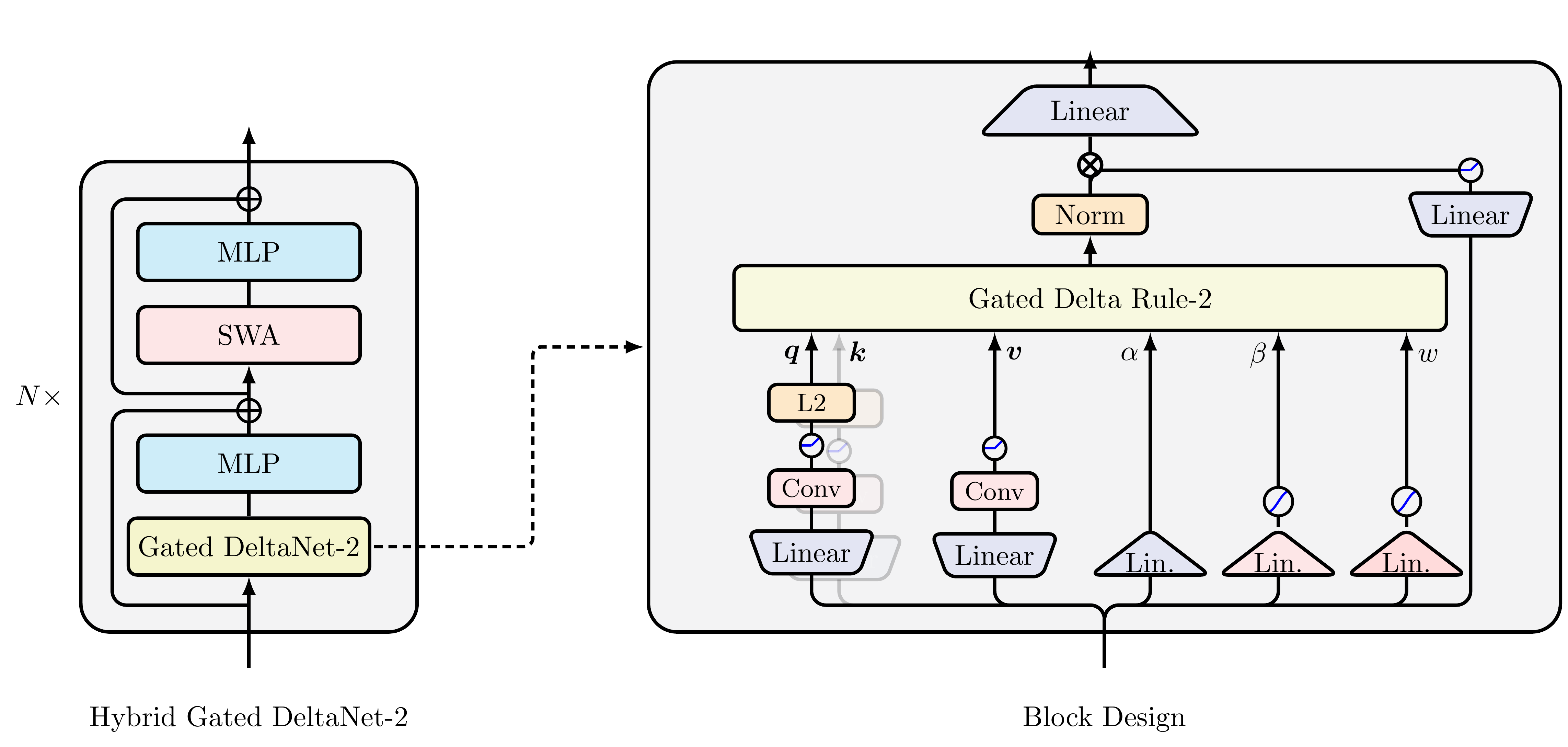
📐 The Gated Delta Rule-2
Given an erase gate b_t ∈ [0,1]^{d_k}, a write gate w_t ∈ [0,1]^{d_v}, and channel-wise decay D_t = Diag(α_t), the recurrent state evolves as:
S_t = (I − k_t (b_t ⊙ k_t)ᵀ) D_t S_{t−1} + k_t (w_t ⊙ v_t)ᵀ
Compared with KDA, the right factor of the rank-one erase becomes channel-selective on the key axis, and the write term becomes channel-selective on the value axis. The two decisions no longer share a single scalar.
📊 Results
We train all models at 1.3B parameters on 100B tokens of FineWeb-Edu, matched in recurrent state size, and compare against Mamba-2, Gated DeltaNet, KDA, and Mamba-3 (SISO and MIMO).
Language Modeling and Commonsense Reasoning
Gated DeltaNet-2 achieves the best average across both recurrent-only and hybrid settings:
| Model | Wiki ppl ↓ | LMB ppl ↓ | LMB acc ↑ | Avg. acc ↑ |
|---|---|---|---|---|
| Recurrent | ||||
| Mamba-2 | 16.79 | 12.38 | 45.24 | 51.82 |
| Gated DeltaNet | 16.40 | 11.89 | 49.62 | 52.07 |
| KDA | 16.81 | 11.68 | 48.13 | 52.28 |
| Mamba-3 (MIMO) | 16.45 | 11.66 | 47.82 | 52.39 |
| Gated DeltaNet-2 | 15.90 | 11.41 | 48.09 | 53.11 |
| Hybrid (+ SWA) | ||||
| Transformer | 19.22 | 13.72 | 48.32 | 50.86 |
| Gated DeltaNet | 16.00 | 10.82 | 48.71 | 52.25 |
| KDA | 16.01 | 10.66 | 49.21 | 52.68 |
| Mamba-3 (MIMO) | 15.81 | 10.92 | 49.82 | 52.72 |
| Gated DeltaNet-2 | 15.62 | 10.43 | 50.90 | 53.97 |
Long-context Retrieval (RULER)
Gated DeltaNet-2 is strongest where memory editing matters most — particularly the interference-heavy multi-key needle-in-a-haystack settings:
| Model | S-NIAH-2 @4K | S-NIAH-3 @2K | MK-NIAH-1 @4K |
|---|---|---|---|
| Recurrent | |||
| Gated DeltaNet | 87.2 | 54.2 | 27.8 |
| KDA | 89.0 | 63.2 | 28.0 |
| Mamba-3 (MIMO) | 64.2 | 72.4 | 18.0 |
| Gated DeltaNet-2 | 93.0 | 89.8 | 37.8 |
| Hybrid | |||
| Gated DeltaNet | 57.3 | 91.2 | 44.8 |
| KDA | 56.0 | 93.4 | 40.4 |
| Mamba-3 (MIMO) | 53.0 | 98.4 | 46.6 |
| Gated DeltaNet-2 | 57.9 | 99.0 | 48.0 |
Real-world Retrieval
Across SWDE, SQuAD, FDA, TriviaQA, NQ, and DROP, Gated DeltaNet-2 leads the recurrent and hybrid frontier:
| Setting | Mamba-2 | GDN | KDA | Mamba-3 (MIMO) | GDN-2 |
|---|---|---|---|---|---|
| Recurrent avg. | 26.84 | 28.09 | 28.67 | 28.35 | 29.88 |
| Hybrid avg. | 39.74 | 39.11 | 40.14 | 40.11 | 42.28 |
Throughput
Gated DeltaNet-2 retains near-flat scaling with sequence length on a single H100 (training, hybrid 1.3B), with only a small constant overhead over KDA for the added channel-wise gates.
🔧 What's New in the Update Rule
| Method | Decay | Erase | Write |
|---|---|---|---|
| Mamba-2 | scalar | — | scalar |
| Gated DeltaNet | scalar | scalar β_t | scalar β_t |
| KDA | channel-wise | scalar β_t | scalar β_t |
| Gated DeltaNet-2 | channel-wise | channel-wise b_t | channel-wise w_t |
Ablations confirm both gates contribute, with the erase gate b_t accounting for most of the gain — consistent with its role in selectively protecting or revising key-side associations in the recurrent state.
📢 Latest Updates
05/21/2026: 🔥 Code Release: Train your own Gated DeltaNet-2 on FineWeb-Edu- Watch this space for more exciting updates!
🚀 Getting Started
Training Your Model
Launch your training with our streamlined command:
python ../pretrain.py \
--train_data_dir ${TRAIN_DATA} \
--val_data_dir ${VALIDATION_DATA} \
--output_root ${SAVE_DIR} \
--exp_name ${NAME} \
--model_name ${MODEL} \
--train_config ${CONFIG} \
--eval_iters ${EVAL_ITERS} \
--learning_rate ${LR} \
--micro_batch_size ${MICRO_BATCH_SIZE}
💡 Pro Tip: Add --interactive_job --debug for interactive debugging sessions!
Default Recipe
We train 1.3B-parameter models on 100B tokens of FineWeb-Edu with:
- AdamW, peak LR
4e-4, weight decay0.1, gradient clip1.0 - Cosine schedule with 1B-token warmup
- Global batch size
0.5Mtokens, sequence length4K - Hybrid models use a
2Ksliding-window attention size - 16 heads,
d_k = d_v = 128, matched recurrent state size against Mamba-2/3 baselines
📜 License
Copyright © 2026, NVIDIA Corporation. All rights reserved.
Licensed under the NVIDIA Source Code License-NC. See LICENSE for details.
🙏 Acknowledgements
Built on the shoulders of giants:
📖 Citation
If you find this work useful, please consider citing:
@article{hatamizadeh2026gated,
  title={Gated DeltaNet-2: Decoupling Erase and Write in Linear Attention},
  author={Hatamizadeh, Ali and Choi, Yejin and Kautz, Jan},
  journal={arXiv preprint arXiv:2605.22791},
  year={2026}
}
⭐ Support Us
If you find this work useful, please consider:
- Starring the repository
- Citing our paper
- Contributing to the codebase
Join us in pushing the boundaries of linear attention! 🚀