FoJin 佛津
Ask the Buddhist canon — get cited, verifiable answers.
AI Q&A grounded in the world's largest open aggregation of Buddhist texts: 600+ sources, 30+ languages, trilingual cross-canon retrieval — every answer linked back to its source passage.
Ask a question in plain language and FoJin's assistant "XiaoJin" answers from the canon itself — Retrieval-Augmented Generation over 680K+ embedded passages, optional cross-encoder reranking and root-sutra recall, clickable 【《sutra》juan N】 citations that open the exact source text, anti-hallucination guards, and a citation drawer with side-by-side 汉 / 巴利 / 藏文 cross-canon parallels. You can also ask in the voice of 15 historical Buddhist masters, each scoped to their own tradition's scriptures.
What makes those answers trustworthy is the corpus underneath. FoJin aggregates 613 data sources into one searchable platform — 10,500+ texts with 23,500+ volumes of full content in Classical Chinese, Pali, Tibetan and Sanskrit, the first LLM-driven trilingual cross-canon parallel reading platform (CBETA × SuttaCentral × 84000) with LLM-verified chunk-level alignment, a 110K+ entity knowledge graph on a Deck.GL geo map, and 32 dictionaries with 748K entries. Every feature exists to make the answers more grounded — and to let you go deeper once you have one.
FoJin is built to be open, cross-canon, verifiable Buddhist knowledge infrastructure — not just a site to read, but a corpus other tools can call. Every passage carries a stable, resolvable cross-canon URN (fojin:cbeta/T0001.1), and the fojin-mcp server lets AI assistants (Claude, ChatGPT, any MCP client) answer from FoJin's cited passages directly.
Live Demo · API Docs · 中文文档 · Discussions · Discord · Report Bug






Why FoJin?
Buddhist texts are scattered across hundreds of databases worldwide — CBETA, SuttaCentral, BDRC, SAT, 84000, GRETIL, and many more. Each has its own interface, language, and data format. When you have a question — "what does the Heart Sutra mean by 'form is emptiness'?", "how do the Pali and Chinese versions of this passage differ?" — you spend more time hunting for the right passage than understanding it.
FoJin answers the question for you. Ask in plain language; XiaoJin retrieves the relevant passages from 613 sources and answers with clickable citations you can verify. Everything else FoJin does — full-text reading, cross-canon alignment, the knowledge graph, 32 dictionaries — exists to make those answers more grounded, and to let you go deeper once you have one:
| What you need | How FoJin helps |
|---|---|
| Ask a question, get a sourced answer | AI Q&A ("XiaoJin") — RAG over 680K+ passages, reranking, root-sutra recall, clickable 【《sutra》juan N】 citations, cross-canon citation drawer, anti-hallucination guards |
| Trust the answer | Verifiable answers — deterministic citation whitelist + verbatim-quote downgrade + per-answer trust state; ~98% served-trustworthy at temp 0 |
| Research a hard, multi-step question | Research Assistant (/research) — plans across corpus + dictionaries + knowledge graph, then synthesises a cited answer behind the same guards |
| Call FoJin from an AI assistant | MCP server — uvx fojin-mcp; 6 read-only, URN-addressable tools for Claude / ChatGPT |
| Ask in a master's voice | Master Persona Mode — 15 historical masters, each with tradition-scoped RAG |
| Find a sutra across databases | Multi-dimensional search across 10,500+ texts from 613 sources |
| Read the full text online | 8,900+ texts with 23,500+ volumes of full content, CBETA-style layout |
| Compare translations | Parallel reading in 30+ languages side by side |
| Compare sutras across Buddhist canons | Trilingual cross-canon parallel reading — 3,000+ LLM-verified chunk alignments across Chinese / Pali / Tibetan covering Heart Sutra, Vimalakīrti, Lotus Sutra (法华 ↔ Toh 113, 259 pairs), 8,000-verse Prajñāpāramitā (小品般若 ↔ Toh 11, 127 pairs), Satipaṭṭhāna + the full Āgama ↔ Nikāya corpus (MN/DN/SN/AN), Dhammapada |
| Look up Buddhist terms | 32 dictionaries, 748K entries (Chinese/Sanskrit/Pali/Tibetan/English) |
| Explore relationships | Knowledge graph with 110K+ entities and 28K+ relations (22K+ lineage chains) |
| Discover similar texts | Semantic similarity powered by 680K+ embedding vectors (pgvector + HNSW) |
| Explore Buddhist geography | Knowledge Graph Map — geo-enabled entities, monastery locations, lineage arcs on Deck.GL |
| Track source updates | Activity Feed — real-time updates from 613 data sources |
| Explore history visually | Timeline & Dashboard — dynasty charts, translation trends, category analytics |
| Save and organize | Collections, bookmarks, annotations for personal study |
| Cite in research | Citation export (BibTeX, RIS, APA) for academic use |
Quick Start
git clone https://github.com/xr843/fojin.git
cd fojin
cp .env.example .env        # edit POSTGRES_PASSWORD before starting
docker compose up -d         # database migrations run automatically
Then visit: http://localhost:3000
API docs at http://localhost:8000/docs
After first startup, the platform has the database schema and source metadata but no text content. To import texts from public data sources:
# Import CBETA catalog (auto-scans local xml-p5 directory or fetches from remote)
docker exec fojin-backend python scripts/import_catalog.py

# Import CBETA full text content (requires xml-p5 repository)
docker exec fojin-backend python scripts/import_content.py --all --xml-dir /data/xml-p5

# Generate embeddings for AI Q&A (supports incremental processing)
docker exec fojin-backend python -m scripts.archive.misc.generate_embeddings --source cbeta

# Import SuttaCentral Early Buddhist Texts
docker exec fojin-backend python scripts/archive/imports/import_suttacentral.py

# See all available importers (one-off importers live under archive/)
ls backend/scripts/archive/imports/
Each importer downloads data directly from the original source (CBETA, SuttaCentral, etc.) — no data is bundled in this repository.
Use FoJin from your AI tools (MCP)
FoJin's verified, cross-canon corpus is callable directly from AI assistants (Claude Desktop, ChatGPT, or any MCP client) via the published fojin-mcp server — so the assistant answers Buddhist questions from FoJin's cited passages instead of hallucinating.
uvx fojin-mcp                 # zero-install run
# or: pip install fojin-mcp && fojin-mcp
It exposes six read-only tools over the public API, each returning passages with a stable, resolvable cross-canon URN (fojin:cbeta/T0001.1):
| Tool | What it does |
|---|---|
search_corpus | Semantic search across the aggregated canon |
read_passage | Read a specific text / volume |
get_parallels | Cross-canon parallels (汉 ↔ 巴利 ↔ 藏) for a passage |
lookup_dictionary | Term lookup across 32 dictionaries |
lookup_entity | Knowledge-graph entity facts |
resolve_urn | Resolve a FoJin URN to its source location |
Claude Desktop config and ChatGPT setup are in mcp-server/README.md. The server is a thin, read-only client: it holds no credentials, bundles no corpus, and only calls FoJin's public endpoints — its default target is https://fojin.app/api, overridable via FOJIN_API_BASE_URL to point at a self-hosted instance.
Features
Multi-Dimensional Search
Search across Buddhist canons by title, translator, catalog number, or full-text keyword. Powered by Elasticsearch with ICU tokenizer for multi-language support.

Full-Text Reading
Read 8,900+ Buddhist texts with 23,500+ volumes of full content online. CBETA-style typography with intelligent verse/prose detection, paragraph reflow, and adjustable font size. Navigate by volume, scroll through content, and jump between related texts.
Parallel Reading (30 Languages)
Compare translations side by side — Classical Chinese, Sanskrit, Pali, Tibetan, English, Japanese, Korean, Gandhari, and 21 more languages.
Dictionary Lookup
32 authoritative dictionaries with 748,000+ entries across Chinese, Pali, Sanskrit, Tibetan, and English:
Chinese Buddhist Dictionaries (14)
- NTI Reader (佛学辞典) — 161K entries, Chinese↔English
- Suihan Lu (新集藏經音義隨函錄) — 72K entries, Tang dynasty phonetic glossary
- Fo Guang (佛光大辭典) — 32K entries
- Ding Fubao (丁福保佛学大辞典) — 31K entries
- Yiqiejing Yinyi (一切經音義, 慧琳音義) — 23K entries, Buddhist scriptural phonetics
- Faxiang Dictionary (法相辭典, 朱芾煌) — 15K entries, Yogācāra terminology
- Zhonghua Encyclopedia (中華佛教百科全書) — 6K entries
- Common Buddhist Terms (佛學常見詞彙, 陳義孝) — 6K entries
- Agama Dictionary (阿含辭典, 莊春江) — 5K entries
- Fanfanyu (翻梵語) — 4K entries, Sanskrit-Chinese translation glossary
- Xu Yinyi (續一切經音義, 希麟) — 2K entries
- Yogācāra Glossary (唯識名詞白話新解) — 2K entries
- Sanzang Fashu (三藏法數) — 1K entries
- Buddhist Origins of Idioms (俗語佛源) — 567 entries
Pali Dictionaries (5)
- Digital Pali Dictionary (DPD) — 89K entries, grammar + etymology + examples
- NCPED (New Concise Pali-English Dictionary) — 21K entries
- PTS PED (Pali Text Society) — 16K entries
- Buddhadatta (巴利語辭典, 達摩比丘中譯) — 11K entries, Pali→Chinese
- SuttaCentral Glossary — 6K entries
Sanskrit Dictionaries (4)
- Apte (Practical Sanskrit-English Dictionary) — 35K entries
- Monier-Williams (Sanskrit-English Dictionary) — 32K entries
- Edgerton BHS (Buddhist Hybrid Sanskrit Dictionary) — 18K entries
- Fanyi Mingyi Ji (翻譯名義集) — 1K entries
Tibetan Dictionaries (2)
- Rangjung Yeshe (Tibetan-English Dictionary) — 74K entries
- Hopkins (Tibetan-Sanskrit-English Dictionary) — 18K entries
Multilingual Reference (4)
- Soothill-Hodous (Chinese Buddhist Terms, Chinese↔English) — 17K entries
- Mahāvyutpatti (翻譯名義大集, Sanskrit↔Tibetan↔Chinese) — 9K entries
- Nanshan Vinaya (南山律学辞典) — 3K entries
- Pentaglot (五體清文鑑, Manchu-Mongolian-Tibetan-Chinese-Sanskrit) — 1K entries
Specialized (3)
- Abhidharma Dictionary (阿毗達磨辭典) — 1K entries
- Tiantai Dictionary (天台教學辭典) — 1K entries
- DDB (Digital Dictionary of Buddhism) — CJK Buddhist terminology
Knowledge Graph
110,000+ entities (monasteries, persons, texts, schools, concepts) and 28,000+ relationships — including 22,000+ teacher-student lineage chains from the DILA Authority Database — visualized as an interactive force-directed graph. Click any node to explore connections.
Trilingual Cross-Canon Parallel Reading (三语对读)
The first LLM-driven cross-canon parallel reading system for Buddhist texts. No other platform provides this: CBETA (汉文), SuttaCentral (Pali), and 84000 (Tibetan) each operate in their own language silo. FoJin bridges them via LLM-verified chunk-level alignment.
Current coverage (3,000+ chunk-level alignments across 11 pair definitions):
| Sutra / Corpus | Source | Target | Pairs | Type |
|---|---|---|---|---|
| 《妙法蓮華經》Lotus Sutra (2026-06-08) | T0262 罗什 (Chinese) | Toh 113 Kangyur (Tibetan) | 259 | 汉 ↔ 藏 |
| 《小品般若波羅蜜經》8,000-verse Prajñāpāramitā (2026-06-09) | T0227 罗什 (Chinese) | Toh 11 Aṣṭasāhasrikā (Tibetan) | 127 | 汉 ↔ 藏 |
| 《維摩詰所說經》Vimalakīrti | T0475 罗什 (Chinese) | Toh 176 (Tibetan) | 20 | 汉 ↔ 藏 |
| 《般若波羅蜜多心經》Heart Sutra | T0252 (Chinese) | Toh 21 Kangyur (Tibetan) | 6 | 汉 ↔ 藏 |
| Mahāsatipaṭṭhāna Sutta 念处经 | MN 10 (Pali) | T0026 中阿含 (Chinese) | 50 | 巴 ↔ 汉 |
| Dhammacakkappavattana 转法轮经 | SN 56.11 (Pali) | T0099 杂阿含 (Chinese) | 17 | 巴 ↔ 汉 |
| Dhammapada 法句经 | T0210 (Chinese) | SC 26 vaggas (Pali) | 49 | 汉 ↔ 巴 |
| Majjhima Nikāya ↔ 中阿含 | All MN suttas (Pali) | T0026 (Chinese) | ~1,800 | 巴 ↔ 汉 |
| Dīgha Nikāya ↔ 长阿含 | All DN suttas (Pali) | T0001 (Chinese) | ~700 | 巴 ↔ 汉 |
| Saṃyutta Nikāya 56 ↔ 杂阿含 | SN 56 suttas (Pali) | T0099 (Chinese) | ~150 | 巴 ↔ 汉 |
| Aṅguttara Nikāya 4 ↔ 增一阿含 | AN 4 suttas (Pali) | T0125 (Chinese) | ~400 | 巴 ↔ 汉 |
Confidence distribution: all pairs ≥ 0.75. Hand-verified precision on the original MVP sample: 100%. Mahāyāna 汉藏 batches: Lotus Sutra (2026-06-08) at $1.70 / 259 pairs (8.6% accept rate); 8,000-verse Prajñāpāramitā (2026-06-09) at $3.64 / 127 pairs (3.4% accept rate, lower because the sūtra's repetitive paratactic style yields fewer 1:1 chunk-level correspondences).
How to use:
-
In AI Q&A — When XiaoJin cites an aligned sutra, the citation drawer shows tabs
[ 汉文 ] [ 巴利 (5) ] [ 藏文 (3) ]. Click a tab to see the corresponding passage in another canon, rendered with proper Devanagari / Tibetan fonts. -
In the reader — Click the 🌐 「多语对读」 (Multilingual Parallel) button in the toolbar. Default tab 「按经对读」 shows sutta-level parallels from SuttaCentral's authoritative Akanuma-style table (3,293 pairs covering all 4 Āgamas ↔ Nikāyas), with Pāli original + Sujato English previews and "read full text" links. Alternate tab 「按段对读」 retains the experimental embedding+LLM chunk-level alignment (pipeline-generated, known to have noise). The panel sits to the left of the AI reading panel; both can be open simultaneously and independently resized.
Pipeline (backend/scripts/build_alignments.py):
- pgvector top-20 candidate recall within target text's embeddings
- LLM verification (DeepSeek V3) returns
{is_parallel, confidence, reason}JSON per candidate - Pairs with
confidence ≥ 0.75persisted toalignment_pairswith unique(text_a, text_b)chunk tuple for idempotent re-runs $50cost ceiling guard (actual MVP spend: ~$0.15)- Multi-target resolver supports cases where target is split across rows (e.g., SC Dhammapada's 26 separate vagga texts)
RAG layer automatically includes parallel_chunks in the LLM context when a retrieved chunk has alignments, so answers can naturally reference "the Pali version says…" without hallucinating.
Growing the alignment set — the flywheel: beyond the batch pipeline above, an alignment flywheel (backend/app/services/alignment_flywheel.py) mines new candidate parallels by expanding outward from already-verified pairs — neighbouring chunks tend to align too, so this is both fast and precise where blind nearest-neighbour search drowns in same-language matches. Candidates are staged for human review and only promoted into the ground-truth alignment_pairs once accepted (method='flywheel-verified'). Nothing is auto-promoted — human review is the precision gate — and each verified alignment makes the next round of mining better.
AI Q&A — "XiaoJin"
This is FoJin's core. Ask questions in natural language; XiaoJin answers from canonical Buddhist texts using RAG (Retrieval-Augmented Generation) over 680K+ embedding vectors with an HNSW index for fast semantic search. Answers stay grounded because retrieval combines vector similarity, keyword reranking, and root-sutra recall (the sutra you asked about is always pulled into context), and every quoted passage is checked against the retrieved sources before it can become a clickable citation. Features include:
- Multi-turn conversation with context awareness
- Keyword + optional API cross-encoder reranking for higher answer quality
- Clickable citations in 【《经名》第N卷】 format — click to open a side drawer with surrounding context, plus multi-language tabs for cross-canon parallels when available (see Trilingual section above)
- GFM markdown tables — comparative answers (e.g., "Madhyamaka vs Yogācāra") render as proper tables instead of raw pipe syntax
- Progressive follow-up suggestions (concept → related texts → practice)
- Smart data source recommendations — when users ask about finding databases, AI automatically recommends relevant sources from 613 data sources via semantic similarity
- Meta-question handling — detects self-introduction queries ("who are you" / "what can you do") and skips RAG to give a clean functional overview, instead of randomly citing scriptures
- Anti-hallucination citation rules — the system prompt strictly forbids wrapping a text name in 【…】 unless that exact source appeared in the retrieved context, preventing broken citation links
- Inline split-view in reader — AI panel opens by default beside the text with a draggable divider; independent scrolling on each side, resizable width persisted to localStorage
- "Ask XiaoJin" button on the reader page — select text to ask about it
- Tab key cycles through suggested questions in the input box
- BYOK (Bring Your Own Key) support for multiple LLM providers
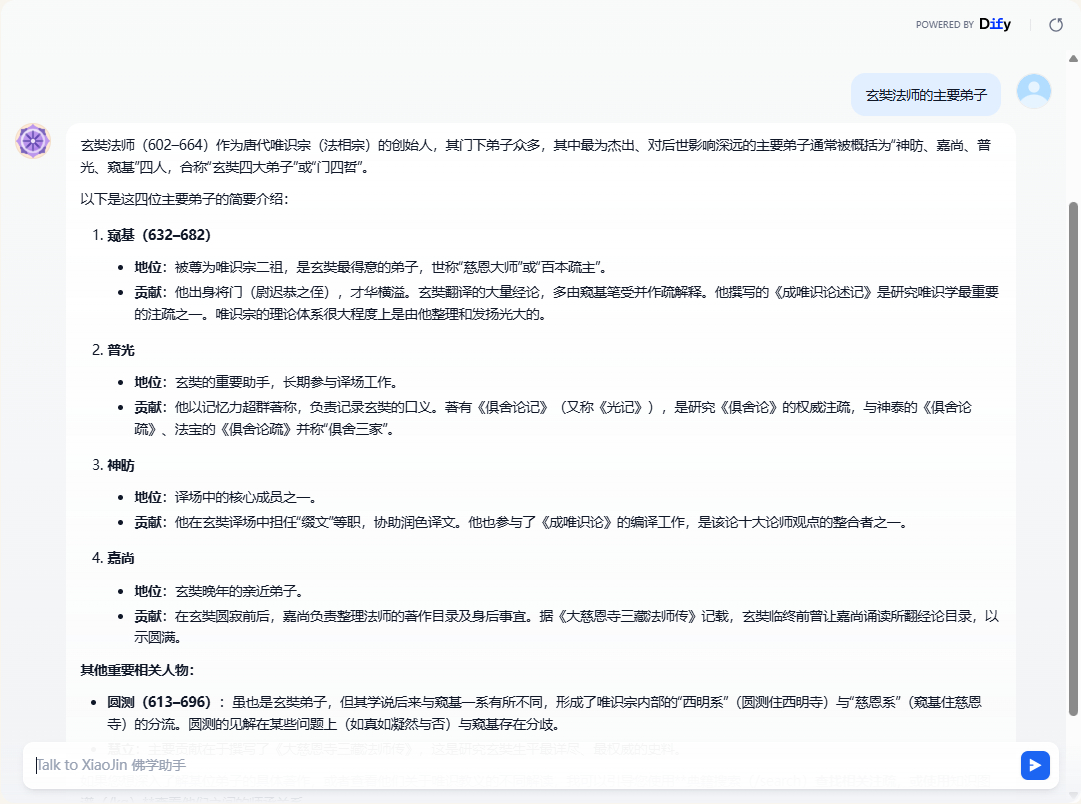
Verifiable answers — 每一句都能点回原典
Trust is the point. Every answer passes three deterministic guards before it reaches you:
- Citation whitelist — a 【《sutra》juan N】 citation is stripped or corrected unless that exact source was actually retrieved, so a citation link never points at something FoJin didn't read.
- Quote verification — text inside quote marks is checked to be a verbatim substring of the retrieved passage (traditional/simplified folded); a non-verbatim "quote" is downgraded to plain prose rather than passed off as scripture.
- Trust state — each answer is labelled
verified/citation_corrected/quote_relaxed/no_sourcesso you can see how grounded it is.
Measured on the eval harness at temperature 0, the raw model is verbatim-faithful only ~11% of the time — but after the guards ~98% of served answers are trustworthy: FoJin either points you to a real source or honestly hedges, and never fabricates scripture. The metric (served_trustworthy_rate) is tracked in backend/eval/faithfulness.py as a regression gate.
Research Assistant (研究助手)
For multi-step questions a single search can't answer — "how is śūnyatā treated across Prajñāpāramitā, Madhyamaka and Yogācāra, with cited cross-canon parallels?" — the research assistant plans the question into steps, retrieves across the corpus, dictionaries and knowledge graph, then synthesises a grounded answer. The synthesis runs through the same citation guards as chat, so the agent can plan freely but cannot cite what it didn't retrieve. Available at /research (sign-in required); API at POST /api/research/query.
Master Persona Mode (法师模式)
Select a specific Buddhist master to receive answers in their teaching style, grounded in their tradition's core scriptures. 15 historical masters available:
| Master | Tradition | Core Teachings |
|---|---|---|
| 龙树 Nāgārjuna | 印度·中观 | 八不中道、缘起性空、二谛中道、戏论寂灭 |
| 智顗 Zhiyi | 天台宗 | 一念三千、三谛圆融、五时八教、止观双修 |
| 慧能 Huineng | 禅宗 | 直指人心、见性成佛、无念无相无住 |
| 玄奘 Xuanzang | 法相唯识宗 | 八识、三性、五位百法、转识成智 |
| 法藏 Fazang | 华严宗 | 法界缘起、四法界、十玄门、六相圆融 |
| 鸠摩罗什 Kumarajiva | 三论宗/中观 | 八不中道、缘起性空、不二法门 |
| 印光 Yinguang | 净土宗 | 信愿行、持名念佛、敦伦尽分 |
| 蕅益 Ouyi | 天台/净土·跨宗派 | 教宗天台行归净土、六信、性相融会 |
| 虚云 Xuyun | 禅宗·五宗兼嗣 | 参话头、起疑情、老实修行 |
| 米拉日巴 Milarepa | 藏传·噶举派 | 雪山闭关瑜伽士、那洛六法、以道歌说法 |
| 阿姜查 Ajahn Chah | 南传·泰国森林禅林派 | 正念、放下、朴素生活化教学 |
| 宗喀巴 Tsongkhapa | 藏传·格鲁派 | 菩提道次第、三主要道、应成中观 |
| 阿底峡 Atiśa Dīpaṃkara | 藏传·噶当派(印藏桥梁) | 菩提道灯论、三士道、七因果 |
| 觉音 Buddhaghosa | 南传·上座部论师 | 清净道论、戒定慧、七清净十六观智 |
| 马哈希 Mahasi Sayadaw | 南传·缅甸内观传统 | 标记现象法、腹部起伏、四念处密集禅修 |
Each master has a 100-150 line enriched system prompt with lineage, core doctrines, speaking style, teaching methods, key allusions, and terminology table. When a master is selected, RAG retrieval is scoped to their core scriptures (e.g., selecting Zhiyi only searches 《摩诃止观》《法华玄义》 etc.), providing more precise citations.
Powered by Master-skill — the open-source Buddhist master AI persona framework.
Knowledge Graph Map (知识图谱地图)
Visualize 50,000+ geo-enabled Buddhist entities on an interactive world map — monasteries, historical places, persons, and schools. Built with Deck.GL + MapLibre.
- Entity types: Monasteries (green), Places (purple), Persons (red), Schools (blue)
- Lineage arcs: Toggle 8,000+ teacher-student lineage relations as animated arcs on the map
- Chinese-only filter: Quickly filter to show only Chinese-named entities
- Entity search: Find entities by name with simplified/traditional Chinese conversion (OpenCC)
- Interactive tooltips: Hover to see metadata, country flags, and source attribution
Activity Feed (佛学动态)
Track real-time updates from 613 data sources — new texts added, translation releases, manuscript scans, and schema changes. Includes academic content aggregation and platform-wide activity summary.
Similar Passages Discovery
When reading any text, the sidebar automatically finds semantically similar passages from other texts using pgvector cosine similarity. Discover cross-textual parallels, related commentaries, and thematic connections across the entire canon.
Timeline & Statistics Dashboard
Visualize Buddhist textual history with interactive D3 charts — dynasty distribution, translation trends, language breakdown, category treemap, and top translators. Toggle between scholarly and popular presentation modes.
Collections, Bookmarks & Annotations
Save texts to personal collections, bookmark specific passages, and add annotations for study and research.
Citation Export
Export citations in BibTeX, RIS, and APA formats for academic papers and reference managers.
Multi-Language UI
Available in 9 languages: Simplified Chinese, Traditional Chinese, English, Japanese, Korean, Thai, Vietnamese, Sinhala, and Burmese.
Data Sources
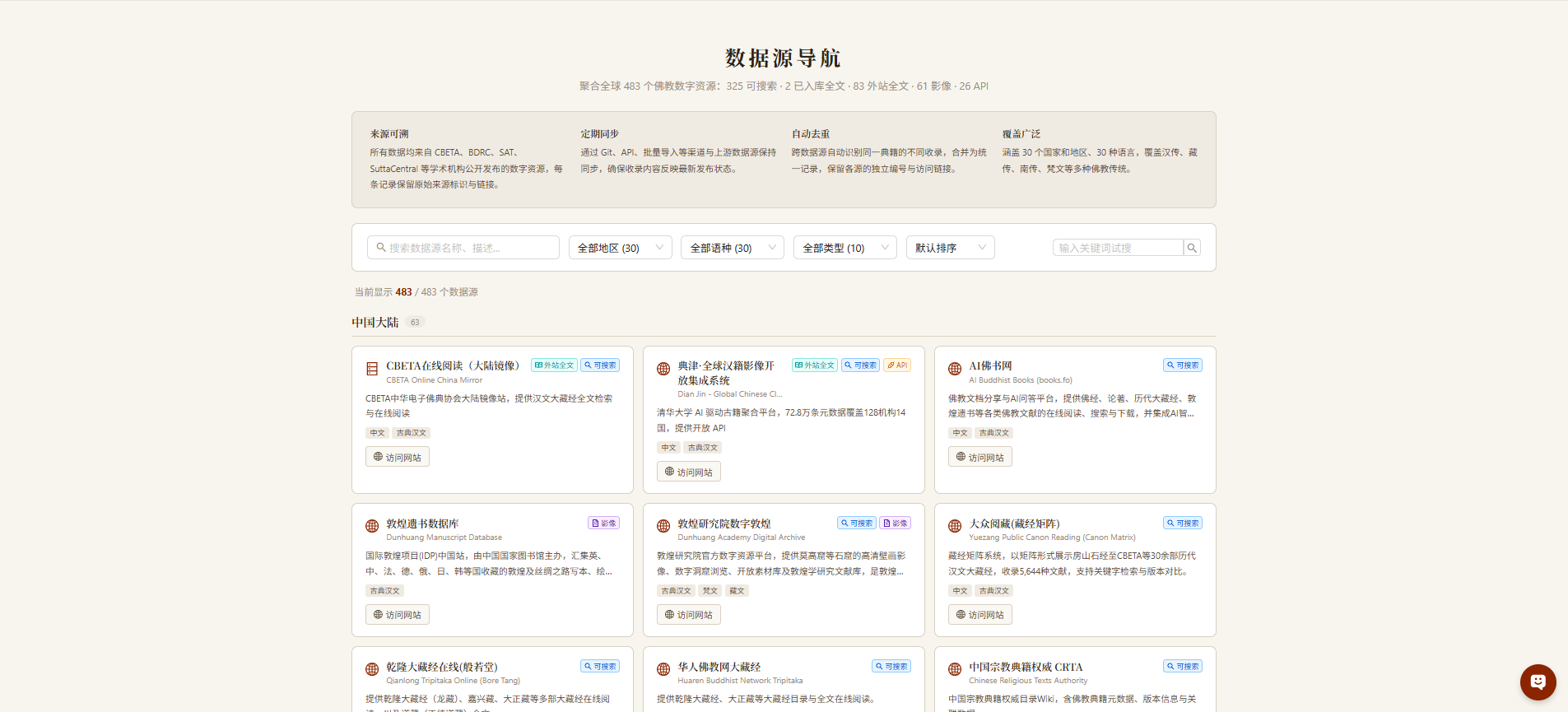
FoJin aggregates data from major Buddhist digital projects worldwide. Sources are categorized by research field (Han, Theravada, Tibetan, Sanskrit, Dunhuang, Art, Dictionary, Digital Humanities) and filterable by region, language, and type:
| Source | Content | Languages |
|---|---|---|
| CBETA | Chinese Buddhist Canon | Classical Chinese |
| SuttaCentral | Early Buddhist Texts | Pali, Chinese, English |
| 84000 | Tibetan Buddhist Canon | Tibetan, English, Sanskrit |
| BDRC | Tibetan manuscripts (IIIF) | Tibetan |
| SAT | Taisho Tripitaka | Chinese, Japanese |
| DILA | Authority databases (persons, places, catalogs) | Multi-language |
| GRETIL | Sanskrit e-texts | Sanskrit |
| DSBC | Digital Sanskrit Buddhist Canon | Sanskrit |
| Gandhari.org | Gandhari manuscripts | Gandhari |
| VRI Tipitaka | Pali Canon (Chattha Sangayana) | Pali |
| Korean Tripitaka | Goryeo Tripitaka | Chinese, Korean |
| + 602 more... |
Tech Stack
| Layer | Technology |
|---|---|
| Frontend | React 18, TypeScript, Vite, Ant Design 5, Zustand, TanStack Query, D3.js, Deck.GL + MapLibre (geo map) |
| Backend | FastAPI, SQLAlchemy (async), Pydantic v2, SSE streaming |
| Database | PostgreSQL 15 + pgvector (HNSW index) + pg_trgm |
| Search | Elasticsearch 8 (ICU tokenizer) |
| Cache | Redis 7 |
| AI | RAG (680K+ vectors, BGE-M3, HNSW) + 14 master personas + multi-provider LLM (OpenAI/Anthropic/DeepSeek/DashScope/Gemini/+10 more) + deterministic citation/quote guards |
| Integration | MCP server (fojin-mcp, stdio) + public REST API with OpenAPI/Swagger docs + cross-canon URN scheme |
| Deploy | Docker Compose, Nginx (gzip, security headers), Cloudflare CDN |
| CI | GitHub Actions (lint, test, security scan) |
Architecture
                  +-------------+
                  | Cloudflare  |  (CDN, SSL, DDoS protection)
                  +------+------+
                         |
                  +------+------+
                  |   Nginx     |  (gzip, security headers, static cache)
                  +------+------+
                         |
             +-----------+-----------+
             |                       |
       +-----+------+         +-----+------+
       |  React 18   |         |  FastAPI    |
       |  Vite + D3  |         |  async SSE  |
       +-------------+         +------+------+
                                      |
                   +--------+---------+---------+
                   |        |         |         |
             +-----+--+ +--+----+ +--+---+ +---+--------+
             | PG 15   | | ES 8  | |Redis | | LLM APIs   |
             | pgvector | | ICU   | |cache | | (multi-    |
             | HNSW idx | |       | |      | |  provider) |
             +---------+ +-------+ +------+ +------------+
Development
# Backend
cd backend
python -m venv .venv && source .venv/bin/activate
pip install -r requirements-dev.txt
alembic upgrade head
uvicorn app.main:app --reload

# Frontend
cd frontend
npm install
npm run dev

# Tests
cd backend && pytest tests/ -q
Security
- Non-root containers (backend:
app, frontend:nginx) - Multi-stage Docker builds (no build tools in production)
- Internal services (Postgres, Redis, Elasticsearch, backend, Umami) bound to
127.0.0.1only - Memory/CPU limits per container
- CSP, X-Frame-Options, X-Content-Type-Options headers
- Query length limits on all search parameters
- JWT with 8h expiry, production requires strong secret
Self-hosting privacy defaults
- No analytics phone-home. The Umami tracking script is opt-in via build-time
VITE_UMAMI_URL+VITE_UMAMI_WEBSITE_ID; if either is unset, the frontend ships without telemetry. - LLM / embedding traffic is upstream by default. Stock config calls DeepSeek + SiliconFlow with your platform key — user questions go there. Point
LLM_API_URL/EMBEDDING_API_URLat a local OpenAI-compatible server (vLLM, Ollama, LM Studio) for a fully offline setup, or have each user provide their own key via the in-app BYOK flow. - The frontend container binds to
127.0.0.1by default (set viaFRONTEND_BIND), so out of the box it's reachable only from the host — put an authenticated reverse proxy or CDN in front of it as the public entry. If you need direct LAN/remote access without a proxy, setFRONTEND_BIND=0.0.0.0; note that Docker publishes ports through its own iptables rules that bypass host firewalls likeufw, so anyone who can reach the host on that port hits your instance.
See SECURITY.md for the full picture.
Contributing
Contributions are welcome! Whether it's adding a new data source, improving search, fixing bugs, or translating the UI — we'd love your help.
- Fork the repository
- Create your feature branch (
git checkout -b feat/amazing-feature) - Commit your changes (
git commit -m 'Add amazing feature') - Push to the branch (
git push origin feat/amazing-feature) - Open a Pull Request
See CONTRIBUTING.md for detailed guidelines.
Roadmap
- Citation export (BibTeX, RIS, APA)
- Mobile-responsive reader
- Public REST API with rate limiting
- User annotations
- Community-contributed data sources
- Internationalization (i18n) — 9 UI languages
- Embedding-based semantic search (680K+ vectors, HNSW index)
- AI Q&A with RAG, multi-turn context, and streaming
- Similar passages discovery (cross-text semantic matching)
- Timeline visualization and statistics dashboard
- User feedback system and notification center
- Admin dashboard (user management, platform analytics)
- API documentation (OpenAPI/Swagger at
/docs, ReDoc at/redoc) - AI answer reranking (keyword + optional API cross-encoder)
- Clickable citation links in AI answers
- Progressive follow-up suggestions after AI answers
- "Ask XiaoJin" floating button on reader page
- Tab key to cycle through suggested questions
- CBETA-style text layout with verse/prose detection
- Auto database migration on Docker startup
- AI answer rating (thumbs up/down) for quality tracking
- Research field filtering for data sources (8 categories)
- Admin feedback reply with notification system
- AI-powered data source recommendations in chat (semantic similarity)
- DILA Authority lineage import (22K+ teacher-student relations)
- DILA catalog associations (contributors, places for 2,300+ texts)
- Nanshan Vinaya Dictionary (3,200+ Buddhist precept terms)
- CBETA full-text import — Taishō (T) + Xuzangjing (X): 3,600+ texts, 143M characters, 432K embedding vectors
- Dictionary expansion — 32 dictionaries, 748K entries (DPD, Apte, Mahāvyutpatti, Buddhadatta, Pentaglot, buddhaspace 7 dicts)
- Master Persona Mode — 14 Buddhist masters with tradition-scoped RAG (powered by Master-skill)
- Knowledge Graph Map — 50K+ geo entities, Deck.GL + MapLibre, lineage arcs
- Activity Feed — real-time source update tracking, academic feeds
- Inline split-view AI reader panel with draggable divider and independent scrolling
- AI panel auto-open in reader for one-click access to interpretation
- Meta-question detection in chat — recognizes "who are you / what can you do" and skips RAG
- Trilingual cross-canon parallel reading — 11 pair definitions, 3,000+ LLM-verified chunk alignments across CBETA / SuttaCentral / 84000 (incl. Lotus Sutra 法华 ↔ Toh 113, 8,000-verse Prajñāpāramitā 小品般若 ↔ Toh 11, the full Āgama ↔ Nikāya corpus, and the original 5 MVP classics)
- Chat citation drawer with multi-language tabs (汉 / 巴 / 藏 side-by-side)
- Reader "多语对读" inline sidebar — dual tabs: sutta-level SC-authoritative parallels + legacy chunk-level RAG alignment; coexists with AI panel, independent drag-resize
- GFM markdown tables in AI answers (remark-gfm) — comparative responses render as proper tables
- Anti-hallucination citation rules (Rule 4/4b) — forbid wrapping non-retrieved sutra names in 【…】
- Server-side SEO meta injection for
/texts/{id}pages — proper<title>/<description>per sutra for search engines (SPA route crawlability) - Deterministic answer verifiability — citation whitelist + verbatim-quote downgrade + per-answer trust state;
served_trustworthy_rate~98% at temp 0 as an eval regression gate - Cross-canon URN scheme — stable, resolvable passage identifiers (
fojin:cbeta/T0001.1) interoperable with CBETA / SuttaCentral / 84000 / GRETIL / VRI - MCP server — published to PyPI as
fojin-mcp— 6 read-only, URN-addressable tools; callable from Claude Desktop / ChatGPT - Agentic research assistant (
/research) — plan → retrieve (corpus + dictionary + KG) → grounded synthesis behind the same citation guards - Alignment flywheel — anchor-expansion candidate mining + human-review promotion into ground-truth alignments
- Trilingual MVP v1.1 — expand to 20+ sutras (Lotus, Avataṃsaka, Madhyamakakārikā, Laṅkāvatāra, full Āgama↔Nikāya)
- Topic ontology browsing page
- Cross-lingual search (query in Chinese, find Sanskrit/Pali/Tibetan results)
- Open data export (JSON/CSV for researchers)
- OCR pipeline for scanned texts
- Collaborative annotation sharing
- Integration with Zotero and reference managers
License
Apache License 2.0 — applies to FoJin source code only. Third-party data sources retain their own licenses (CC BY-NC-SA, CC0, CC BY-NC-ND, etc.). See NOTICE for details.
Acknowledgments
FoJin is built on the generous work of the global Buddhist digital humanities community. Special thanks to:
- CBETA — Chinese Buddhist Electronic Text Association
- SuttaCentral — Early Buddhist Texts
- BDRC — Buddhist Digital Resource Center
- 84000 — Translating the Words of the Buddha
- SAT — SAT Daizokyo Text Database
- All other data source providers listed in the Sources page
Community
- LINUX DO — Thanks to the LINUX DO community for support and feedback
Related Projects
- Master-skill — Buddhist master AI persona framework (powers FoJin's master mode)
- The Open Buddhist University — Free courses, books, and encyclopaedia for Buddhist studies
If FoJin is useful for your research, please consider giving it a star!
Discussions · Issues · Contributing · contact@fojin.app
Made with care for the Buddhist studies community.